



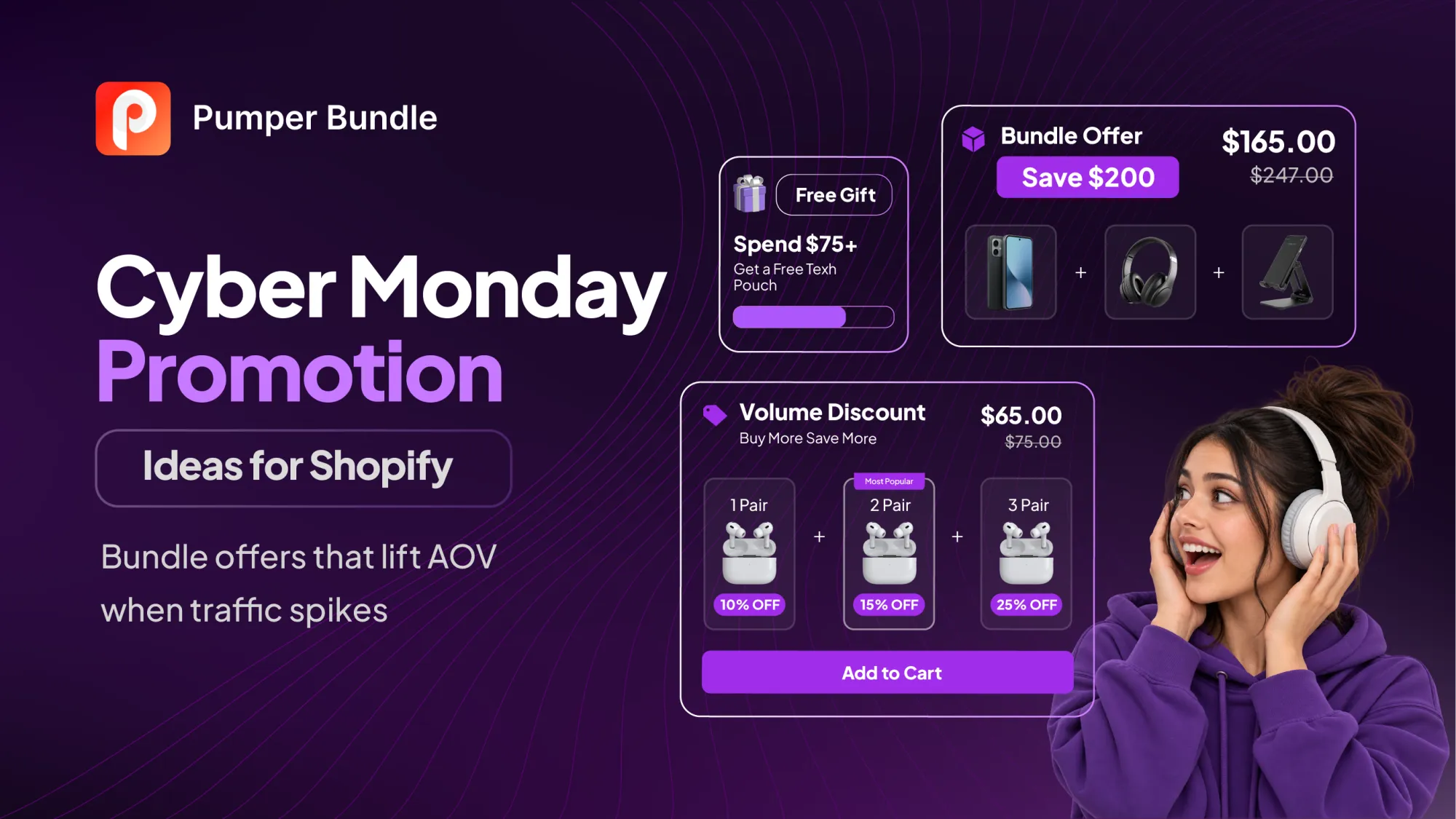
Cyber Monday 2025 became the biggest online shopping day in US history: $14.25 billion in a single day, up 7.1% from the year before. The National Retail Federation counted 75.9 million people shopping online that Monday, up from 64.4 million a year earlier. It's the one major sales day built entirely for ecommerce, which makes it a natural fit for a Shopify store.
This year it lands on Monday, November 30, 2026. That timing matters because shipping cutoffs for Christmas delivery arrive about two and a half weeks later, so every offer you run has a delivery clock attached. Stores that treat the day as a sales event and a shipping-certainty event tend to do better than stores that only announce a percentage off, and the strongest promotion strategies usually match the offer to the shopper's moment.
This guide covers 10 Cyber Monday promotion ideas for Shopify stores. Some are offer mechanics for your product pages, and a few are deliberately unusual: shipping-cutoff promises, a partner sample swap, and preparing your catalog for AI shopping assistants. Below the ideas, you'll find the core context: what Cyber Monday is, when it starts, the 2025 data, and what shoppers expect.
TL;DR
- Cyber Monday 2025 reached $14.25 billion in US online sales, the largest single day ever for US ecommerce, with 75.9 million online shoppers (Adobe and NRF, 2025).
- Cyber Monday 2026 is Monday, November 30. USPS recommends shipping by December 17 for Christmas delivery with Ground Advantage, about 17 days after the sale.
- Mobile drove 57.5% of Cyber Monday sales in 2025, and the evening peak ran at $16 million per minute between 8 and 10 p.m. (Adobe, 2025). Plan offers around the clock, not just the date.
- Weekend abandoned carts are your cheapest Monday revenue. Baymard Institute puts average cart abandonment at 70.22%, with 40% of abandoners citing extra costs.
- Supply-based quantity tiers, Subscribe & Save, recipient gifts, ready-to-ship gift sets, and post-purchase upsells all raise order value without a sitewide discount.
- Four ideas are deliberately unconventional: hour-by-hour drops, a shipping-cutoff promise, a partner sample swap, and AI-ready product data.
- AI-driven traffic to US retail sites rose 670% on Cyber Monday 2025 (Adobe), so product data quality is now part of promotion planning.
- Check margin on every offer before you publish it. Revenue that arrives with a lower profit per order hasn't helped.
10 Cyber Monday Promotion Ideas for Shopify
The first two ideas shape how the day runs and how you recover demand from the weekend. Ideas 3 through 7 are on-page offer mechanics that raise order value. Ideas 8 through 10 are the unconventional ones, for stores that want to compete on something other than a bigger percentage. Choose three or four that fit your catalog.
1. Run hour-by-hour drops instead of one all-day sale
An all-day sale gives shoppers no reason to act at a particular moment, and Cyber Monday traffic isn't flat. Adobe measured $16 million per minute in online spending between 8 and 10 p.m. in 2025, and mobile accounted for 57.5% of the day's sales. Shoppers browse in the morning, buy at lunch, and make their biggest decisions in the evening.
A drop schedule gives each of those moments its own offer, with times in your store's time zone:
- 9 a.m., the early offer: a modest quantity tier on your best sellers, rewarding shoppers who are already checking email.
- 1 p.m., the midday add-on: a free gift unlocked at a spend threshold, announced by SMS to people who clicked a morning email but didn't buy.
- 8 p.m., the last-call doorbuster: your deepest offer of the day on one or two products, capped at a fixed number of units, running through midnight.
The deepest offer goes at the traffic peak because that's where it reaches the most people, and the shallow offer goes where traffic is thin. Automatic discounts in Shopify can carry a start and end date and time, so you can schedule the drops in advance and test them the week before instead of switching things on by hand during the day. Write the end time on the page with a time zone ("Ends tonight at 11:59 p.m. ET").
Common mistake: announcing too many drops. Three clear windows are easy to remember, and eight turn the day into noise.
2. Run a weekend cart and browse recovery push on Monday morning
By Sunday night, your store has a pile of high-intent shoppers who looked, added something, and left. Baymard Institute's analysis of 50 studies puts average cart abandonment at 70.22%, and 40% of abandoners cite extra costs such as shipping and fees (Baymard Institute). Cyber Monday gives you a reason to bring them back that didn't exist when they left.
Build the segments before the day starts:
- Cart abandoners from the past 7 days, your highest priority.
- High-intent browsers who viewed the same product two or more times with no cart.
- Past purchasers of related items, who already trust your delivery and returns.
Then send a three-step sequence:
- 8 a.m. email showing the exact item they left and the offer now attached to it.
- 12 p.m. SMS, only to people who opened but didn't click, with one line, one link, and the end time. Confirm each recipient gave explicit SMS consent.
- 7 p.m. email, ahead of the evening peak, stating what's left in stock and the Christmas shipping cutoff.
Exclude anyone who has already bought, and stop the sequence the moment they do. A "your cart is waiting" message sent to someone who checked out an hour ago erodes trust faster than a discount can rebuild it. Keep the recovery discount no deeper than the public offer, since abandoners who learn that leaving earns a better deal will leave on purpose. Judge the sequence by revenue per recipient and profit after discount, not by opens. The psychology behind promotions points the same way: a reminder works because it reduces friction, and a bigger discount mostly teaches people to wait.
Common mistake: a generic "come back and save 10%" blast to the whole list, which discounts people who would have bought anyway.
3. Sell replenishment tiers with Buy More Save More
Cyber Monday shoppers often buy for themselves as well as for others, and for consumables a stock-up offer matches that behavior. Build the tiers around supply length instead of a bare unit count: "1 month," "3 months," and "6 months" tell the shopper what they're buying and make the larger tier a decision about their own routine.
Set depth from your landed cost and a gross-margin floor you won't go below, and keep every tier well inside the ceiling that floor implies. That's the core of sound quantity break pricing, and it leaves room to test a deeper top tier if sales data supports it. Plan inventory before you advertise a six-month tier, since it pulls a lot of future demand into one order.
Pumper's Buy More Save More tiers sit above the Add to Cart button, so shoppers see the supply options before they scroll.
Set Up Buy More, Save More With PumperBuild supply-based quantity tiers above the Add to Cart button and apply discounts automatically at checkout, with no theme code or discount codes for shoppers to enter.
|
4. Turn one-time buyers into subscribers with Subscribe & Save
Cyber Monday attracts first-time buyers, and most of them buy once and never return. You've paid to acquire a customer you may never see again. If you sell anything people use up, a subscription option offered at the moment of purchase earns a second order without another ad, and it's one of the more reliable ways to increase average order value over a customer's lifetime.
Show a "Subscribe & Save" choice next to the one-time price, with a discount in the 10% to 15% range and a delivery schedule the shopper picks. Add a small incentive that applies only to the first subscription order, such as a free sample, so the option feels like a better deal and not just a different one. A subscriber needs to ship at least twice to beat a one-time order on profit, so model your breakeven and your expected repeat rate before you set the discount.
Make the terms honest and the exit easy. State the schedule, the price, and how to pause or cancel in the offer copy, and walk through your own cancellation steps once before the sale. A subscription that's hard to leave produces chargebacks and one-star reviews, which cost more than the discount did. This fits coffee, tea, supplements, skincare, pet food, and cleaning products, and it fits poorly on one-off purchases where a second shipment makes no sense.
Pumper's Subscribe & Save adds a subscription option beside one-time purchase, so the same product page can carry a quantity tier and a subscription choice.
Set Up Subscribe & Save With PumperAdd a subscription option alongside one-time purchases on your product page, giving Cyber Monday shoppers an easy way to come back and buy again.
|
5. Give the recipient a gift too, with Unlock Free Gifts
Most free-gift offers reward the buyer. On a gifting day, you can reward the person who receives the package as well. When a shopper crosses a threshold, they unlock a free item that goes in the box for the recipient: a small sample, a card, or an insert with a first-order code for the recipient's own purchase.
That does two things. It makes the buyer's gift feel more generous at no extra effort, and it puts your product in front of a second person who becomes a lead you didn't pay for. Set the thresholds a little above your average order value, and scale the gift with each step: a travel-size sample first, a full-size item from a slower-moving product next, and limited packaging or an extra product at the top.
Track insert-code redemptions separately so you can see what the recipient channel is worth, and keep the recipient discount modest, since its job is to start a relationship. A free gift adds value to the order without lowering the price of the product, which keeps your pricing intact.
Pumper's Unlock Free Gifts lets each tier unlock a different gift with a visible FREE label.
Set Up Tiered Free Gifts With PumperLet shoppers unlock a different free gift at each spend or quantity threshold, with a clear FREE label on your product page so customers can easily see what they get at each tier.
|
6. Sell ready-to-ship gift sets by recipient and by budget
Last-minute gift shoppers don't want to browse a catalog. They want an answer to "what do I get for my brother, my host, or my coworker?" Gift sets organized by recipient and by budget answer that in one click.
Two formats work well on this day:
- Sets by recipient. "For the host," "For the coffee lover," "For someone who has everything," each with a short line explaining why it works.
- A stocking-stuffer box. The shopper picks five small items from a curated collection of low-priced products, and a combined discount applies once the box is complete. This is the mix-and-match approach applied to small gifts.
Check weight and packaging, since a five-item box ships heavier than a single product, and make sure the set price still clears your shipping cost. Put the shipping cutoff on the page so a Monday buyer knows the set will arrive in time. Fixed sets and open picks also behave differently, which is the distinction behind pure versus mixed bundling: fixed sets suit shoppers who want an answer, and open picks suit shoppers who want control.
Pumper's Bundle & Save covers both, with a product picker inside a bundle and a combined discount for the full set.
Set Up Gift-Set Bundles With PumperLet shoppers build mix-and-match gift sets and stocking-stuffer boxes from your catalog, with a combined discount applied once the set is complete. Make holiday gifting easier with customizable bundles.
|
7. Add a one-click "add to my order" upsell after checkout
The evening peak is when the most shoppers check out, and speed matters. A post-purchase upsell works with that, because it waits until payment is complete. The shopper has already committed, the card has already been entered, and the offer can't lower the conversion rate of the main order.
The best offers are small, relevant, and priced below what the shopper would pay for the same item on the product page:
- The refill or second unit: "Sending this as a gift? Add a second one."
- The complement: the case, the cleaning kit, or the matching accessory, in the spirit of a frequently bought together pairing.
- The personalization add-on: gift wrap, engraving, or an extended warranty if you sell one.
Test one offer first and read the numbers the next morning. If acceptance is low, swap the product and leave the discount alone, because a shopper who ignores a relevant offer at 20% off rarely changes their mind at 30%.
8. Sell delivery certainty with a Christmas-arrival promise
Most Cyber Monday offers compete on price. Gift shoppers also care about a second question: will it arrive in time? A clear shipping-cutoff promise answers it, and you can turn it into the promotion itself.
The carrier dates give you the structure. For delivery by December 25 in the contiguous US, USPS recommends shipping by Thursday, December 17 for Ground Advantage and First-Class Mail, Friday, December 18 for Priority Mail, and Saturday, December 19 for Priority Mail Express (USPS, 2026). UPS and FedEx list their last two-day service dates around December 22, with overnight on December 23, according to CBS News. Delivery dates vary by service and location, so check each carrier's own page.
Ways to build a promotion around those dates:
- A "Christmas arrival" banner on every page, stating your last order date for each shipping speed.
- A free expedited-shipping upgrade on Cyber Monday orders above a spend threshold, which often costs less per order than the percentage discount it replaces.
- A visible countdown to a cutoff date you will honor.
- A guarantee, if you can back it: order by a set date and it arrives by December 24, or the shipping is refunded.
Only promise what your fulfillment can deliver. Count your own processing time, add carrier transit, and leave a buffer for weather and volume. A broken delivery promise costs more in refunds and reviews than any discount saves.
Common mistake: publishing the carrier's last-day date as if it were your own. Your cutoff is the carrier date minus your handling time.
9. Run a sample swap with a complementary brand
A partner promotion borrows another brand's audience without a media budget. Find a Shopify brand that sells to the same customer but doesn't compete with you, such as a candle brand and a tea brand, or a skincare line and a jewelry line, and agree to put a small sample of each other's product into every Cyber Monday order.
How to structure it:
- Pick a partner with a similar price point and audience. A much larger or smaller brand makes the swap lopsided.
- Agree on quantities and sample specs, sized to fit your parcel.
- Add a card with a first-order code, with a distinct code per partner so you can track the source.
- Announce it to both lists with a short email or social post from each brand.
- Share results, not customer data. Trade aggregate redemption numbers, never subscriber lists.
The swap gives your own customers something extra, and it works at a small scale, since two stores with a few hundred orders each can run it. Choose the partner carefully, because your name is on the card and a poor sample reflects on you.
10. Get your catalog ready for AI shopping assistants
Adobe recorded a 670% year-over-year jump in AI-driven traffic to US retail sites on Cyber Monday 2025, and Salesforce estimated that AI and agents influenced $67 billion in global sales, 20% of all orders during the week (Salesforce, 2025). Shoppers now ask AI assistants for gift ideas and comparisons, and the products that appear are the ones with clear, complete data.
Shopify has built a path for this. Agentic Storefronts make eligible stores' products discoverable in AI channels including ChatGPT, Microsoft Copilot, and Google AI Mode and Gemini, and you manage which channels you sell on under Sales channels, then Agentic, in Shopify admin (Shopify Help Center). Shopify reports that AI-driven traffic grew 8x year over year in the first quarter of 2026, and orders from AI-powered searches rose nearly 13x (Shopify, 2026).
Because Shopify Catalog syncs updates to price, inventory, and descriptions automatically, run a data audit before the day:
- Fill in product attributes: material, size, weight, compatibility, care instructions, and anything shoppers ask about.
- Write clear titles and descriptions that say what the product is and who it's for.
- Check price and inventory accuracy, since changes flow through to AI channels.
- Publish shipping and returns policies in plain text, because assistants answer those questions too.
- Test it. Ask an AI assistant for gifts in your category at a few price points, and see whether your products appear and how they're described.
Nobody can guarantee placement in an AI answer, but every missing attribute gives an assistant a reason to pick a competitor's product, and fixing your data costs nothing. It's also a permanent upgrade that helps regular search traffic.
What Is Cyber Monday Sale?
A Cyber Monday sale is an online promotion held on the Monday after US Thanksgiving. The National Retail Federation's digital arm introduced the term in 2005, when Comscore recorded $484 million in online spending that day (Shopify, 2026). Twenty years on, the day brought in $14.25 billion in 2025. Unlike other sale days, it's built around ecommerce: no doorbuster lines, no store hours, and no physical inventory limits. For Shopify merchants, it's the day your store competes on equal footing with the largest retailers, using the same tools: offers, email, product pages, and shipping promises.
When Does Cyber Monday Sale Start?
Cyber Monday is Monday, November 30, 2026, and it traditionally runs from 12:00 a.m. to 11:59 p.m. Many stores open earlier with a Sunday-evening preview. State your start and end times in your store's time zone, and use scheduled discounts so offers begin and end on time.
Why Cyber Monday Matters for Shopify Merchants
Cyber Monday gives an online store its largest single-day audience, and it arrives just as shipping deadlines begin to matter. Adobe measured $14.25 billion in US online spending in 2025, and NRF counted 75.9 million online shoppers. A September 2026 summary of holiday forecasts projects $16.27 billion for this year's day, up 7.4%, though forecasts shift as the season approaches.
For a Shopify store, the day matters for three reasons. First, it's digital-only, so your product pages and offers do the selling. Second, it falls 17 days before USPS's December 17 Ground Advantage cutoff, so orders placed that day still have time to ship by standard methods. Third, mobile accounted for 57.5% of the day's sales, so a store that works well on phones captures more of it. Small gains in conversion rate and order value carry more weight on a day when traffic is this concentrated.
Thanksgiving vs. Cyber Monday
Thanksgiving and Cyber Monday are four days apart on the calendar and far apart in behavior. Thanksgiving Day is early deal-hunting, mostly on phones, with a single simple offer. Cyber Monday is a destination day with a large online audience, deeper category discounts, and the shipping-cutoff clock close behind. The table compares them on numbers and on what to run.
Cyber Monday Shopping Trends for Shopify Stores
- The day keeps setting records. $14.25 billion beat Adobe's own $14.2 billion forecast and grew 7.1%. Salesforce measured $13.6 billion in US digital sales that day, up 6%, using a different method.
- Three categories drive most spend. Electronics (3.7billion),apparel(2.6 billion), and furniture ($1.8 billion). made up 57% of online spending, per Adobe.
- Mobile is the majority. It drove 57.5% of sales, and NRF counted 46.9 million mobile shoppers, up from 40.4 million in 2024.
- Evening is the peak. Spending hit $16 million per minute between 8 and 10 p.m.
- Flexible payment keeps growing. Buy now, pay later passed 1billioninadayforthefirsttime(1.03 billion). , with 79.4% of it on mobile.
- AI is a new traffic source. AI-driven traffic rose 670%, and Shopify reports 8x growth in AI-driven traffic in early 2026.
What Customers Expect From Cyber Monday Sale
Baymard Institute's cart-abandonment research gives the clearest checklist of what shoppers expect.
- A deal they can read in seconds. "Buy 2, save 15%" works, and a paragraph of terms doesn't.
- No surprise costs. Forty percent of abandoners cite extra costs, and 12% say they couldn't see the total upfront.
- Delivery they can plan around. Twenty percent cite slow delivery, and on this day shoppers also want to know a gift will arrive before December 25.
- Fast checkout on a phone. Eighteen percent abandon over forced account creation and 17% over a long process.
- Trust and payment choice. Nineteen percent worry about card security, and 9% cite too few payment methods.
- Returns that suit gift buyers. Thirteen percent cite an unsatisfactory returns policy.
- Real stock and real deadlines. If the offer ends at midnight, it should end then, and "only 12 left" should be true.
Plan Your Cyber Monday 2026 Promotions With Pumper
Every idea above comes back to one principle: grow what each shopper buys without discounting everything you sell. Cyber Monday rewards stores that plan specific offers for specific moments, check margin before every publish, and put the offer where shoppers see it on a phone.
Pumper Bundles is one of several bundle apps for Shopify, and it covers the on-page ideas here: Buy More Save More, Subscribe & Save, Unlock Free Gifts, and Bundle & Save in one app, with offers placed above the Add to Cart button and no theme code. It holds a 4.9-star rating across more than 3,500 reviews on the Shopify App Store, and the free plan covers up to $300 in extra revenue, enough to test an offer before you scale it.
Get Your Cyber Monday 2026 Offers Live With PumperBuild quantity breaks, subscriptions, free gifts, and bundles from one Shopify app. Set up your offers and publish when you're ready. Start on the free plan.
Install from Shopify App Store → Start on the free plan. Publish when you're ready. |
Frequently Asked Questions
When is Cyber Monday 2026?
Cyber Monday 2026 is Monday, November 30, the Monday after Thanksgiving on November 26. Many stores open with a Sunday-evening preview or a midnight start, and some extend the offer by a day, but the traditional window runs from 12:00 a.m. to 11:59 p.m.
What time of day should I launch Cyber Monday offers?
Adobe's 2025 data shows peak spending between 8 and 10 p.m., at $16 million per minute, so plan your biggest offer for the evening. A staged schedule with a modest morning offer, a midday add-on, and an evening doorbuster covers the full day. Use scheduled discounts so each drop starts on time.
What discount should I offer on Cyber Monday?
There's no universal number. Adobe measured peak category discounts of 31% for electronics, 28% for toys, and 25% for apparel in 2025, but those reflect big-retailer margins. Set your own depth from landed cost and a gross-margin floor, and favor tiered offers, which is the logic behind volume discount apps: the shopper earns the discount by buying more.
Should I discount my whole store or just selected products?
Selected products and threshold-based offers usually protect margin better. A sitewide code discounts orders that would have happened anyway, while tiers, gift thresholds, and bundles reward the behavior you want, which is a bigger basket.
How do I make sure Cyber Monday orders arrive before Christmas?
Work backward from the carrier dates. USPS recommends December 17 for Ground Advantage and First-Class Mail and December 18 for Priority Mail, with UPS and FedEx two-day service ending around December 22. Subtract your own handling time to get your store's cutoff, publish it by shipping speed, and leave a buffer.
Do subscription offers work on Cyber Monday?
They can, for products people use up. A subscriber has to ship at least twice to beat a one-time order on profit, so model your own breakeven. Keep terms plain and cancellation easy, since a subscription that's hard to leave creates chargebacks and bad reviews.
Do BOGO offers work on Cyber Monday?
They can, particularly for gifting and for moving slow inventory, since the shopper sees a free item and your margin on the main product stays intact. BOGO sale ideas for Shopify tend to work best when the free item is relevant to the paid one.
Is it worth running a post-purchase upsell on Cyber Monday?
For most stores, yes. The shopper has already paid, so the upsell can't lower the conversion rate of the main order, and testing costs little. Keep the offer relevant and the price below the product-page price, then check results the next morning and swap weak offers.