



A Shopify store doing 500 orders a month at a $38 AOV earns $19,000. Nudge that AOV to $55, and the same 500 orders suddenly bring in $27,500. With the same traffic and ad spend, the revenue increases by 45%.
Yet, most merchants focus on traffic and conversion first; AOV usually gets attention last, if at all. They pay to acquire customers, only to let them check out with a single item.
This guide shows you how to change that.
We’ll break down the seven highest-impact AOV tactics, the psychology behind why they work, which offers perform best across different verticals, and examples and benchmarks.
You’ll also learn how to implement each tactic on Shopify without touching theme code or hiring a developer.
TL;DR
- AOV is revenue per order. If you are able to double it, you increase your revenue much faster than with an increase in traffic alone.
- The highest-impact AOV tactics for Shopify are quantity breaks, BOGO offers, product bundles, free gifts with purchase, and subscribe-and-save.
- Each mechanic targets a different shopper psychology: savings, value, reward, or habit.
- The right tactic depends on your product type and purchase pattern, not one-size-fits-all.
- All of these can be set up on Shopify without code using a bundling app like Pumper.
- Measure AOV improvement per offer, not just sitewide, so you know what's actually working.
What AOV Actually Is (And Why Most Merchants Track It Wrong)
Average order value (AOV) tells you how much customers spend, on average, each time they place an order.
The formula is simple: AOV = Total Revenue ÷ Number of Orders.
While the conversion rate gets shoppers to buy, AOV determines how much they buy. And because every AOV increase compounds across every order, it can quickly become one of the highest-leverage growth metrics for a Shopify store.
Most merchants, however, track AOV incorrectly by:
- Looking at AOV in isolation while ignoring conversion rate.
- Obsessing over getting more orders instead of increasing cart depth.
- Assuming a higher AOV automatically means higher overall revenue.
- Using aggressive upsells that increase order size but frustrate shoppers and suppress conversions.
That's why revenue per session is often a better north-star metric when testing offers. It accounts for both conversion rate and AOV. If an upsell increases AOV by 20% but causes enough shoppers to abandon checkout, you're not actually winning.
The goal isn't simply to maximize AOV. It's to increase how much each shopper is worth without compromising conversion or the customer experience.
The 7 Levers That Help Increase AOV on Shopify
1. Quantity Breaks (Buy More, Save More)
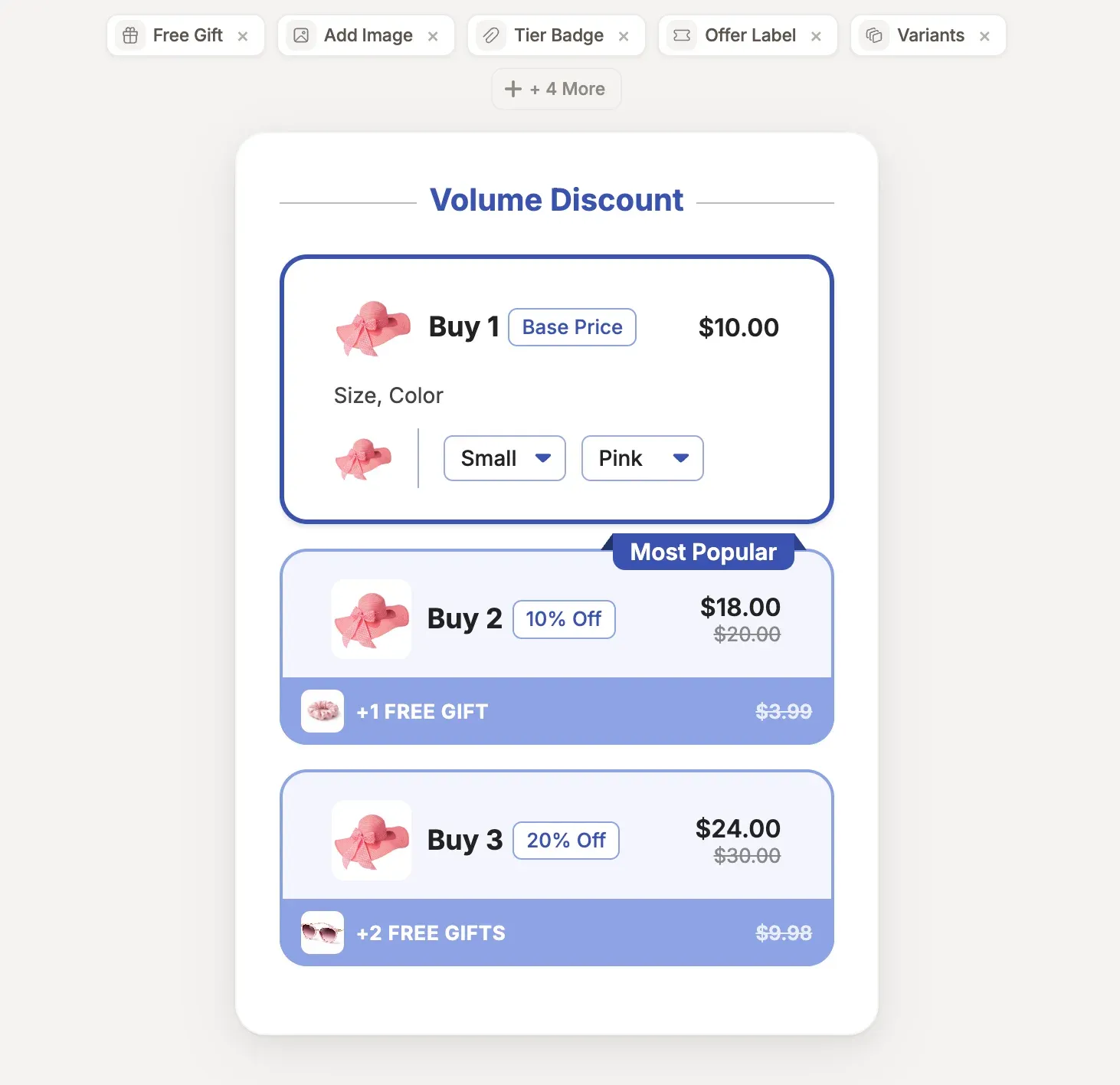
Quantity breaks encourage shoppers to buy more by rewarding larger purchases with tiered discounts. Instead of offering a discount after customers reach the cart, present the savings directly on the product page.
Seeing 1 candle at full price, 2 candles at 10% off, and 4 candles at 20% off triggers loss aversion. Shoppers feel they're missing out if they don't unlock a better deal. A candle brand using this strategy increased average units per order from 1.1 to 2.4 in just 30 days.
Well-configured quantity breaks can typically increase AOV by 25-40%, especially for consumables, supplements, skincare, candles, socks, and similar products. Place the widget above the Add to Cart button so shoppers see the offer before making a purchase decision.
With Pumper's Volume Discount (Buy More, Save More) widget, this can be implemented without writing a single line of code.
2. BOGO Offers (Buy One Get One)
BOGO offers work because they turn a single-product purchase into a multi-item order. The second product feels significantly more valuable when it's positioned as a reward rather than an additional expense.
While the classic Buy One, Get One Free remains popular, Shopify merchants can also use BOGO at a percentage discount, Buy 2 Get 1 Free, Buy 3 Get 1, or even cross-product offers like buy a yoga mat and get a carrying strap at 50% off.
These promotions naturally introduce shoppers to complementary products, making BOGO one of the most effective cross-sell strategies.
For example, an apparel brand running "Buy 2 T-shirts, Get the 3rd at 50% Off" can see shoppers who intended to buy one shirt leave with three, increasing AOV from $34 to $68.
Industry studies consistently show that BOGO promotions outperform standard percentage discounts because the perceived value is much higher. Instead of relying on occasional sitewide discount codes that train customers to wait for sales, display BOGO offers directly on relevant product pages as an always-on deal.
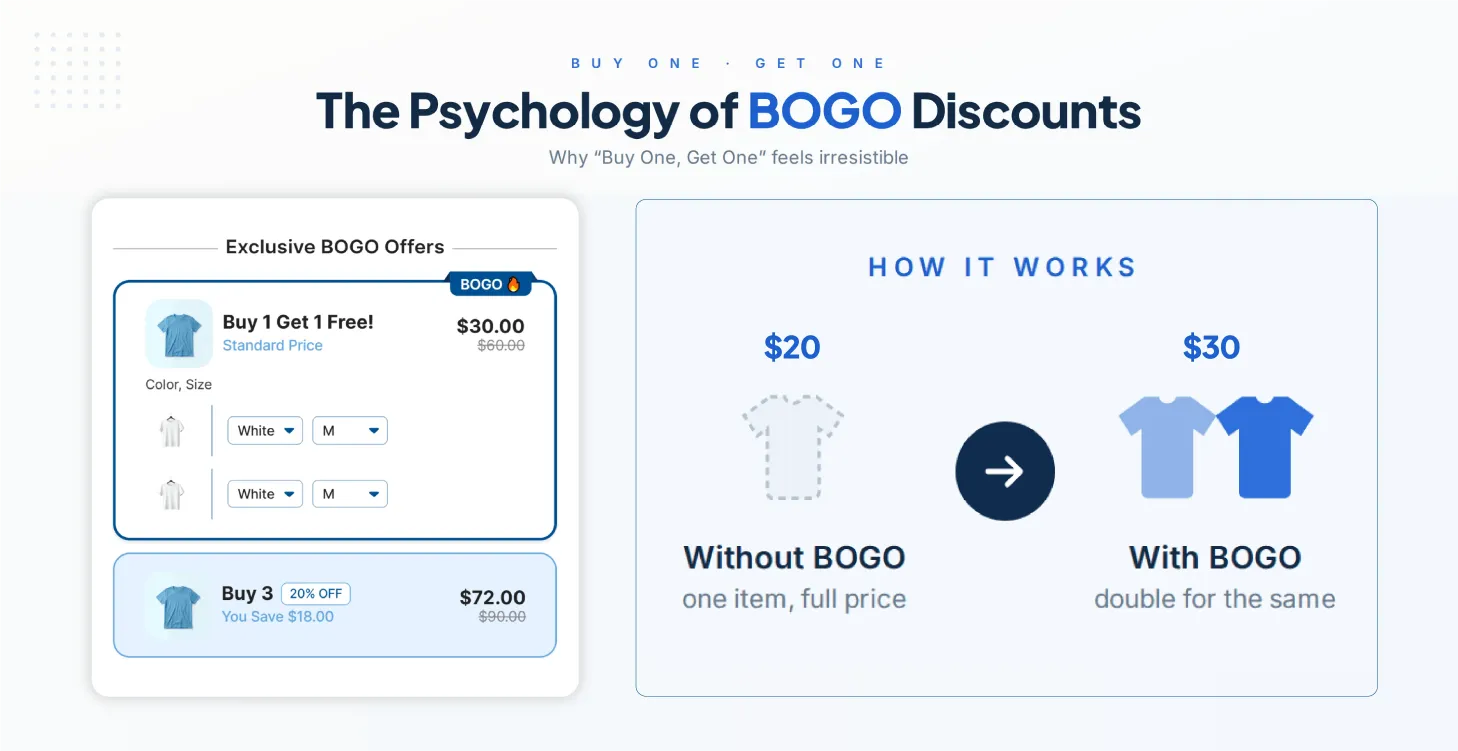
With Pumper, merchants can create both same-product and cross-product BOGO offers using configurable tier cards—no custom development required.
3. Product Bundles (Bundle and Save)
Product bundles increase AOV by selling shoppers a complete solution instead of individual products. Rather than asking customers to decide what else they need, you make that decision for them. This reduces decision fatigue while increasing the perceived value of the purchase through a bundled discount.
A skincare brand, for instance, might create a Morning Routine Bundle containing a cleanser, serum, and moisturizer at 18% off, resulting in an $87 bundle AOV compared to a $29 single-product purchase.
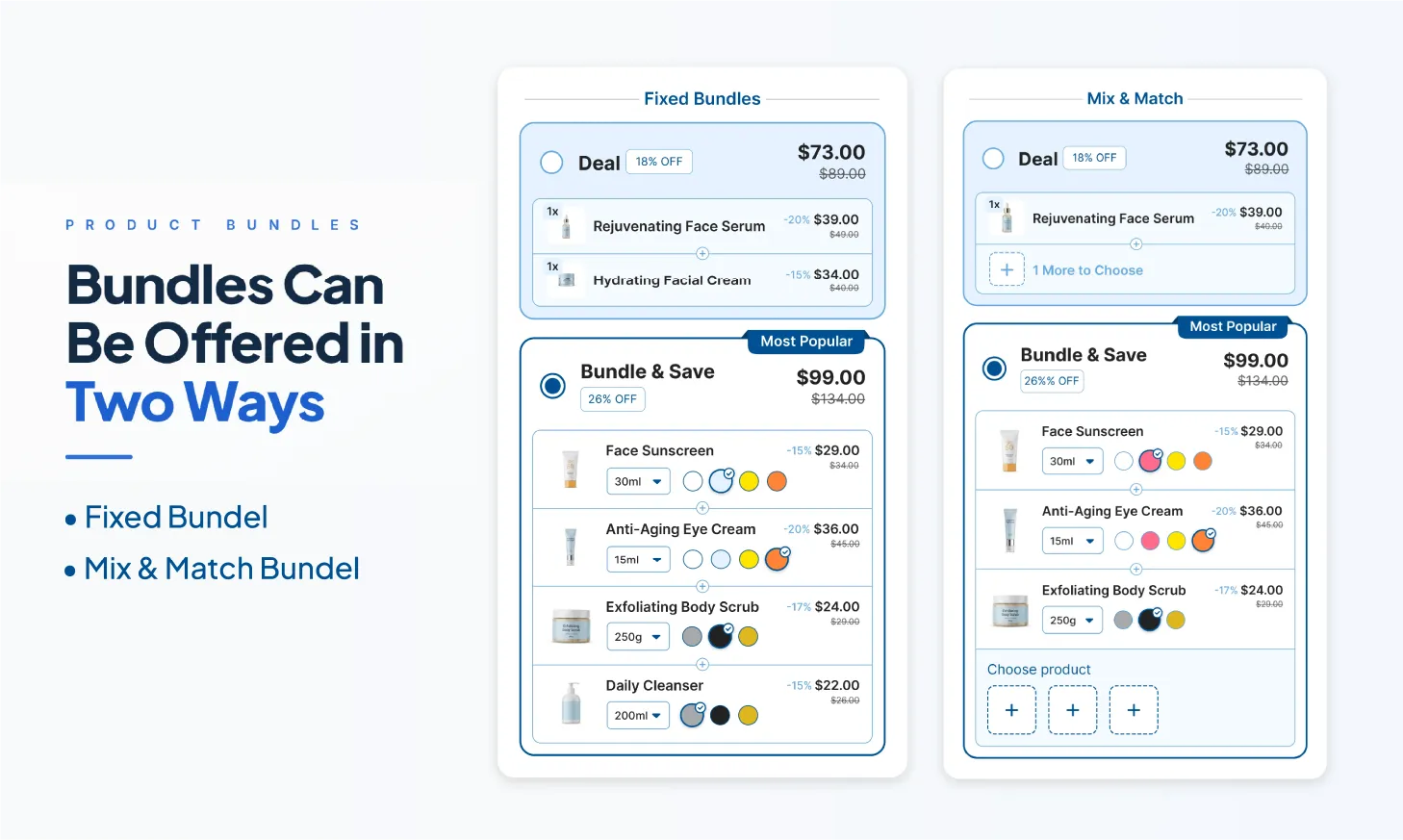
Bundles can be offered in two ways.
Fixed bundles package the same products together every time, making them simple to understand and quick to purchase.
Mix-and-match bundles let shoppers choose products from a predefined collection, creating a more personalized experience while encouraging exploration across a larger catalog.
The key is relevance.
Bundles designed around an outcome such as "Starter Skincare Routine" or "Work From Home Essentials" consistently outperform collections of unrelated products created simply to move inventory.
Pumper's Bundle and Save feature supports both curated and mix-and-match bundles through an intuitive product picker, allowing merchants to build high-converting offers without editing their Shopify theme.
4. Free Gift with Purchase
A Free Gift with Purchase (GWP) is one of the simplest ways to increase AOV without relying on deep discounts. Instead of reducing the order value, you reward shoppers for reaching a spending threshold. This taps into a powerful psychological trigger: people hate missing out on something they're close to earning.
If a customer has $44 worth of products in their cart and sees a message like "Spend $50 to unlock a FREE travel pouch," they're far more likely to add a small accessory than abandon the opportunity. The incremental purchase feels like a smart trade rather than an unnecessary expense.
The strategy becomes even more effective with tiered rewards. For example, unlock a sample at $50, a full-size product at $100, and a premium gift at $150. Each milestone creates another reason to keep adding items. A beauty brand using a free travel kit at a $75 threshold increased its average cart value from $52 to $71 because shoppers routinely added one more product to qualify.
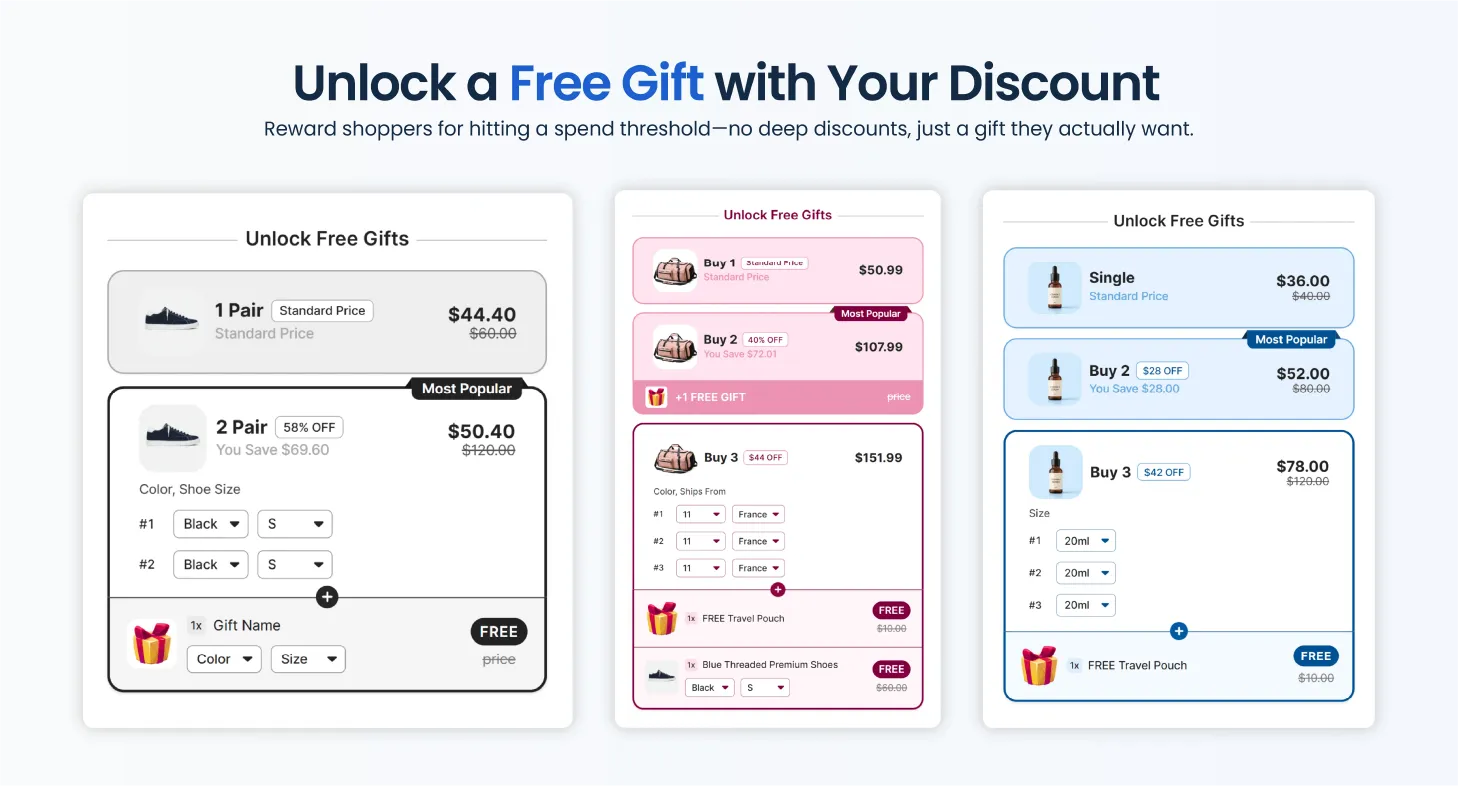
Unlike percentage discounts, gifts feel like a reward instead of a markdown, often protecting margins because the cost of the gift is typically much lower than the discount it replaces. The key is choosing a gift customers genuinely want, not excess inventory you're trying to clear. A complementary, aspirational gift reinforces the value of the purchase and enhances the shopping experience.
Pumper's Free Gifts feature makes this easy by displaying each gift tier directly on the product page, complete with gift names and clear FREE labels that motivate shoppers before they reach checkout.
5. Subscribe and Save
Most merchants think of subscriptions as a retention strategy, but they're equally powerful as an AOV growth lever. A subscription doesn't just increase the value of today's order, it increases the value of the customer's purchase decision. When someone chooses a recurring delivery instead of a one-time purchase, they're committing to future revenue from the very first transaction.
Consider a supplement brand that offers shoppers two options directly on the product page: One-Time Purchase or Subscribe & Save 15%. The discount isn't simply there to reduce price sensitivity, it's designed to encourage a longer-term commitment.
If 38% of first-time customers choose the subscription option, the business has already increased the expected value of those orders before fulfillment even begins. Over a year, a subscriber can easily generate 6-12 times the revenue of a one-time buyer, depending on the product category and retention rate.
The user experience plays a huge role in subscription adoption. Many stores bury subscriptions behind tabs or introduce them only after checkout, by which point the customer has already decided on a one-time purchase.
A better approach is to present One-Time Purchase and Subscribe & Save as equal options directly on the product page. This gives shoppers ownership over the decision, making the subscription feel like their choice rather than an upsell.
Pumper's Subscribe and Save offer places the subscription selector directly on the product page and supports weekly, monthly, or fully customizable delivery intervals. By removing friction from the decision, merchants can increase the long-term value of every new customer while creating a more predictable revenue stream.
6. Tiered Cart Goals (Spend X, Get Y)
Tiered cart goals encourage shoppers to increase their cart value by giving them a clear spending target. Unlike product-page offers, these messages appear in the cart or across the site and guide shoppers once they've already started building their order. The most common example is "You're $12 away from free shipping," but the same principle applies to offers like "Spend $75 to unlock 20% off" or "You're $8 away from a free gift."
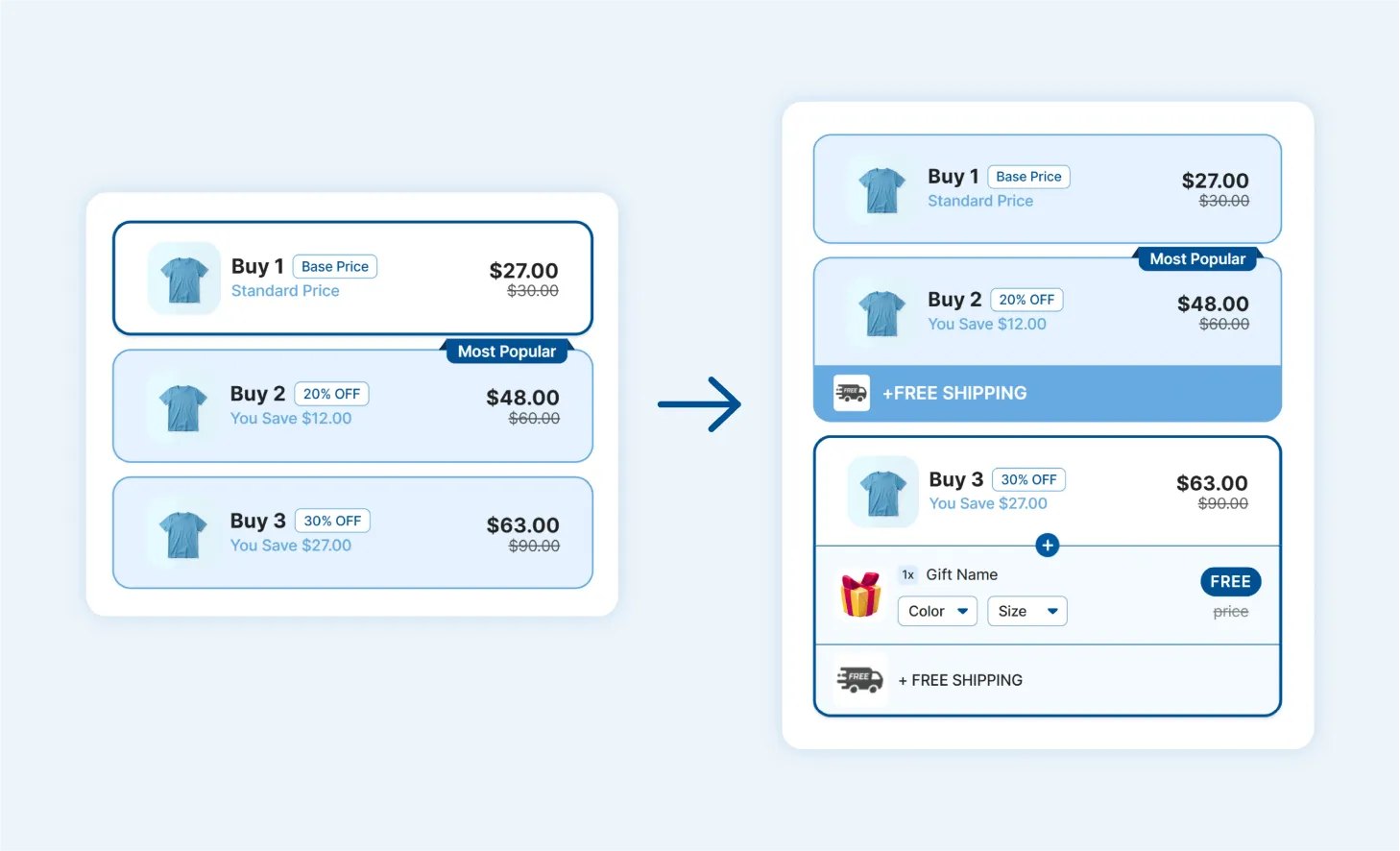
The psychology is simple: shoppers become focused on reaching a goal rather than evaluating individual products. Instead of checking out immediately, they browse for an item that helps them qualify for the reward. This tactic is even more effective when paired with personalized product recommendations.
Rather than simply displaying a threshold, show products that fit the gap, for example, accessories under $15 when a shopper is $12 away from a reward. While this complements product-page offer widgets like Pumper's quantity breaks or free gifts, it shouldn't replace them.
Together, they influence shoppers throughout the buying journey, from product discovery to checkout.
7. Post-Purchase Upsell (One-Click Add-On)
The checkout confirmation page is one of the most overlooked opportunities to increase revenue. Once a customer has completed payment, they've already made the hardest decision; they've said yes. Their payment details are authorized, trust has been established, and the remaining friction is minimal. A well-timed post-purchase offer takes advantage of this mindset by presenting a single relevant product that can be added to the existing order with one click.
For example, a fitness brand selling protein powder might immediately offer a shaker bottle at 15% off after checkout. Because the offer complements the original purchase, it feels helpful rather than intrusive. In one implementation, 22% of customers accepted the offer, increasing revenue per order without affecting the checkout experience. While this technically raises revenue per order rather than the original cart AOV, the financial outcome is effectively the same.
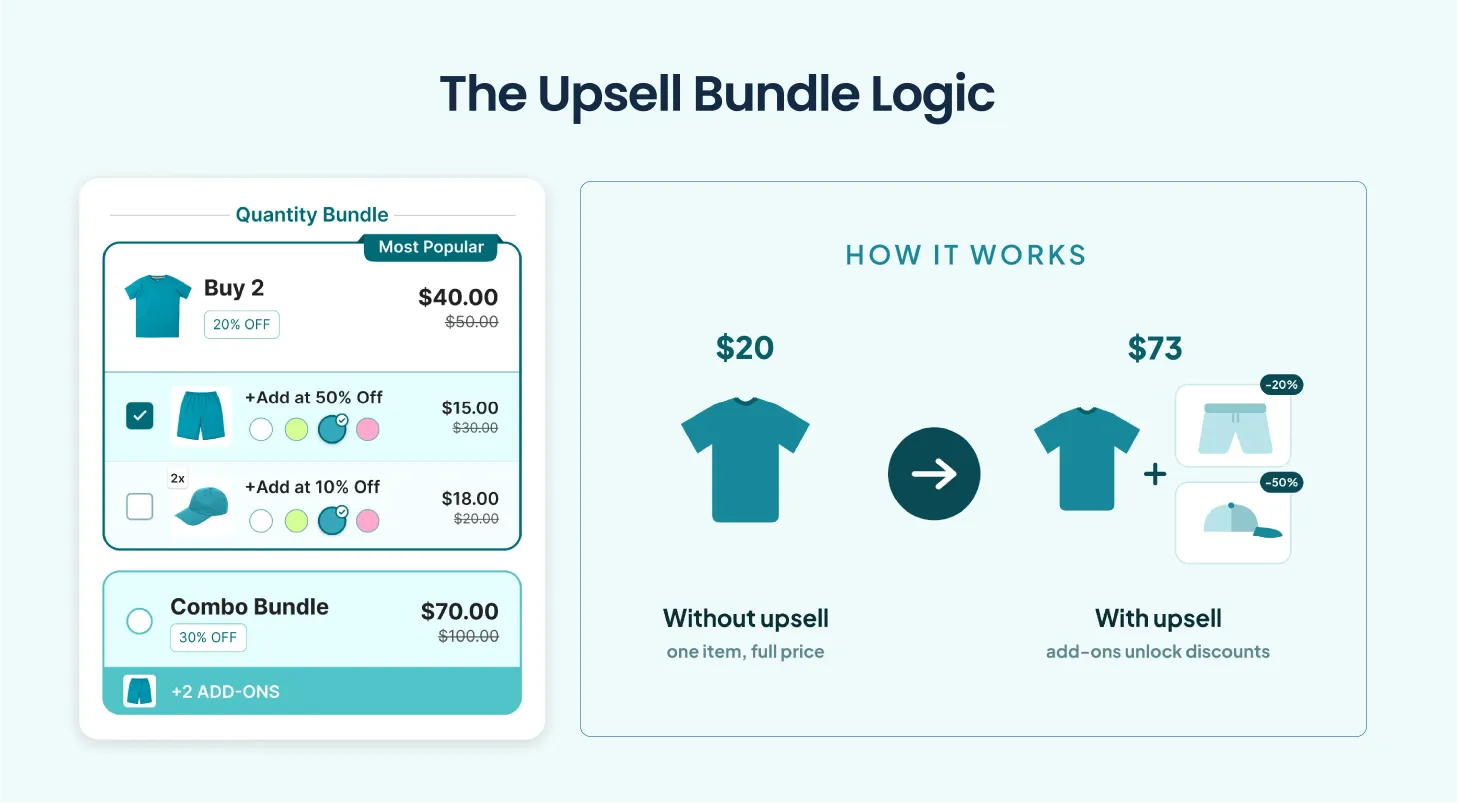
The key is restraint. Many merchants clutter the page with multiple products or generic "Customers also bought" carousels, creating unnecessary decision fatigue. Instead, present one highly relevant product, pair it with a modest time-sensitive discount, and clearly communicate that the offer expires shortly.
Post-purchase upsells work best as the final layer of an AOV strategy, not a substitute for product-page tactics like quantity breaks, bundles, or BOGO offers, but a complementary opportunity to capture additional revenue after the purchase decision has already been made.
Pumper also supports post-purchase upsells, enabling you to add one-click offers to your checkout confirmation page to capture extra revenue.
Which AOV Tactic Works for Which Product Type
The effectiveness of an offer depends on how customers use your product, how often they buy it, and what motivates them to add more items to their cart.
A customer buying protein powder already expects to reorder it. Someone shopping for skincare is looking for a complete routine. A customer purchasing a refrigerator, on the other hand, is unlikely to buy two just because there's a discount.
The biggest mistake merchants make is copying an offer that worked for another brand without considering whether it matches their buying behavior.
Instead of asking, "What's the highest-converting offer?", ask "What's the most natural next purchase for my customer?" That's where the biggest AOV gains come from.
Matching offer types to product categories
The table below can serve as a starting point when deciding which AOV mechanic to implement first.
Product Type | Best Tactic | Why It Works |
Supplements & Consumables | Quantity Breaks + Subscribe & Save | Customers naturally buy multiple units to avoid running out, while subscriptions secure future purchases. |
Apparel & Accessories | BOGO + Bundle & Save | Shoppers often buy multiple colors, sizes, or complementary products. Bundles and BOGO offers feel like better-value purchases. |
Skincare & Beauty | Bundle & Save + Free Gift | Customers prefer complete routines over standalone products, while premium gifts encourage higher cart values. |
Candles & Home Goods | Quantity Breaks + Free Gift | Multi-unit purchases are common for gifting, seasonal shopping, and stocking up. |
Pet Products | Subscribe & Save + Quantity Breaks | Predictable consumption makes subscriptions highly effective, while bulk buying reduces reorder frequency. |
Starter Kits & Beginner Products | Bundle & Save | New customers want an easy, curated starting point instead of researching individual products. |
Notice the pattern? The best-performing offers align with existing purchase behavior rather than trying to create entirely new habits.
For example, quantity breaks perform exceptionally well for coffee, protein powder, vitamins, candles, socks, and skincare refills because customers already purchase multiple units over time. The offer simply gives them a reason to consolidate those future purchases into today's order.
The opposite is also true.
Offering Buy 4, Save 20% on an expensive coffee machine or office chair is unlikely to change buying behavior because customers rarely purchase multiple units. Even if the discount looks attractive, it doesn't solve a real customer need.
The same principle applies to bundles. A "Morning Skincare Routine" or "Home Office Starter Kit" feels intuitive because every product contributes to a specific outcome. A random bundle of unrelated items created solely to clear inventory rarely performs well because customers struggle to understand its value.
The strongest AOV strategies don't convince shoppers to buy things they don't want, they simply make it easier to buy what already makes sense together.
How to read your own order data before choosing a tactic
Before installing any apps to increase AOV or configuring offers, spend a few minutes looking at your existing Shopify data. It often tells you exactly which strategy will work best.
Start by answering these three questions:
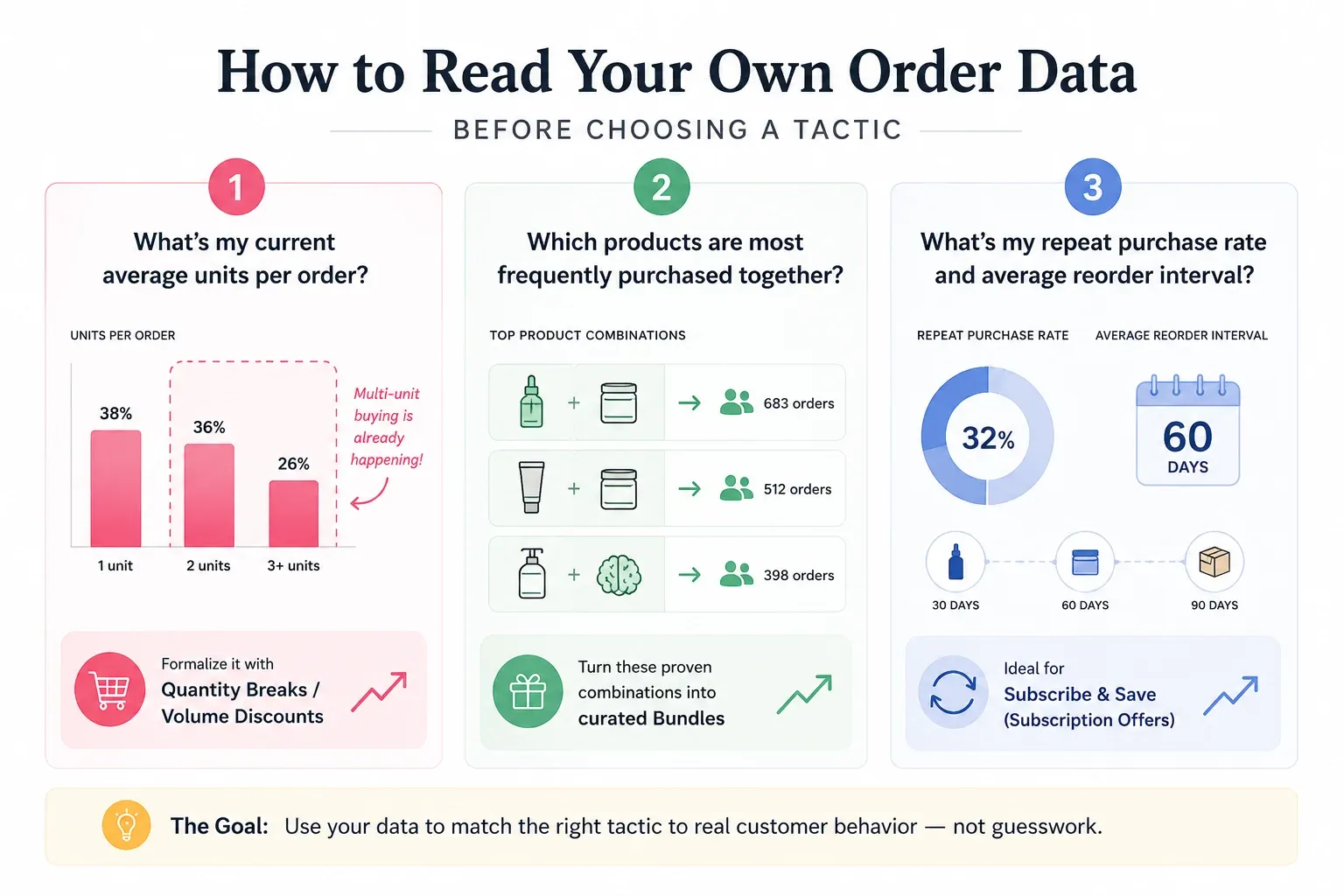
1. What's my current average units per order?
If customers already purchase two or more units per order, there's evidence that multi-unit buying is natural. Instead of hoping shoppers continue doing it on their own, formalize the behavior with quantity breaks or volume discounts that encourage even larger purchases.
2. Which products are most frequently purchased together?
Look for combinations that consistently appear in the same order. These are your best bundle candidates because customers have already validated the relationship. Turning those combinations into curated bundles reduces decision-making and increases attachment rates.
3. What's my repeat purchase rate and average reorder interval?
Products that customers repurchase every 30, 60, or 90 days are excellent candidates for Subscribe & Save. If your data shows predictable replenishment cycles, subscriptions can increase the value of the first purchase while improving long-term customer lifetime value.
You can find much of this information in Shopify Analytics, under Products, Top Products, and inventory or product performance reports. If you need deeper insights into customer cohorts, repeat purchase behavior, or lifetime value, analytics platforms like Triple Whale and Lifetimely provide much richer reporting.
The biggest AOV wins usually don't come from introducing completely new shopping behaviors. They come from recognizing patterns that already exist and making them more intentional. If 15% of your orders already include three units of the same product, a quantity break simply gives more customers a reason to do the same.
If shoppers frequently purchase a cleanser and moisturizer together, a bundle removes the effort of finding both individually.
How to Set Up AOV Offers on Shopify Without Code
Why Native Shopify Discounts Aren't Enough
Shopify's built-in discount engine is great for creating discounts, but it's limited when it comes to presenting them effectively. You can configure percentage discounts, fixed discounts, automatic discounts, and even BOGO rules from the Shopify admin. What you can't do natively is display those offers as an interactive widget on the product page where shoppers are deciding what to buy.
This creates a major gap.
The discount technically exists, but customers often don't discover it until they reach the cart or checkout. For example, you might configure a Buy 3, Get 1 Free offer in Shopify, then rely on a banner or announcement bar to communicate it.
Many shoppers will simply miss the promotion because they never see it at the moment they're choosing quantity.
A better approach is to use an app that displays the offer directly on the product page through Theme App Extensions. Instead of editing Liquid files or adding custom code, the app injects a visual widget between the product description and the Add to Cart button.
Shoppers can instantly compare quantity tiers, bundle savings, or BOGO offers before making their purchase decision, significantly increasing the likelihood that they'll choose the higher-value option.
What to Look for in a Shopify AOV App
Not all Shopify AOV apps offer the same level of flexibility. The first thing to look for is Theme App Extension support, which allows widgets to be installed without modifying theme files. This makes setup faster and prevents offers from breaking whenever you update your Shopify theme.
Next, consider the number of offer types the app supports. Managing quantity breaks, bundles, BOGO offers, free gifts, and subscriptions across multiple apps quickly becomes difficult. A single platform that supports all major AOV tactics keeps your storefront consistent while reducing app conflicts and maintenance.
Analytics are equally important. Every offer should report metrics such as impressions, add-to-cart rate, orders, conversion rate, and additional revenue generated. Without this data, it's impossible to know which campaigns are driving incremental sales and which ones need optimization.
If you sell internationally, multilingual support should also be a priority. Offer copy, button text, and widget labels should be translatable so customers receive a localized shopping experience.
Pumper Bundles is designed around these requirements.
It supports five AOV offer types, including quantity breaks, bundles, BOGO offers, free gifts, and subscriptions, through Theme App Extensions, so no code changes are required. Merchants also get detailed per-offer analytics, support for 11 dashboard languages, and a revenue-capped pricing model that ranges from $0 to $49.99 per month, ensuring costs grow only as the app generates more revenue. A 7-day free trial lets merchants test different AOV strategies before committing.
Five Mistakes That Kill AOV Gains (And How to Avoid Them)
- Stacking too many offers at once. When every product page has a quantity break, a BOGO, and a free gift widget, shoppers get confused about which deal to take. Prioritize one primary offer per product page. Use A/B testing or sequential rollout to find what works.
- Setting thresholds that are too far from current AOV. A "Spend $150 to unlock free shipping" threshold doesn't move the needle for a store with a $40 AOV. Set thresholds 20-30% above current AOV to create a realistic nudge without requiring an enormous leap.
- Ignoring widget placement. If the offer widget appears below the fold or after the Add to Cart button, most shoppers never see it. Pumper Bundles lets you position the widget above any element on the page. Place it between the product description and the buy button.
- Discounting products that don't have natural multi-unit demand. Quantity breaks on a $200 piece of furniture or a unique art print won't move units. Use your order data to confirm multi-unit behavior exists before building a quantity break around it.
- Measuring AOV sitewide instead of per offer. A sitewide AOV number obscures which offers are working. Use Pumper's per-offer analytics (or Shopify's order tagging) to attribute AOV movement to specific offers. Kill what's not converting; double down on what is.
Conclusion
Increasing AOV on Shopify requires presenting the right quantity, combination, or incentive at the right moment in the purchase flow. A well-placed quantity break on a consumable product, a curated bundle built around a use case, or a free gift threshold set just above your current AOV can each move the needle substantially, without spending a dollar more on acquisition.
The merchants who get this right treat AOV as a product page design problem, not a pricing problem. Start with one offer type, measure it per-offer rather than sitewide, and layer in additional tactics once you have a baseline.
Pumper's free plan is a zero-risk starting point. Install it, activate your first offer this week, and check your extra revenue dashboard in 7 days.
Install Pumper Bundles free on the Shopify App Store and set up your first AOV offer in under 20 minutes.
Frequently Asked Questions
What is a good AOV for a Shopify store?
Average AOV varies by category, but $55-$100 is a reasonable benchmark for most physical product DTC stores. More useful than an industry number is measuring your own 30-day baseline and tracking improvement against that.
What's the difference between upselling and AOV optimization?
Upselling is nudging a customer toward a higher-priced version of the same item. AOV optimization is getting them to add more items or commit to a larger quantity. Both increase revenue per order; bundles and quantity breaks are AOV tools, not upsells in the traditional sense.
Can a small Shopify store benefit from AOV tactics, or is this for larger brands only?
AOV tactics work at any store size. Quantity breaks and BOGO offers can be set up on Pumper's free plan with no minimum sales volume required. Smaller stores often see proportionally larger AOV lifts because there's more room to grow from a low baseline.
How long does it take to see results from AOV offers?
Most merchants see measurable movement within 7-14 days of publishing a well-configured offer. Offers need enough impressions to generate statistically meaningful data. If you're under 200 product page views per day, give it 3-4 weeks before drawing conclusions.