



Most merchants who start bundling products ask the wrong first question. They ask which bundle to build before they've decided what kind of bundle it should be. That decision, pure or mixed, changes how fast AOV moves, how much choice you're taking away from the shopper, and how much risk you're carrying if the bundle doesn't land. This guide breaks down both models, where each one wins, and which one is more likely to move your average order value faster without quietly cutting into margin or conversion.
What Pure Bundling Actually Means
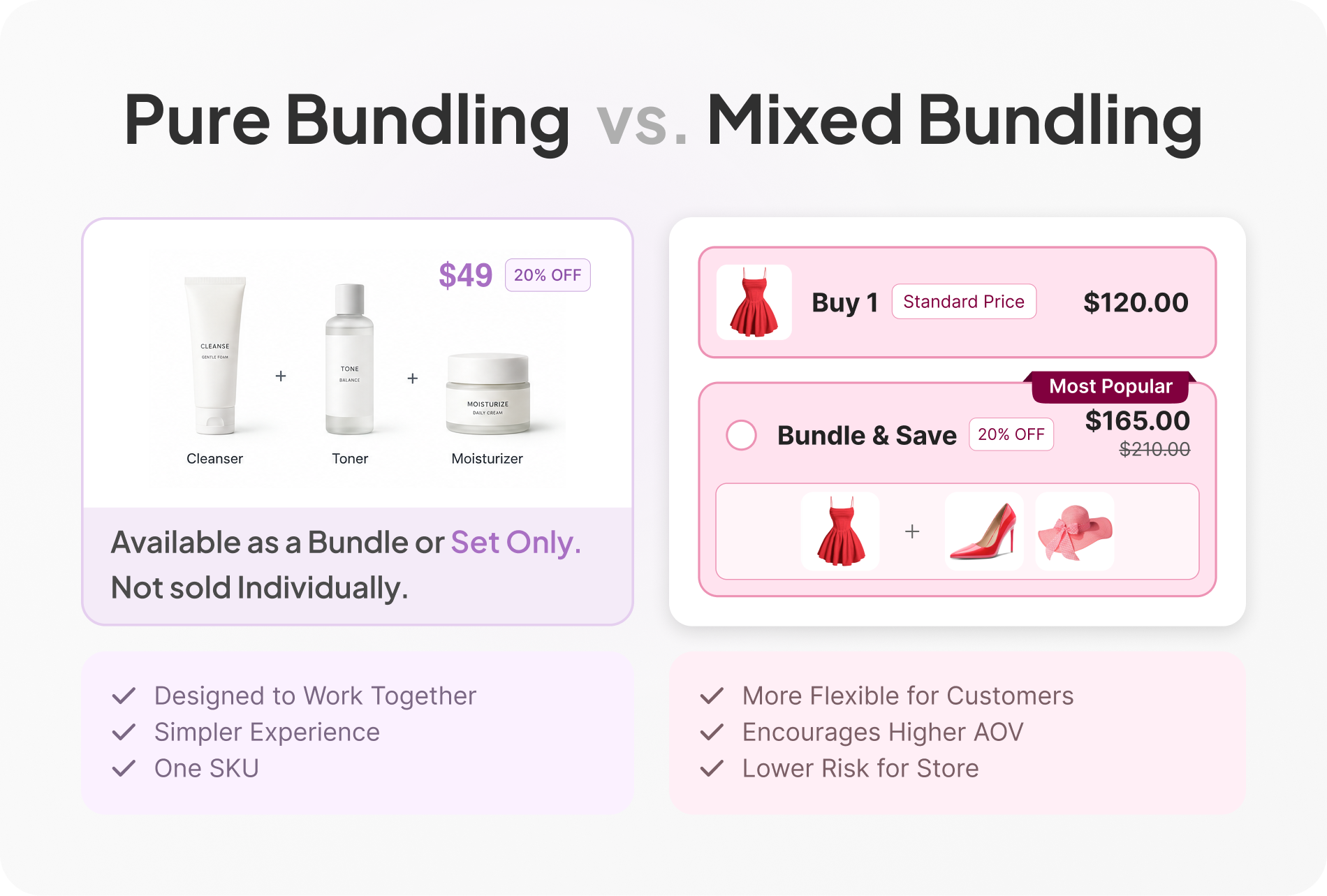
Pure bundling packages products into a single, fixed offer. The components aren't sold separately within that offer. If a shopper wants one item from the set, they still have to buy the whole set.
Software suites, streaming subscriptions, and pre-built gift sets are classic examples. A cleanser, toner, and moisturizer sold only as a three-step skincare routine is pure bundling. A camera kit sold only as body, lens, and memory card together is the same idea applied to hardware.
Pure bundling works because it removes decision friction. The shopper isn't comparing five variations of a purchase; they're accepting or declining one offer. That simplicity tends to push attach rates higher than a comparable mixed bundle, since there's no cheaper single-item path sitting next to it to pull the shopper away.
What Mixed Bundling Actually Means
Mixed bundling keeps every component available on its own, and adds a bundle option at a better combined price. The shopper chooses: buy the single item, or buy the set and save.
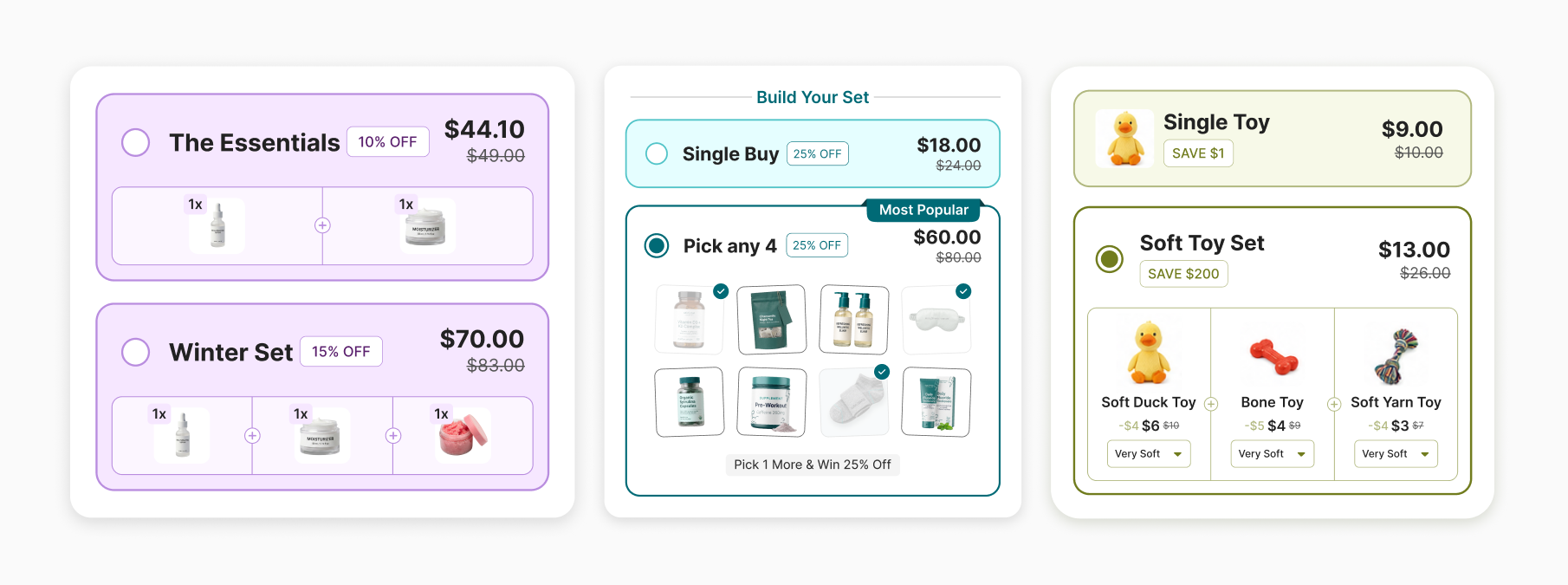
This is the more common structure in ecommerce, and it's the one most Shopify stores default to without naming it. A lipstick and lip liner sold separately, with a "buy both and save 15%" option on the product page, is mixed bundling. A build-your-own bundle where a shopper picks any three items from a candle collection at a set bundle price is also mixed bundling, just with more flexibility built in.
Because nothing is locked, mixed bundling captures a wider range of shoppers. Someone who only wants one item still converts. Someone who's open to spending more sees a clear reason to.
The AOV Math: How Each Model Moves the Needle
Both models lift AOV. They just lift it through different mechanisms, and that difference matters when you're picking one for a specific product line.
Pure bundling raises AOV through volume per transaction. Every accepted offer is a fixed, larger basket by definition, since there's no smaller option to fall back to. Industry data on pure bundling shows meaningfully higher attach rates than mixed formats, precisely because the smaller purchase path doesn't exist to compete with it.
Mixed bundling raises AOV through conversion breadth plus upsell. It doesn't force every shopper into a bigger basket, but it recovers a segment that pure bundling would lose entirely: the shopper who only wanted one item, while still nudging the value-conscious segment toward the bundle. Reported AOV lifts from mixed and tiered bundling on Shopify tend to fall in the 20% to 35% range, with well-targeted "good, better, best" tiering pushing past that.
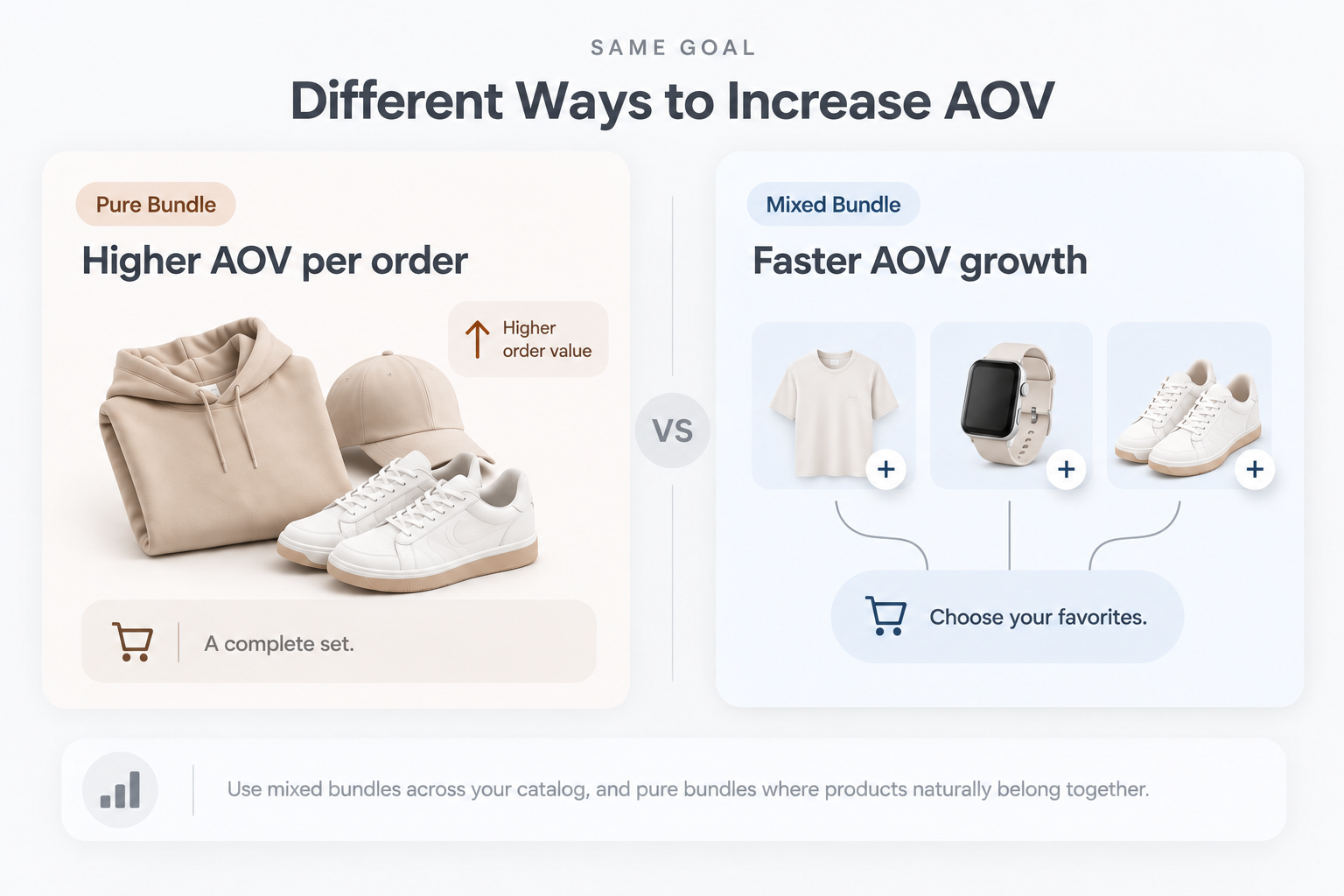
In practice, pure bundling tends to move AOV faster on a per-transaction basis when it converts. Mixed bundling tends to move total AOV faster across the store, because it doesn't sacrifice the customers who wouldn't have accepted a fixed offer at all.
Where Pure Bundling Wins
Pure bundling is the right call when the products genuinely don't stand alone. A subscription box, a starter kit for a new hobby, a multi-step skincare routine designed to be used as a system rather than a single product- these are cases where forcing the bundle isn't really forcing anything. The shopper was always going to need all the pieces.
It also works well for digital goods and anything with near-zero marginal cost to include, since bundling in an extra component doesn't meaningfully change your unit economics the way it would with a physical product that has its own cost of goods.
Where Mixed Bundling Wins
Mixed bundling is the safer default for most physical-product Shopify stores, and for one simple reason: most product catalogs don't have a natural "must buy together" structure. A supplement brand's protein powder and multivitamin are complementary, not inseparable. A shopper should be able to buy either on its own.
Mixed bundling also performs better across a wider range of price points. It lets you build a $30 single-item purchase, a $55 two-item bundle, and a $90 three-item set from the same catalog, capturing budget-conscious and higher-spend shoppers with the same offer structure instead of picking one price point and hoping it fits everyone.
One price point never fits your whole catalog. Pumper Bundles is where you build three.
7-day free trial · No code required · Free plan
The Risk in Pure Bundling: When It Backfires
Pure bundling carries a real failure mode: shoppers who don't want the full set simply don't buy at all. A widely cited Harvard Business School case on Nintendo found that requiring customers to purchase games exclusively bundled with consoles led to a noticeable sales decline, because a meaningful share of buyers wanted the console without the attached software and had no path to get it.
The lesson isn't that pure bundling is a bad strategy. It's that pure bundling only works when the bundle reflects how customers already think about the products, not how the merchant wants to move inventory. Bundling a slow seller into a pure bundle with a bestseller to force volume usually backfires, because shoppers notice when a bundle exists to solve the store's problem instead of theirs.
So Which One Increases AOV Faster?
For a single, well-matched bundle, pure bundling usually produces a bigger jump in that specific transaction's value, because there's no smaller option pulling the average back down. If your product line has a genuine "system" (a routine, a starter kit, a subscription), a pure bundle will often outperform a mixed one on raw AOV per order.
Across a full storefront, mixed bundling wins on speed because it starts lifting AOV immediately across more of your catalog and more of your traffic, without needing every product line to have a natural bundle partner. It also carries less risk, since no purchase path gets blocked if the bundle doesn't resonate with a given shopper.
Mixed bundling as the default, a pure bundle where it earns its place. Pumper Bundles runs both from one offer type.
7-day free trial · No code required · Free plan
The realistic answer for most Shopify stores: run mixed bundling as the default across the catalog, and layer in a pure bundle only where the products genuinely belong together as a system.
Running Both Without Overcomplicating Your Store
You don't need two separate apps or two separate strategies to run both models. Pumper Bundles by Proveway builds bundles through its Bundle & Save offer type, which supports a fixed, predefined bundle structure for products meant to be sold together, as well as a mix-and-match picker that lets shoppers choose which products go into the set. The same underlying offer type covers both the pure and mixed use case, configured through the offer editor rather than two different tools.
For stores that want the upsell mechanics of mixed bundling without a full multi-product bundle, Pumper's other offer types cover the same ground from different angles. Buy More Save More applies quantity-based discounts to a single product line, which functions like a mixed bundle across quantity rather than across products. BOGO offers let you pair one product with a free or discounted second item, same-product or cross-product, without needing a full bundle builder. Unlock Free Gifts adds a threshold-based incentive on top of either model, rewarding shoppers who cross a spend or quantity line with a free item.
All of this runs through Shopify Theme App Extensions, so bundles go live by turning on an app block in the theme editor. No custom development, and a much smaller performance footprint than scripts injected outside Shopify's supported framework.
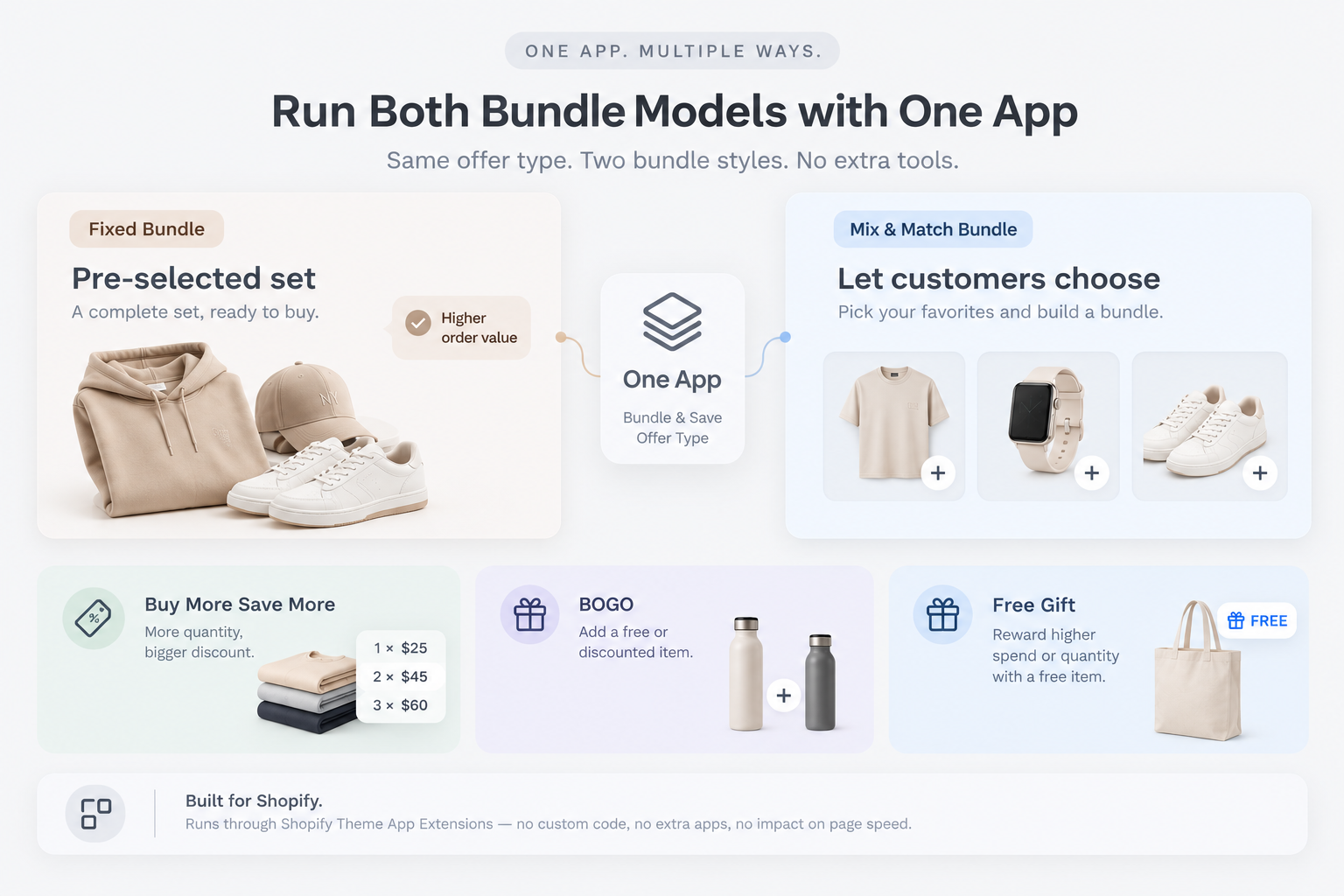
Fixed set or pick-your-own, same offer type. Pumper Bundles handles pure and mixed bundling without two apps.
7-day free trial · No code required · Free plan
A Quick Framework for Choosing
Ask three questions before building your next bundle.
Do the products work without each other? If yes, default to mixed bundling. If the products only make sense together, pure bundling is worth testing.
Is this bundle solving a customer problem or a merchant problem? A bundle built to help a customer complete a routine or a kit tends to convert. A bundle built to clear a slow-moving SKU by attaching it to a bestseller tends to underperform, especially if it's structured as pure bundling with no way to opt out of the weaker item.
How wide is your price range? If your catalog spans a broad range of price points, mixed bundling with tiered options will capture more of that range than a single fixed pure bundle can.
Getting Started
Pure and mixed bundling solve the same problem, a low average order value, through different mechanics. Pure bundling trades flexibility for a bigger jump per transaction. Mixed bundling trades a smaller per-order lift for reach across more of your catalog and less risk of losing the sale entirely.
Most stores don't need to pick one permanently. Start with mixed bundling on your broader catalog, test a pure bundle on one product line that genuinely functions as a system, and compare the AOV and conversion numbers after a few weeks before deciding where to expand.
A low AOV has more than one fix. Pumper Bundles is where you test which one works for your catalog.
7-day free trial · No code required · Free plan
FAQ: Pure Bundling vs Mixed Bundling
What's the main difference between pure bundling and mixed bundling?
Pure bundling sells products only as a set, with no option to buy components individually within that offer. Mixed bundling sells products both individually and as part of a discounted set, giving the shopper the choice.
Which one increases AOV faster?
Pure bundling tends to produce a bigger AOV jump on individual transactions that convert, since there's no smaller purchase path available. Mixed bundling tends to lift AOV faster across the whole store, since it captures both bundle buyers and single-item buyers instead of only the segment willing to accept a fixed offer.
Is pure bundling riskier than mixed bundling?
Yes, generally. Pure bundling loses the sale entirely for any shopper who doesn't want the full set, which is why it works best for products that are already used together, like subscription boxes or multi-step routines, rather than being used to force slower-moving inventory into a purchase.
Can I run pure and mixed bundling on the same Shopify store?
Yes. Most stores benefit from running mixed bundling as the default across the catalog and adding pure bundles only for specific product lines that function as a genuine system, such as a starter kit or a subscription box.
Does bundling always increase margin along with AOV?
Not automatically. A bundle discount that's too aggressive can raise AOV while cutting into per-order profit. Every bundle price should be checked against the combined cost of its components before it goes live, regardless of whether it's structured as pure or mixed.