



Most DTC brands try the same two levers to lift average order value: a sitewide discount code, or a fixed bundle the merchandising team put together in advance. Both hit a ceiling fast. A discount code trains shoppers to wait for the next one. A fixed bundle only converts shoppers who happen to want exactly that combination.
The build-your-own bundle format sidesteps both problems. Instead of picking the combination for the shopper, you hand them a curated pool of products and let them assemble their own, at a price that only applies once they've filled it. It sounds like a small UX difference. The conversion data suggests it isn't.
This guide covers what the format actually is, why it consistently outconverts fixed bundles and generic upsells, what real DTC brands have done with it, and the setup decisions that separate a format that converts from one that sits on a product page unused.
Key Takeaways
- Build-your-own bundle pages have been reported to convert up to 20% higher than pre-selected, fixed bundles, largely because shoppers feel ownership over a combination they assembled themselves (vendor-published 2026 Shopify bundle analysis; directional, not independently verified).
- Bundle product pages generally convert well above the typical ecommerce average of roughly 2.5-3%, with reported ranges of 5-8% depending on format and execution.
- The effect isn't unique to ecommerce: McKinsey's widely cited research on bundling ties well-designed sets, built around real purchase behavior, to a 20% sales lift and a 30% profit lift, though the original study can't be independently traced here and should be treated as directional.
- Real Shopify brands back the mechanic at scale. HiSmile has publicly attributed over 80% of its orders to bundled products, and LVLY grew its bundle SKU count more than 5x after moving platforms while posting a 6% year-over-year AOV lift (Shopify case studies).
- The format only outperforms when the product pool is genuinely curated and the pricing model survives every combination a shopper could build, not just the average one.
What "Build Your Own Bundle" Actually Means
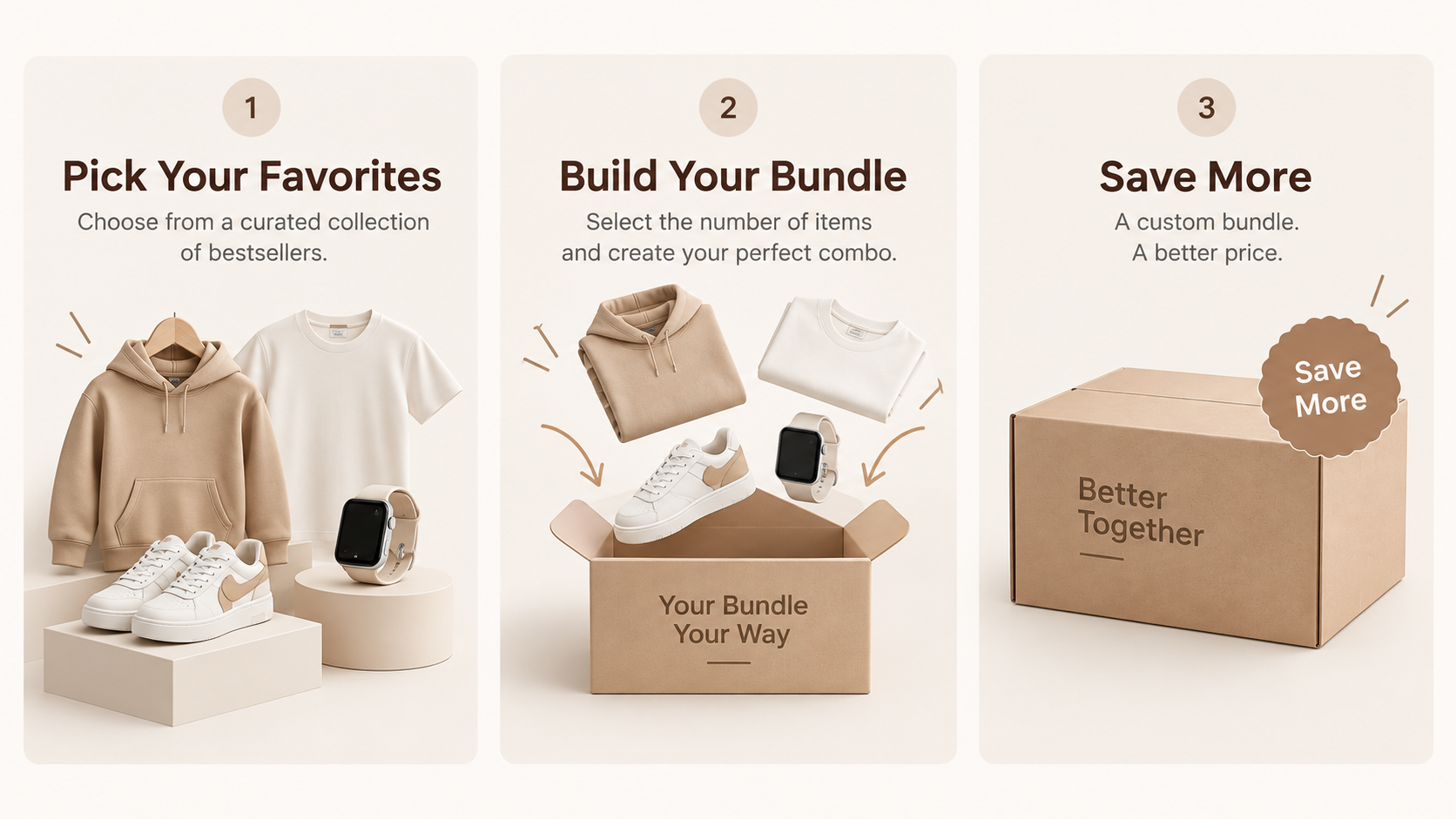
A build-your-own bundle presents a defined pool of products, a rule for how many the shopper needs to pick, and a bundle price or discount that applies once they've filled the requirement. The shopper assembles something specific to them, but only from options the merchant has already chosen, which is worth distinguishing from two adjacent tactics.
A fixed bundle is a predetermined combination the merchant assembles in advance, a cleanser and a serum and a moisturizer sold as one SKU, with no shopper input. A quantity break discounts more units of the same product, with no selection at all, just volume. A build-your-own bundle sits between the two: more flexible than a fixed bundle, but bounded by a pool rather than the entire catalog.
That boundary is the entire mechanism. A pool that's too wide stops feeling like a curated offer and starts feeling like your whole store with extra steps, which is exactly where the conversion advantage disappears.
Why the Build-Your-Own Format Outconverts Fixed Bundles
The headline number is straightforward: build-your-own bundle implementations have been reported to convert up to 20% higher than pre-selected, fixed bundles on the same storefronts, a gap the underlying analysis attributes to the sense of ownership a shopper feels over a combination they picked themselves (vendor-published 2026 analysis of Shopify bundle-app data; the methodology isn't public, so treat it as directional rather than a verified benchmark).
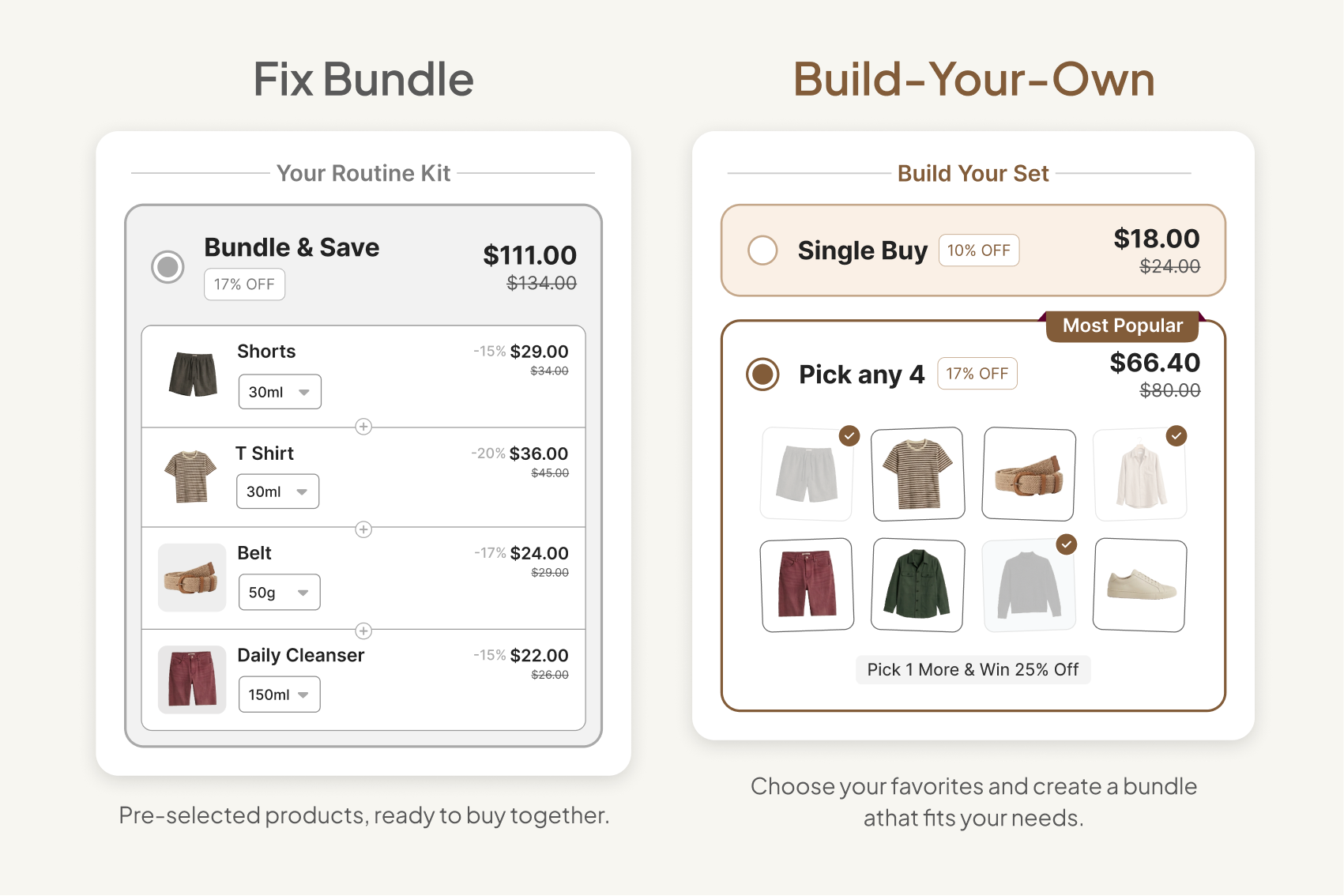
Zoom out to bundle pages generally and the pattern holds. Bundle product pages have been reported converting in the 5-8% range, against a typical ecommerce product page average closer to 2.5-3% (same source). Even at the low end, a bundle page converts roughly double a standard product page. The build-your-own format sits at the upper end of that range because it adds a second conversion driver on top of the bundle discount itself: the shopper has invested effort in building it.
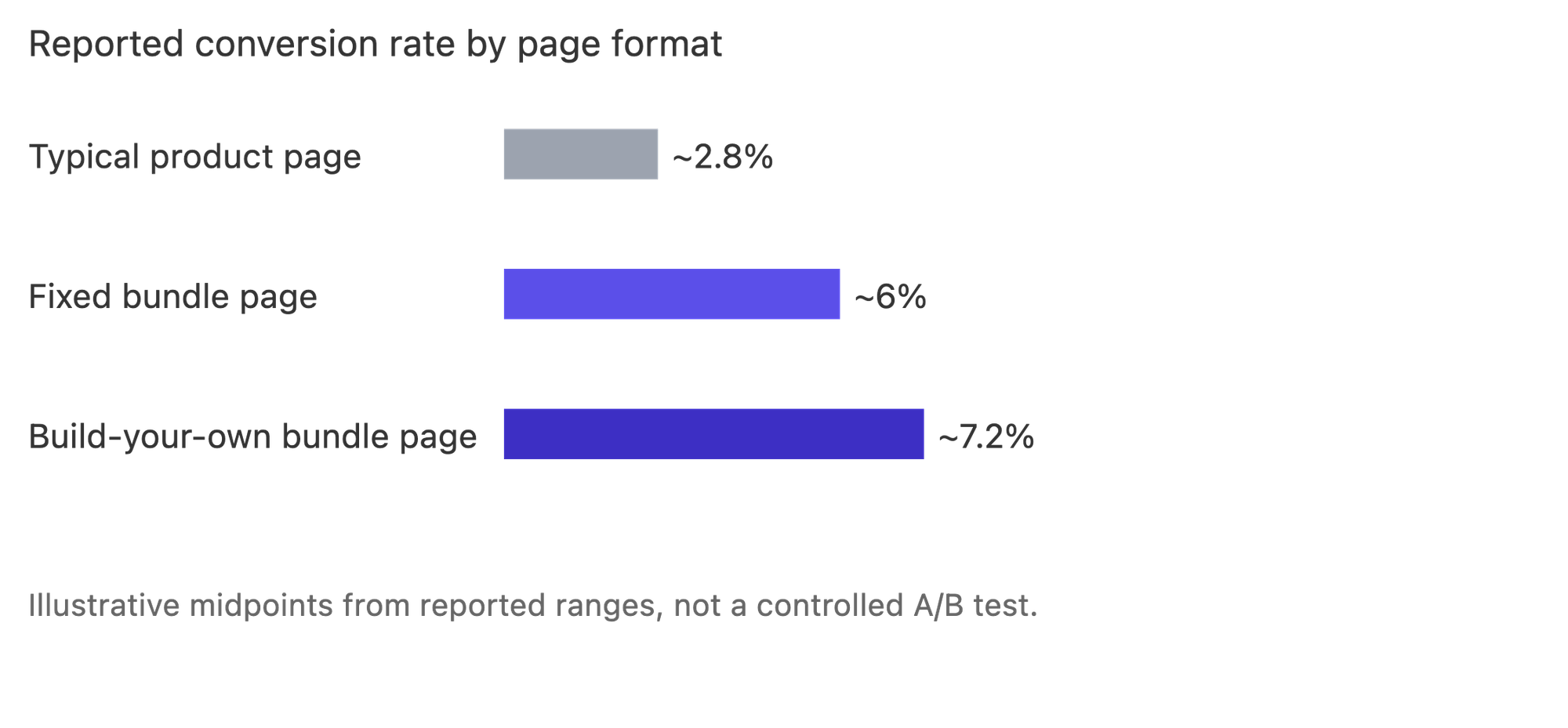
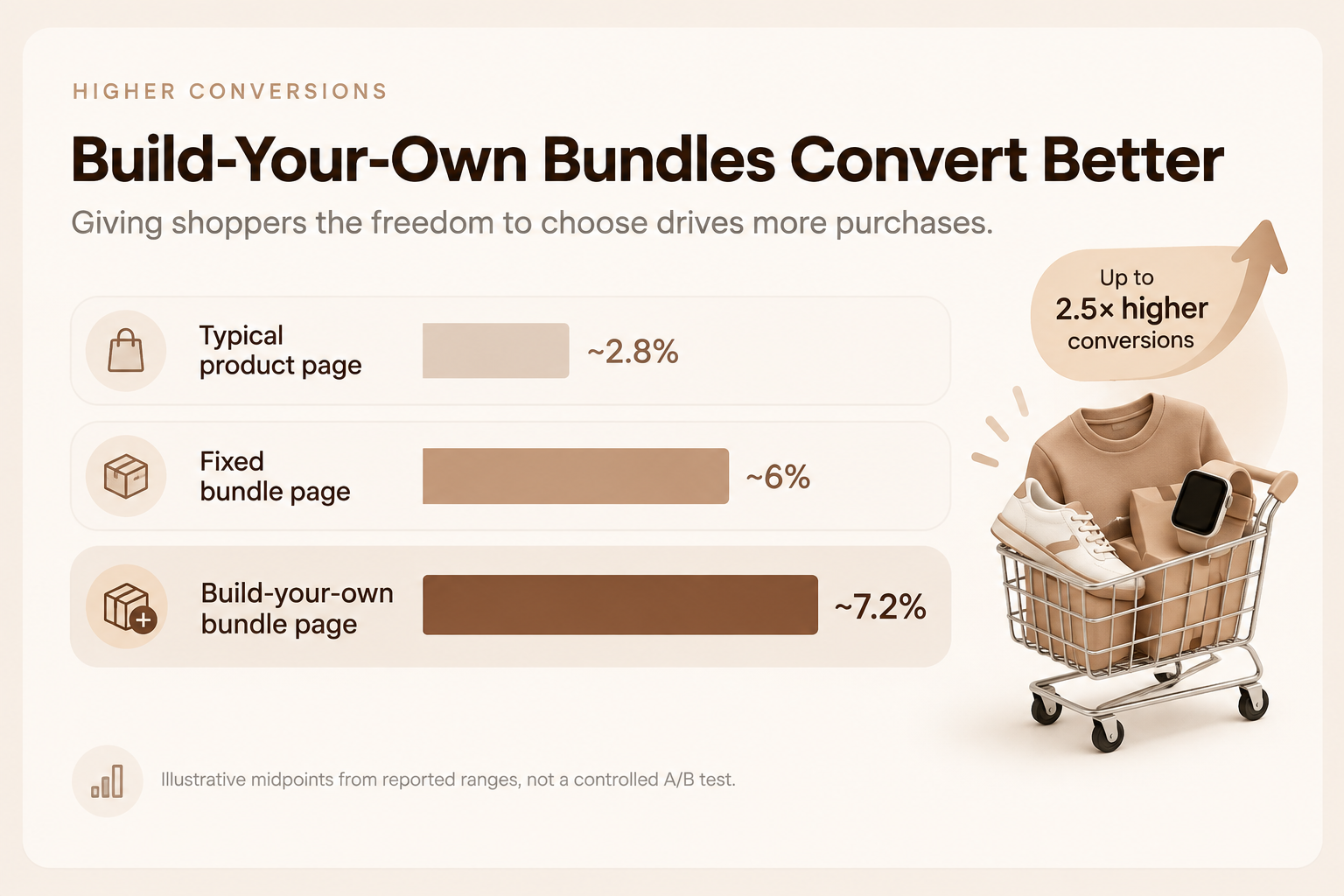
The 20% gap in that chart is consistent with a well-documented psychological pattern known as the IKEA effect: people place disproportionately higher value on things they've had a hand in creating, even when the underlying product is identical. A shopper who picked their own six flavors isn't just buying a box of flavors. They're buying a box they made.
The Ownership Effect: Why Letting Shoppers Choose Increases Perceived Value
Ownership isn't the whole story. Research on mass customization has consistently found that the fit between what a shopper actually wanted and what they ended up building, not the mere fact that they got to customize something, is what drives satisfaction with the final purchase (Journal of Research in Interactive Marketing, 2013). A build-your-own bundle only earns the ownership premium if the pool is stocked with products the shopper genuinely wants.
That comes with a limit worth naming for anyone tempted to make the pool as big as possible. Classic choice research found shoppers were dramatically more likely to actually purchase from a smaller, curated set of options than from an extensive one, even though the larger set drew more initial interest.
Put those two findings together, and the format's real mechanism becomes clearer than "customers like choice" suggests. The build-your-own format converts well specifically at the intersection of enough choice to feel like ownership and little enough choice to cause decision fatigue. Widen the pool past that point and you're trading the ownership premium for the same overwhelm a generic category page produces.
How Build-Your-Own Bundles Compare to Other Bundle Formats
None of these formats replaces the others outright; a supplement brand might run quantity breaks on its bestseller and a build-your-own bundle across its flavor range at the same time. The point is that, for a catalog with genuine variety, build-your-own is usually the highest-converting option available, and the one most brands skip in favor of the easier-to-build fixed bundle.
Real DTC Brands Winning With the Format
The clearest evidence isn't a benchmark number; it's what happens when a brand puts the format at the center of its merchandising instead of treating it as a secondary feature.
HiSmile, an Australian oral care brand, is documented in an official Shopify case study as generating over 80% of its orders from bundled products, a strategy the company credits with multiplying average cart size by roughly 4x (Shopify case study: HiSmile). Not every one of those bundles is a customer-built set, but the scale shows what happens when bundling becomes core to how the catalog is presented, not an afterthought.
LVLY, an Australian gifting brand, expanded from a cap of 30 bundle SKUs on its previous platform to more than 150 after moving to Shopify Plus, alongside a 6% year-over-year increase in average order value (Shopify case study). For a gifting brand, letting the shopper build the specific combination rather than picking from a short fixed list is close to the entire value proposition.
Both examples point to the same lesson: the format performs best applied wherever the catalog has enough natural variety to support it, not as a one-off experiment on a single page.
What Actually Makes a Build-Your-Own Bundle Convert
Getting the mechanic live is the easy part. Converting depends on a handful of decisions that are easy to get wrong on a first attempt.
- Keep the pool tight. Six to ten items tends to feel abundant without tipping into decision fatigue. A pool the size of your full catalog isn't more generous; it's the overwhelming 24-item display dressed up as a feature.
- Curate for what actually sells. A pool used to clear slow-moving inventory undermines the preference-fit that drives satisfaction, and it shows up later as a lower completion rate.
- Choose a pricing model that survives every combination. A flat bundle price only stays fair if every item costs roughly the same. Where price variance exists, an itemized percentage discount protects your margin, since a flat price can end up costing more than buying the items separately.
- Show progress clearly. A visible counter, "4 of 6 selected," reduces the odds a shopper abandons the builder unsure how much further they have to go.
- Retire stale inventory from the pool. A discontinued flavor or a two-month out-of-stock item signals nobody's maintaining the page, and it erodes trust in the whole offer even when the mechanic works.
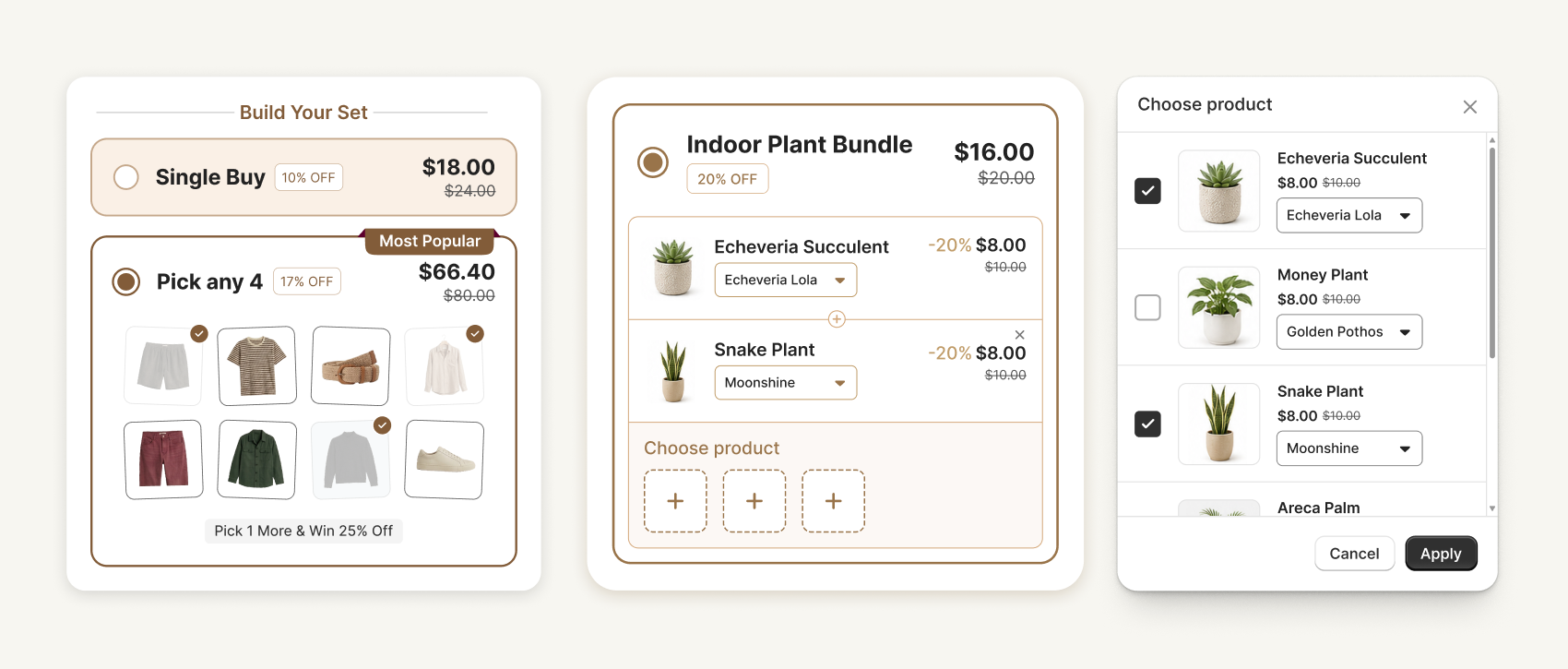
Pumper Bundles' Bundle & Save feature handles the pool definition, pick rules, and pricing model through a single "Choose Product" picker rather than opening the full catalog by default. For the full setup mechanics, including pricing math worked through with numbers, our dedicated guide to Shopify product bundling strategies covers that ground in more depth than this piece needs to.
Measuring Whether It's Really Your Highest-Converting Format
A build-your-own bundle can generate plenty of impressions and add-to-carts while still underperforming a simpler quantity break on the metric that matters: net revenue per visitor. Three numbers tell you more than raw conversion rate alone.
- Bundle completion rate: the share of shoppers who start selecting items and actually finish. A low rate against decent engagement usually points to the pool, the pick rule, or the pricing model, not a lack of interest in the mechanic itself.
- Bundle AOV versus single-item AOV in the same category, so you're comparing the format's real lift against what a shopper would likely have bought otherwise, not crediting every bundle order as pure incremental revenue.
- Repeat purchase rate among bundle buyers, who have been reported to show higher lifetime value than single-item buyers (vendor-published 2025 ecommerce bundling analysis; directional). That's the number that ultimately justifies the setup effort beyond a single order.
Track these three together, and it becomes clear whether the format is earning its place on your product pages, or just adding friction a simpler quantity break would avoid.
The Bottom Line
The build-your-own bundle format converts higher than fixed bundles and generic upsells for one structural reason: it's the only common bundle format where the shopper does part of the work, and that work is what creates the ownership premium the conversion data keeps pointing to. But the premium only shows up when the pool is genuinely curated and the pricing survives every combination a shopper could build. Get the mechanic right, and the format earns the "highest-converting" label the data suggests. Get the pool or the pricing wrong, and it's just a more complicated fixed bundle with a lower completion rate.
If your catalog has the kind of natural variety, flavors, scents, colorways, or component parts that makes a build-your-own format worth testing, Pumper Bundles' Bundle & Save feature handles the pool curation and pricing logic in one editor, backed by a 7-day free trial to test it against your own catalog before committing.
Want to set the best Shopify product bundles in your store? Try Pumper Bundles for free today!
Frequently Asked Questions
Is a build-your-own bundle always better than a fixed bundle?
Not always. A fixed bundle is faster to set up and works well when there's one obvious combination shoppers already want. Build-your-own tends to win when a catalog has genuine variety- flavors, scents, colorways- where no single fixed combination fits most shoppers.
How many products should be in the pool?
Six to ten items tends to work well for most catalogs. Fewer than six can feel restrictive; more than ten or so starts trading real choice for decision fatigue, particularly on mobile.
Does the discount need to be large to make the format work?
Large enough that assembling a bundle feels worthwhile compared to buying items individually, though the exact threshold depends on your margin and price points. A tiered structure, where a larger bundle unlocks a slightly better rate, tends to outperform one flat discount.
What's the single biggest mistake brands make with this format?
Treating the pool as a place to clear slow-moving inventory instead of a curated selection of what actually sells. It undermines the preference-fit that drives the format's conversion advantage in the first place.