



A costume without the mask that completes it.
A candle with no accent piece to sit next to it.
A single bag of candy when the shopper is buying for a whole office or a whole block of trick-or-treaters.
Halloween shopping is full of purchases that are obviously part of a set, even when the store sells them as unrelated, one-off line items.
Costumes, decorations, and candy pulled in $4.3 billion, $4.2 billion, and $3.9 billion respectively in 2025, together the large majority of that year's record $12.4 billion in total Halloween spending.
Every one of those three categories is built for pairing: a costume needs the piece that finishes it, a candle wants a matching accent, candy gets bought in batches for handing out rather than one piece at a time.
The gap isn't whether to bundle. Nearly every "Halloween marketing" roundup tells merchants to bundle. It's that "bundle your costumes" or "create a spooky gift set" names a category without saying what actually belongs in the box, what to charge for it, or how to tell a bundle shopper reaches for it apart from one that just looks like leftover stock wearing a bow.
This post works through 10 bundle concepts by category- costumes and accessories, treats and candy, beauty and home- along with the pricing and setup steps to get one live before October runs out. Let’s dive right in!
Key Takeaways
- Halloween spending reached a record $12.4 billion in 2025, split almost evenly across costumes ($4.3B), decorations ($4.2B), and candy ($3.9B) (NRF, 2025), all categories that pair naturally into a bundle.
- A bundle sells when the items inside it are actually complementary, and the combined price reads as a real discount, not when two unrelated products get Halloween packaging and a bow.
- A 15-20% combined discount off the individual item total is a reasonable starting range, but it needs to be checked against your actual margin, not chosen because it "feels seasonal."
- Pet-focused Halloween bundling is a comparatively underserved category worth testing if your catalog supports it.
- A tiered or limited-run bundle structure gives shoppers a self-selected spend level or a real deadline, without needing the countdown-timer mechanics covered in the sibling promotion-ideas post.
What Makes a Halloween Bundle Actually Sell
A themed bundle converts when the items inside it are complementary in a way the shopper would recognize on their own, and the combined price reads as a real discount. It underperforms, or worse, starts to look like a clearance dump, when two unrelated products just get Halloween packaging and a bundle label with no logic actually connecting them.
The test is simple: would a shopper who bought item A want item B too, independent of the discount?
A costume and the accessory that completes the character pass that test without effort. A candle and a coaster in a vaguely matching color scheme might not, unless the scent story or the look actually ties them together. If you can't say why these two specific items belong in the same box beyond "they're both orange," the pairing needs rethinking.
On pricing, a 15-20% combined discount off buying the items separately shows up consistently across general bundling guidance as a reasonable starting range, though treat it as a starting point to test against your own numbers, not a rule to follow blindly. The pricing and setup section below covers how to check that range against your actual margin before committing to it.
Costume and Accessory Bundles
Pairing a costume with the accessories a shopper would otherwise buy separately, or forget to buy at all, is the most natural Halloween bundle category, since the add-on completes the look the shopper is already building.
1. Costume + themed accessory bundle
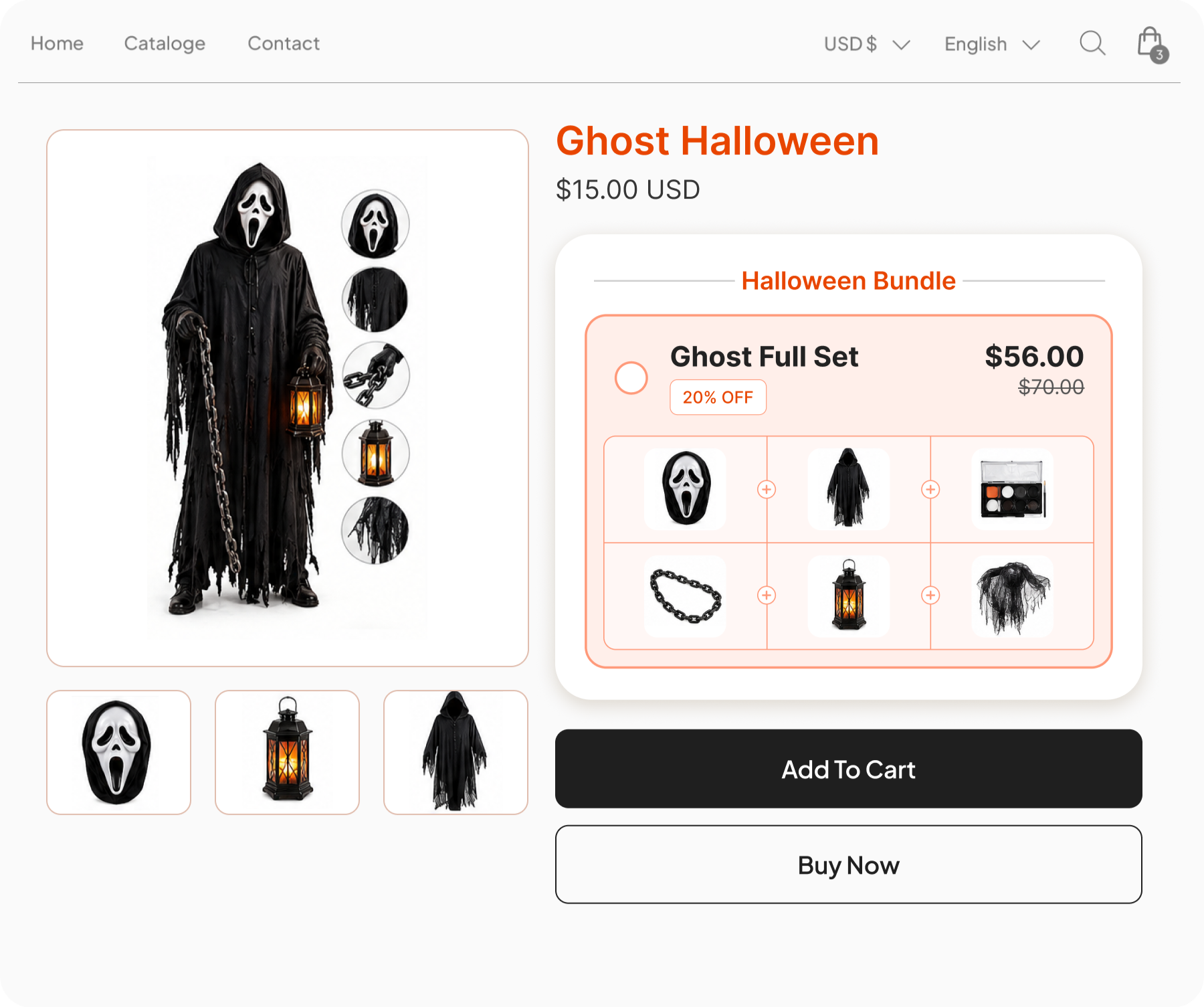
Pair a costume with the makeup, mask, or prop that completes the character, and frame the offer as "complete the look" rather than a generic percentage-off. This framing matters: a shopper who's already committed to a costume isn't being sold on a random accessory; they're being shown the piece that finishes what they started, which is an easier yes than an unrelated cross-sell would be.
Keep the accessory tied to the specific costume rather than a generic Halloween add-on that could pair with anything. A witch costume paired with a cauldron prop or a specific makeup palette looks curated; the same costume paired with a generic bag of plastic spiders looks like inventory clearance wearing a bundle's clothing.
2. Group or family costume bundle
Matching or coordinated costumes bundled at a per-person discount target the household-participation side of Halloween shopping, where one adult is often buying for three or four people at once, not just themselves. This format matches how the purchase actually happens: nobody buys one costume for a family of four across four separate sessions if a coordinated set is available and priced to reward buying the whole group together.
Structure the discount per additional person rather than as one flat bundle price, so a family of three and a family of five both get a proportional deal instead of the smaller group subsidizing a price built around a bigger one.
Treat and Candy Bundles
Candy and treat categories bundle well because the purchase is often for gifting or group distribution, where a curated assortment beats picking single items one at a time.
3. Gourmet or artisan treat box
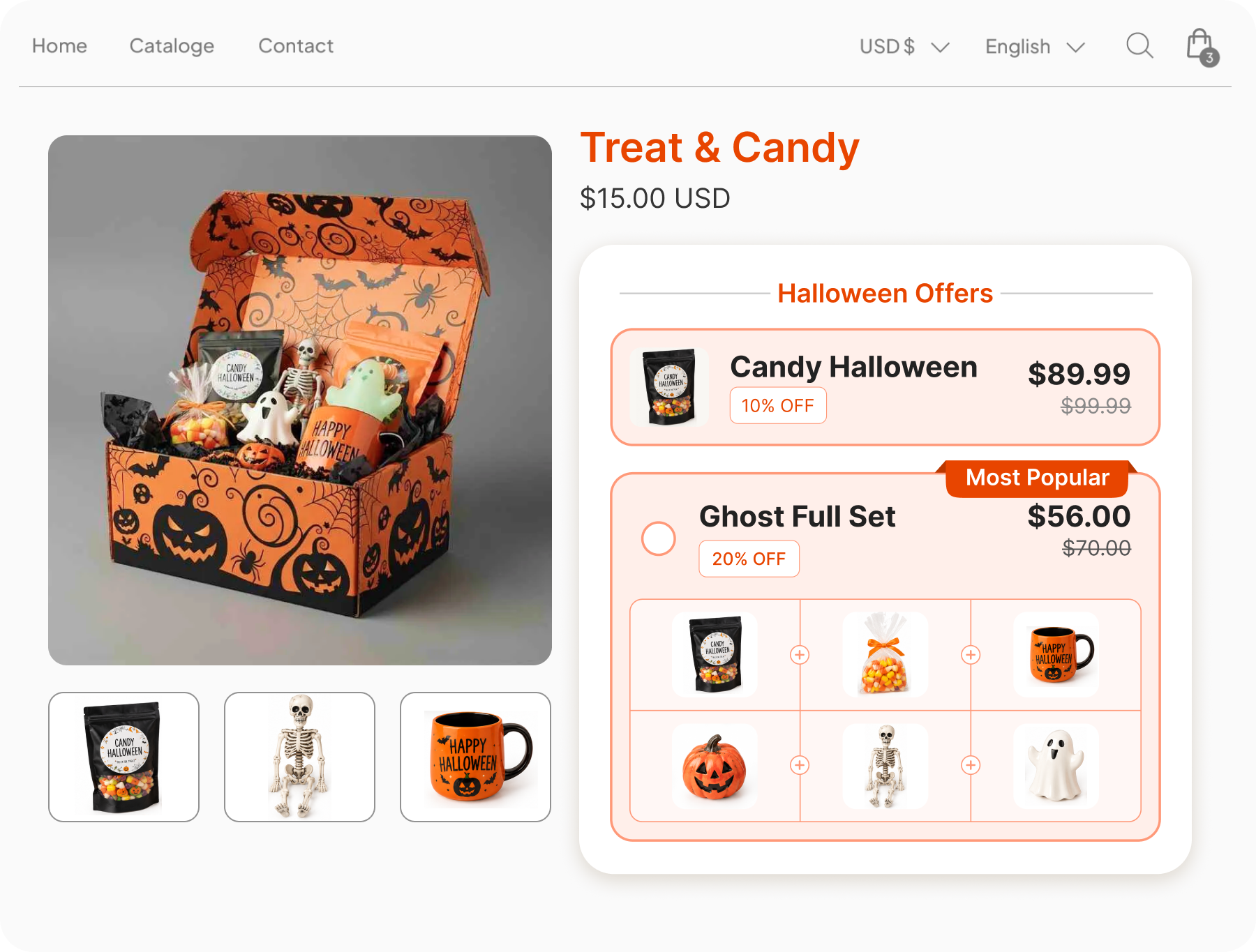
A curated assortment in Halloween packaging, positioned as a gift rather than a self-purchase, removes the decision fatigue of picking individual treats one by one. The bundle itself is close to the whole value proposition here: a shopper buying a gift wants a finished, presentable item, not a shopping list they have to assemble themselves.
NRF's 2025 survey put candy spending at $3.9 billion, one of the three largest Halloween categories, and found that 67% of households plan to hand out candy, the most common Halloween activity of all. That's a large base of shoppers buying candy specifically for group distribution, exactly the use case a curated assortment box is built for, rather than a single self-purchase.
4. Pet Halloween treat and costume bundle
Pairing a pet costume with themed pet treats is a category with real room to grow, since pet-specific Halloween bundling is comparatively underserved by most brands next to the human-facing costume and candy categories. If your catalog includes pet products at all, this is worth testing even as a small, limited-run offer, since the competitive bar for a well-curated pet bundle is lower than in more crowded categories.
Beauty and Home Bundles
Beauty and home categories benefit from a "seasonal edition" framing: bundling a fall or spooky-themed variant with a bestselling core product, rather than launching an entirely new SKU that has to earn its own audience from zero.
5. "Spooky glow" beauty set
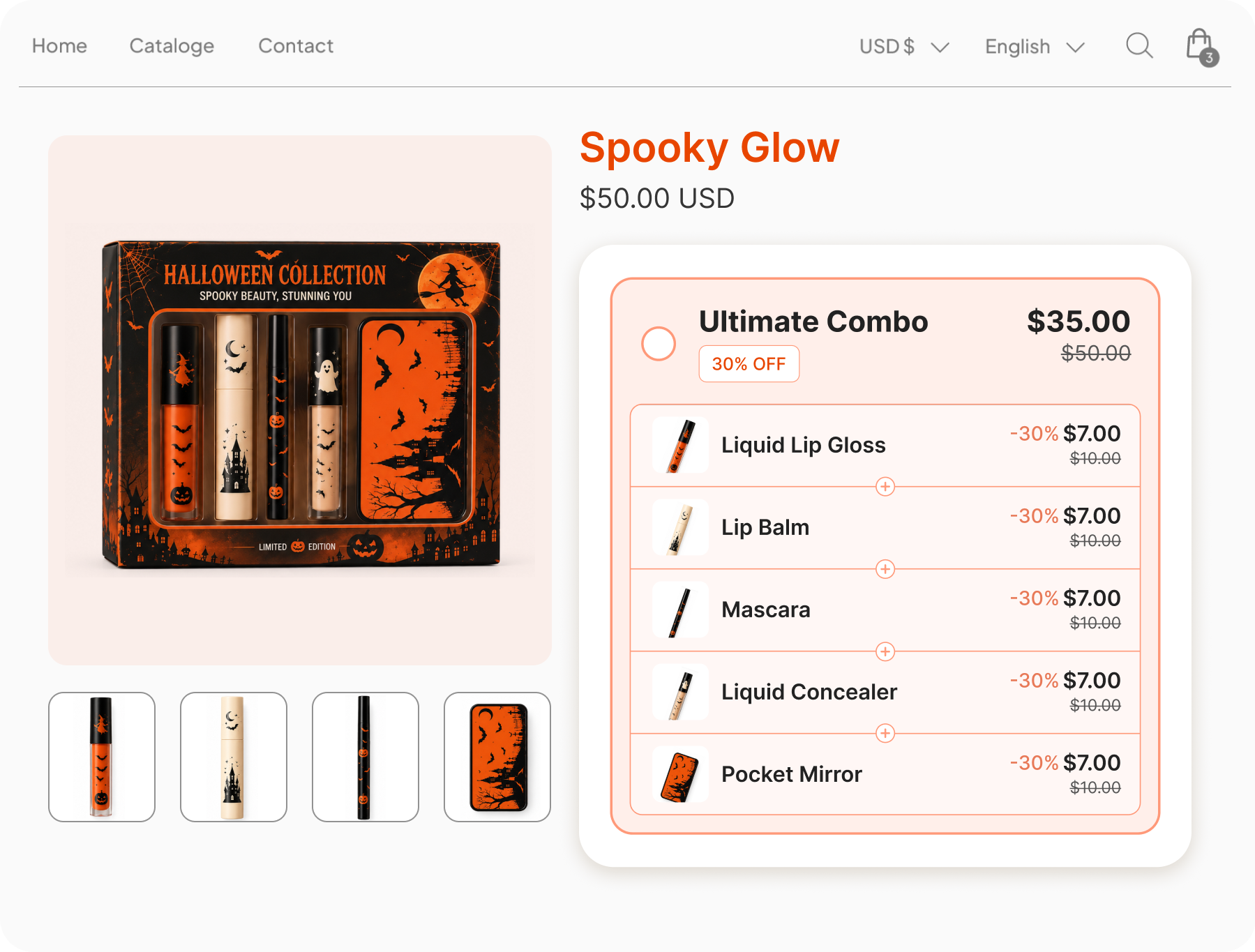
A themed variant or limited packaging of an existing bestseller, bundled with an actually complementary second item, works better than pairing any two skincare products under a Halloween label. The seasonal framing gives an existing bestseller a reason to feel new without the cost and risk of developing a whole new product, and the second item still needs to pass the test from the "what makes a bundle sell" section above: does it belong with the first product, or is it just riding along?
6. Halloween décor kit
A candle, throw, and small accent piece bundled as a quick-decorate set targets the shopper who wants a Halloween look at home without individually sourcing three separate items from three separate product pages. This format sells the outcome, a decorated room, rather than the individual products, which is a meaningfully different pitch than "here are three things, buy them together and save."
7. Candle brand mini-bundle
A votive-sized or trial-sized multi-scent set is a pattern candle brands use seasonally to let shoppers try more scents at a lower per-unit commitment than buying several full-size candles at once. This works particularly well for Halloween specifically, since a seasonal scent (pumpkin, spiced apple, black amber) is often a shopper's first exposure to a scent they haven't tried in full size before, and a lower-commitment mini format removes the risk of committing to a full-size candle they're not sure about yet.
8. Mix-and-match "pick your treats" bundle
Letting shoppers choose from a curated pool rather than locking them into a fixed set works well when your catalog has real variety to offer- multiple flavors, colors, or scents a shopper would reasonably want to choose between rather than accept a predetermined assortment. This format needs a deeper product pool than a simple two-item bundle to feel worth the extra selection step, so it fits brands with real catalog depth in the relevant category better than a two- or three-SKU shop.
9. Tiered Halloween bundle (small, medium, large)
Three price points of the same bundle concept let shoppers self-select their spend level rather than forcing an all-or-nothing purchase decision. A shopper who wants a lighter, cheaper version of the bundle and one who wants the full set are both accommodated, instead of the smaller-budget shopper abandoning the cart because the only option available was more than they wanted to spend.
10. Limited-run seasonal bundle with a hard end date
Framing a bundle as available only through Halloween gives it a real reason for urgency without leaning on the countdown-timer mechanics covered in the sibling promotion-ideas post, since the bundle itself, not a marketing overlay on top of it, is what's actually disappearing after the season ends. This works especially well when the bundle uses seasonal packaging or a limited scent or flavor that won't come back until next year, since the scarcity is real rather than an artificial deadline layered onto an otherwise permanent product.
Pricing and Setting Up a Halloween Bundle on Shopify
Price the bundle off your actual margin, the same discipline that applies to any bundle regardless of season, not a round number picked because it "feels seasonal." A 15-20% discount that looks reasonable on paper can still erode your profit if the items inside the bundle already carry a thin margin individually, so run the numbers before committing to a specific percentage.
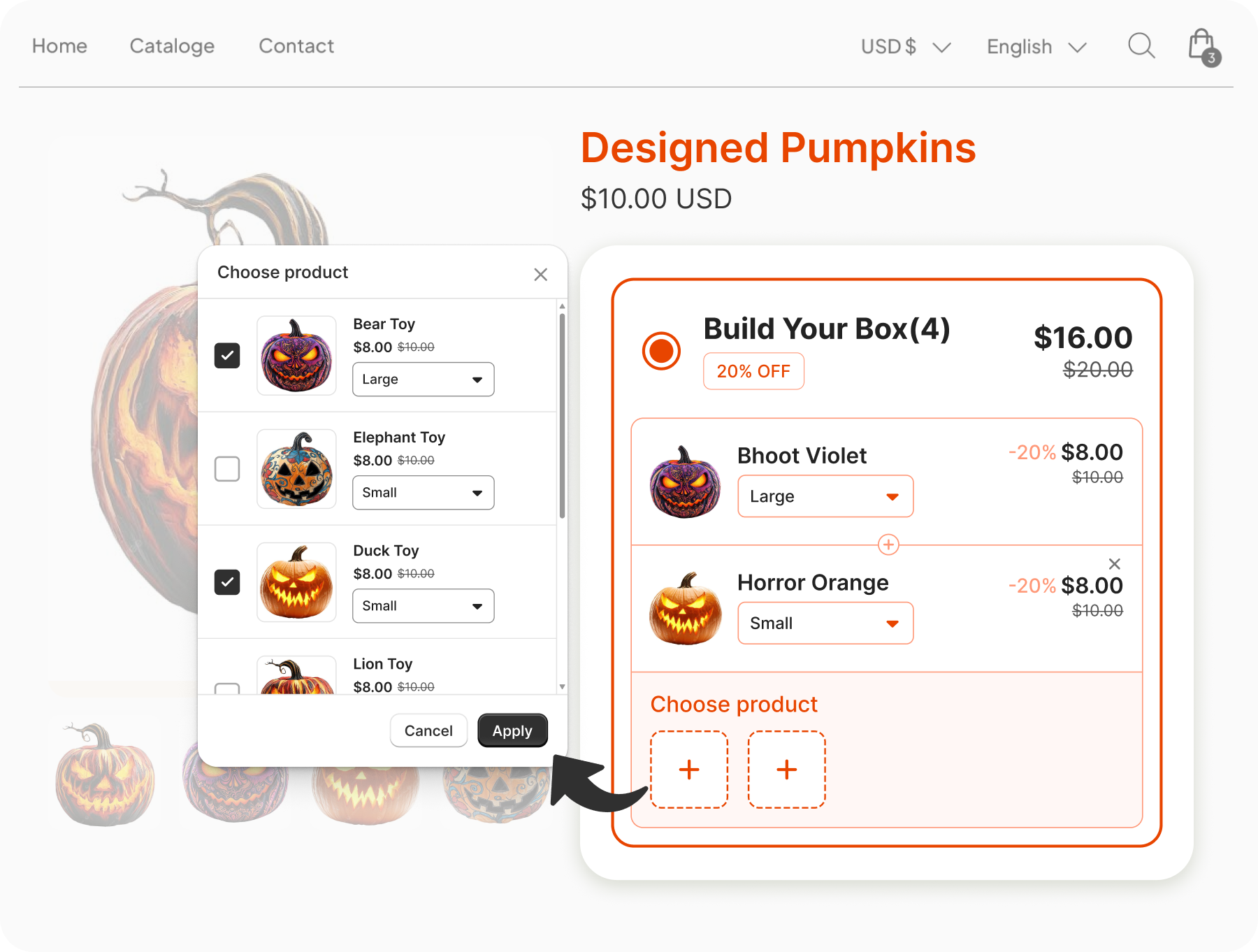
Whichever of these 10 concepts you build, price it the way you'd price any bundle: start from your actual gross margin per item, not your list price, and confirm the combined bundle price still leaves you with a healthy total gross profit once you account for what each item costs to produce, package, and ship together. The margin-math approach in pricing your discount tiers without losing margin was built for a same-product quantity break, but the underlying discipline, checking total gross profit at the bundle level rather than trusting a percentage that "looks right," applies just as directly to a mixed-SKU Halloween bundle.
For the mechanics of actually building a mix-and-match or build-your-own bundle widget on Shopify, curating the product pool, choosing between a fixed and itemized price, and setting up the Theme App Extension itself, our full guide to Mix & Match Bundles covers the complete setup process this post doesn't repeat.
|
Your Halloween Bundle Put the right products together. Give shoppers a reason to buy the set. Build fixed, mix-and-match, or seasonal bundles around the products your customers already buy together. Try Pumper Free Build a Bundle → 2 min setup · No code required · Free plan |
Frequently Asked Questions
What should I put in a Halloween bundle?
Items within one of the category patterns above that actually belong together: a costume with the accessory that completes it, a candle with a scent-matched accent piece, a curated candy assortment for gifting, rather than any two products that happen to both carry Halloween packaging. If you can't explain why the two items belong together beyond the shared holiday theme, reconsider the pairing.
How much should I discount a Halloween bundle?
There's no universal number. A 15-20% combined-discount starting range shows up consistently across general bundling guidance, but check it against your real margin before committing: a discount that looks reasonable can still erode profit if the individual items already carry a thin margin on their own.
How do I set up a Halloween bundle on Shopify?
The short version: curate a tight product pool, decide between a fixed bundle price or an itemized discount, and publish the offer through a Theme App Extension so it renders directly on the product page. Our full Mix & Match Bundles guide walks through the complete setup process, including curation strategy and common setup mistakes.
Should a Halloween bundle be a fixed set or let shoppers choose?
It depends on your catalog depth. A fixed set works well when you have a small number of complementary items and want to control the exact pairing (Idea 1's costume-and-accessory set, for example). Letting shoppers choose- Idea 8's mix-and-match format- works better when your catalog has real variety in flavors, colors, or scents a shopper would reasonably want to pick between rather than accept a predetermined set.
Building the Bundle That Actually Earns Its Bow
The strongest Halloween bundles pair items that belong together within a category, a costume with its accessory, a candle with a scent-matched accent, a curated treat assortment, priced against your real margin rather than a round seasonal number. Costumes, decorations, and candy drove the large majority of 2025's record $13.1 billion in Halloween spending, and all three categories support the bundle formats covered here.
|
Make It a Bundle Pair the products shoppers already want together. Build your Halloween bundle, set your pricing, and give shoppers a simpler way to buy the complete set. Try Pumper Free Build Your Bundle → 2 min setup · No code required · Free plan |