



You've probably seen a store go from "buy 2, get 10% off" to "buy 2, get 25% off" in the space of one bad quarter. Sales don't move the way anyone hoped, so someone decides the tier just isn't deep enough yet. Six months later, the store is discounting a quarter of its revenue away, and nobody can say for sure whether it's actually working.
Quantity break pricing doesn't have to go that way. The whole point of a quantity break, buy more units of the same product, pay a little less per unit, is that it rewards a shopper for doing something you already wanted them to do. It doesn't need to be a steep discount to work. In most cases, it shouldn't be.
This guide is narrowly about that one lever: how to price the tiers on a same-product quantity break so they lift your average order value without quietly eating your margin. You won't find bundles, BOGO, or gift-with-purchase tactics here. Just the pricing mechanics behind the single most common Shopify AOV tool, and how to get the discount depth right.
Let’s dive right in!
Key Takeaways
- A quantity break only needs to be a few percentage points deep to change buying behavior; the tier's visibility and framing usually matter more than how steep the discount is.
- Deeper isn't always more convincing. Academic pricing research has found that as discount depth increases, shoppers can start reading the discount as a signal about product quality, not just a better deal.
- Price your tiers off your actual marginal cost per additional unit, not a percentage that "feels right" or matches a competitor.
- A well-placed second tier, not a maxed-out third or fourth one, usually does most of the AOV work; extra tiers add clutter faster than they add revenue.
- Revisit tier depth on a schedule, not just when a sale underperforms. Landed costs shift quietly, and a tier priced correctly in January can be underpriced by the time your shipping costs change in Q3.
What Counts as a Quantity Break (and What Doesn't)
A quantity break, sometimes called a quantity discount or volume tier, reduces the per-unit price of the same product as the shopper adds more units to their cart. Buy 1 at full price, buy 2 and each unit costs a little less, buy 3 and it drops a little further. That's the entire mechanic.
A quantity break is not a buy-one-get-one offer, which changes the structure of the deal rather than the per-unit price. It's not a mix-and-match bundle, which discounts a combination of different products. It's not a free-gift threshold, which adds a separate item instead of lowering the price of what's already in the cart.
Those are all legitimate AOV tools, and each has its own pricing logic. But none of them behave like a quantity break, and folding them in here would blur the one question this guide is trying to answer clearly: how deep should a same-product quantity tier actually go?
Why "Deeper Discount" Isn't the Same as "Better Discount"
The instinct to make a tier deeper when it underperforms is understandable, but it skips a step. Before assuming the discount isn't big enough, it's worth asking whether the shopper even noticed it, and whether a bigger number would change their decision at all.
The Discount Depth Research Doesn't Say "More Is Better"
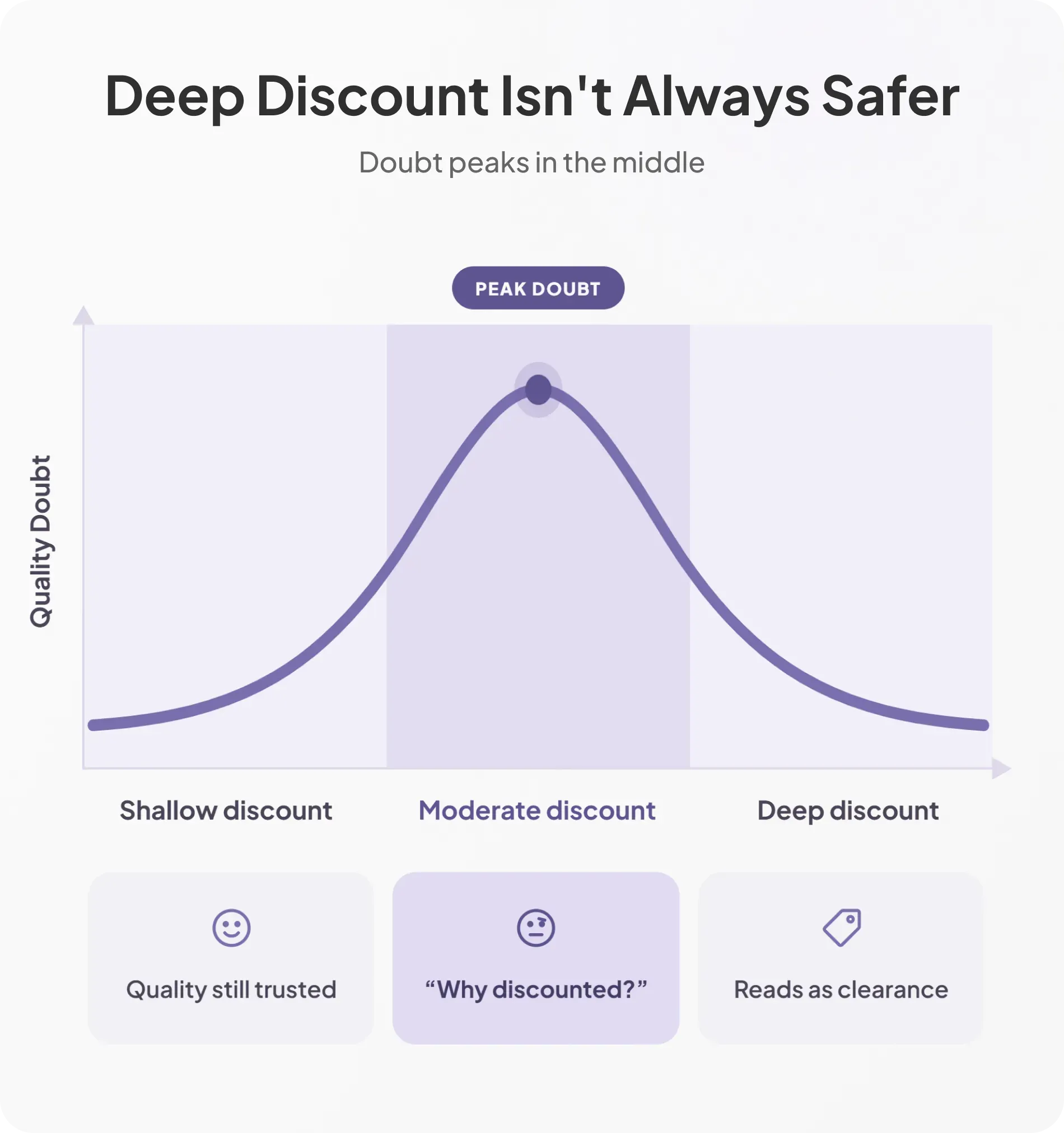
A retail pricing study published in the Journal of Retailing found an inverted-U relationship between discount depth and how uncertain shoppers feel about product quality.
As discounts move from shallow to moderate, quality uncertainty tends to rise; shoppers start wondering why the price dropped. It's only once a discount gets quite deep that uncertainty falls again, typically because the size of the markdown gets read as a clearance signal rather than a quality concern.
For most everyday quantity-break scenarios, that middle zone sits in an awkward spot. It's deep enough to matter but not deep enough to look like clearance. That's exactly where a lot of merchants land by accident, and it's the zone most likely to raise doubt rather than lower it.
A related 2025 study in the Journal of Consumer Behaviour found that how much a discount helps depends on the type of product. Pulling back on discount depth tended to lift purchase intent more for hedonic, want-driven products. Pulling back on discount frequency mattered more for practical, need-driven ones instead.
The practical read for a quantity break: a shallow, consistently available tier can outperform a deep one that shows up inconsistently, especially for considered, non-impulse products.
The Tier Ladder Does More Persuading Than the Percentage Does
Behavioral pricing researchers have documented what's often called the decoy or asymmetric dominance effect since it was first identified by Duke University's Joel Huber, John Payne, and Christopher Puto in a 1982 Journal of Consumer Research study.
Their finding: adding a third option to a two-option choice can shift preference toward one of the original two, even when the third option isn't chosen. Applied to a quantity break, this is the reason a well-built three-tier ladder (1, 2, 3 units) tends to outperform a single "buy 2, save X%" offer standing alone. The presence of the third, less-clearly-worth-it tier makes the middle one look like the obviously smart choice, independent of exactly how big its discount is.
This matters directly for the "no heavy discounting" goal. A lot of the lift attributed to a deep discount is really coming from the comparison structure, three visible price points instead of one, not from the size of the percentage itself. Get the ladder right, and you can often get away with a noticeably shallower tier 2 than you'd guess.
Pricing Your Quantity Tiers Off Marginal Cost, Not a Round Number
This is the part that actually determines whether a shallow discount is doing its job or just leaving revenue on the table.
Start From What the Second and Third Unit Actually Cost You
Your first unit carries your full fixed and variable cost. Your second and third units, in the same order, often cost you less to deliver, because you're not paying a second pick-and-pack fee, a second box, or a second shipping label. That gap between the true marginal cost of unit 2 and the price you're charging for unit 1 is the room you have to work with before a quantity break tier touches your actual profit.
Running the Numbers on a Marginal-Cost Ladder
Say you sell a $22 bag of coffee with a 58% gross margin at full price, meaning it costs you roughly $9.24 to produce, roast, and ship, leaving $12.76 in gross profit on a single-unit order.
Your fulfillment cost per additional unit in the same box is meaningfully lower than your per-unit cost on a standalone order, since you're not paying a second shipping label or a second packaging run. Say that marginal cost per additional bag, once it's riding along in an order that's already shipping, is closer to $7.40 instead of $9.24.
Tier | Price per unit | Total price | Marginal cost per unit | Gross profit per unit | Total gross profit |
1 bag | $22.00 | $22.00 | $9.24 | $12.76 | $12.76 |
2 bags | $20.90 (5% off) | $41.80 | $7.40 | $13.50 | $25.26 |
3 bags | $19.80 (10% off) | $59.40 | $7.40 | $12.40 | $35.36 |
Look at what happens at tier 2: a 5% discount, genuinely shallow, still produces a higher gross profit per unit than the full-price single bag, because the marginal cost of that second bag is lower than what it costs to fulfill a standalone order.
The discount isn't really costing you profit at that tier, it's costing you less than fulfilling the order would have cost anyway. Tier 3 at 10% off starts to trade a bit of per-unit profit for order size, but total gross profit for the order still climbs well past what a single-bag order would have generated.
This is the check every quantity break tier needs to pass: does the marginal cost of the additional unit justify the discount you're offering on it, or are you discounting units that cost you just as much to deliver as the first one?
If your fulfillment cost doesn't actually drop on a multi-unit order (a low-and-bulky item shipped in separate boxes, for instance), you don't have the same room to work with, and your tiers need to stay shallower still.
A Reasonable Starting Depth
For products where a second unit genuinely costs less to fulfill, a starting range of 5-8% off at tier 2 and 10-15% off at tier 3 tends to be enough to register as "a deal" without reading as a clearance signal or eating meaningfully into per-order profit.
Products with thinner margins to begin with (sub-40% gross margin) should lean toward the bottom of that range, or consider whether a quantity break is the right lever at all versus one that doesn't touch unit price.
|
Your margin maths deserves to reach the product page unrounded. Pumper Bundles takes exact figures. Start for Free Explore Pumper Bundles 2 min setup · No code required · Free plan |
Making a Shallow Discount Feel Bigger Than It Is
A 6% discount and a 25% discount can produce a similar change in behavior if the smaller one is framed and placed well. None of this requires touching the tier's actual price.
Show the Dollar Savings, Not Just the Percentage
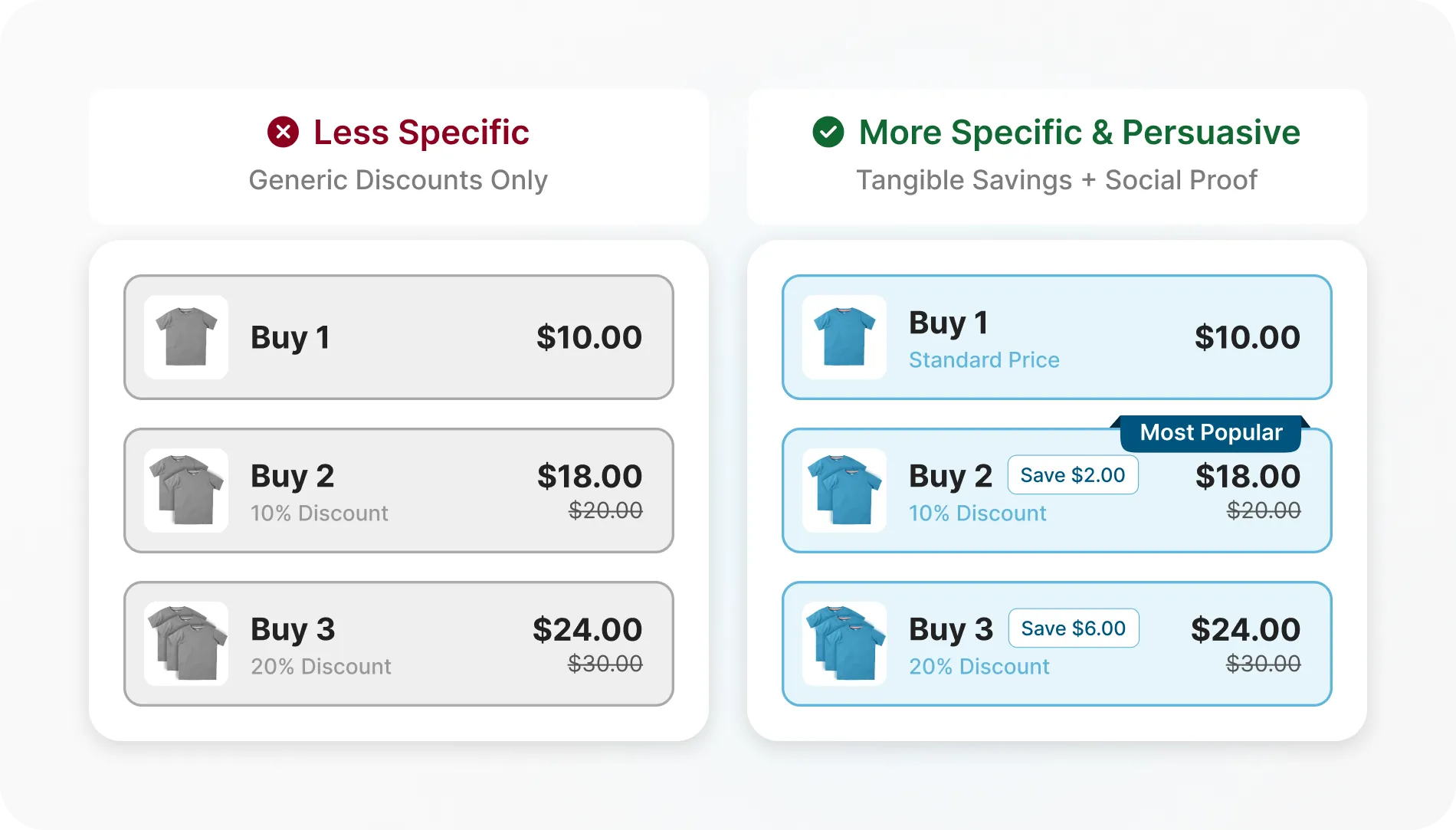
"Save $2.10" often reads as more concrete than "5% off," particularly on lower-priced items where a percentage can look trivial even when the underlying saving is real. Test both framings on the same tier before assuming the percentage version is doing its job.
Anchor the Ladder Around the Middle Tier
Per the tier-ladder research above, the tier you most want chosen should sit in the middle of a three-tier layout, not at either end. A "most popular" or "best value" label on that middle tier reinforces the same comparison effect the ladder is already creating, without adding a single point of extra discount.
Let a Modest Tier Ride on a Real Threshold
If your store has a free-shipping minimum, check whether your tier 2 price crosses it. A shopper who adds a second unit and unlocks free shipping in the same click is getting two reasons to convert from one shallow discount, and the second reason (removing a shipping line item) didn't cost you anything beyond what free shipping already costs you on orders that cross that line regardless.
Don't Undercut the Framing With Loud Discount Language
"Buy 2, Save 5%" in the same visual weight as a 50%-off clearance banner elsewhere on the page reads as a weak offer by comparison, even if 5% is exactly the right number for your margin. Keep quantity-break tier language modest and specific rather than trying to compete visually with deeper, unrelated promotions running on the same page.
Configuring the Tier Itself on Shopify
This section is specifically about the quantity-break configuration decisions that affect pricing, not general app setup:
- Set the discount as a fixed price or a percentage, not both inconsistently across tiers. Mixing the two makes your own math harder to audit later and makes the widget's savings copy inconsistent between tiers.
- Decide your minimum and maximum quantity per tier deliberately. A tier with no upper bound can let a bulk buyer trigger a discount depth you never actually modeled, especially on a lower-margin product.
- Place the widget above the variant picker, not below it, so the tier comparison is visible before the shopper commits to a single-unit purchase, not after.
- Keep tier copy specific to quantity. "Buy 2, Save $2.20" tells the shopper exactly what to expect. Generic copy like "Save More!" forces them to do the math themselves, which is exactly the friction a well-priced shallow tier is supposed to remove.
- Check whether the tier is set to combine with sitewide discount codes. A shallow, carefully-priced 6% tier stacked underneath an unrelated 20%-off sale code produces a combined discount you didn't model and may not want running simultaneously.
When a Third Tier Isn't Worth Adding
Not every product needs three tiers, and a tier that exists but rarely gets chosen is adding visual clutter without adding revenue. Before adding a third quantity tier, check whether your second tier's take rate (the share of purchasers who choose it over the single-unit option) is already reasonably healthy. If it isn't, a third tier usually won't fix that; it just gives the shopper one more option to skim past.
A third tier tends to earn its place when the product is genuinely bought in bulk by a meaningful share of customers already, a six-pack of a low-cost consumable, a multi-month supply of something used daily, rather than being added by default because "three tiers looks more complete than two."
If you do add one, hold it to the same marginal-cost test as tier 2: the discount should still be justified by what that additional unit actually costs you to fulfill.
|
Publish two tiers, read the take rate, then decide on the third. Pumper Bundles does not make you rebuild. Start for Free Explore Pumper Bundles 2 min setup · No code required · Free plan |
How to Tell If Your Shallow Tier Is Actually Working
AOV moving up isn't proof the tier pricing is right. It's possible for AOV to climb while gross profit per order barely moves, if the tier's discount depth was set too deep relative to what the second or third unit actually costs to fulfill.
Two numbers matter more than AOV alone here:
- Tier 2 take rate relative to tier 3. If tier 2 is doing most of the work and tier 3 barely gets chosen, that's a signal your ladder is fine as a two-tier structure, and a third tier may just be added complexity.
- Gross profit per order at each tier, checked against your actual marginal cost, not your assumed one. This is the number that tells you whether a shallow discount is genuinely cheap to offer or whether your fulfillment cost assumptions were optimistic.
Most dedicated quantity-break tools, including Pumper Bundles, break these down per offer so you're not reconstructing take rate and order value manually from a Shopify export every time you want to check whether a tier is still priced correctly.
|
Pumper Bundles tracks take rate and extra revenue per tier, so a tier that stops earning shows up early. Start for Free Explore Pumper Bundles 2 min setup · No code required · Free plan |
Revisiting Your Tier Depth Over Time
A quantity break tier isn't a set-and-forget decision. Three things are worth checking regularly, not just when performance looks off:
1. Your landed cost per unit. If your supplier, freight, or packaging costs shift, the marginal-cost math behind your tier depth shifts with it, even if nothing about your storefront changed.
2. Your tier 2 versus tier 3 take rate. A gradual shift in which tier shoppers actually choose is a better signal than a single week of underperformance, and it's worth checking quarterly rather than reacting to short-term noise.
3. Whether a shallow tier is still shallow relative to what shoppers are used to seeing. If competitors in your category have drifted toward deeper standard discounts, a tier that felt adequately persuasive a year ago may need a modest adjustment to stay visible against that backdrop, without necessarily needing to match their depth.
Summing Up!
A quantity break doesn't need to be deep to work. It needs to be visible, framed against a real comparison, and priced against what the additional unit actually costs you, not a percentage that felt persuasive in the moment. Get those three things right, and a 5-10% tier will often do more for your margin than a 25% tier that looked more exciting to set up.
Start with the marginal-cost math from this guide on one product, set a shallow tier 2, and give it a full sales cycle before deciding whether it needs to go deeper. If you want the tier configuration and per-offer analytics handled in one place rather than pieced together from a spreadsheet, [Pumper Bundles' Buy More Save More feature](https://pumper.run/features/volume-discount/) is built specifically for this, backed by a 7-day free trial to test the math from this guide against your own numbers.
Set up your first Shopify quantity break!
Frequently Asked Questions
Is a 5% quantity break actually enough to change buying behavior?
Often, yes, particularly when it's presented as part of a visible tier comparison rather than standing alone. The ladder structure itself, seeing three price points side by side, does a meaningful share of the persuading; the discount only needs to be large enough to look like a real, specific saving rather than a rounding error.
Should the first tier (single unit) ever carry a discount?
Generally no. The single-unit price is the anchor the rest of the ladder is compared against. Discounting it removes the reference point that makes tier 2 and tier 3 look like a good deal by comparison, and it discounts every purchase, including the ones that were never going to be multi-unit to begin with.
How do I know if my tier is too shallow to notice?
Check whether shoppers who view the product page are engaging with the tier widget at all, not just whether they're purchasing at tier 2 or 3. If engagement is low, the issue may be visibility or copy clarity rather than discount depth, and deepening the discount won't fix a tier nobody is reading.
Does quantity break pricing work for low-margin products?
It can, but the room to work with is smaller. If your marginal cost on a second unit is close to your marginal cost on the first (no meaningful shipping or packaging savings from combining units), a quantity break has less room to be shallow, and it's worth checking whether the math still produces a positive gross profit at your intended tier before publishing it.
How often should I re-check my tier pricing?
Quarterly is a reasonable default for most physical product stores, or sooner if your supplier costs, shipping rates, or packaging change materially. Treat it the same way you'd treat any other cost-dependent pricing decision, not a one-time setup step.