



You already know a 20% off code doesn't land the same way with everyone who sees it. A first-time visitor comparing you against three other stores reads it as a reason to trust you. A loyal customer who's ordered from you five times reads the same code as a reminder that you never gave them one before. Same discount, same percentage, two completely different reactions.
Most merchants pick one promotion type, run it storewide, and hope it works evenly across a customer base that isn't actually one audience. It rarely is. A gift shopper, a bulk-buying regular, and a browser who just found you through a Google search are driven by different psychological triggers, and they respond to different offer mechanics for different reasons.
This guide walks through the psychology behind why certain promotions work on certain people, and gives you a practical way to match offer type to customer instead of running one generic promotion and hoping it lands.
Key Takeaways
- The same discount can motivate one customer and undervalue another, depending on where they are in their relationship with your store.
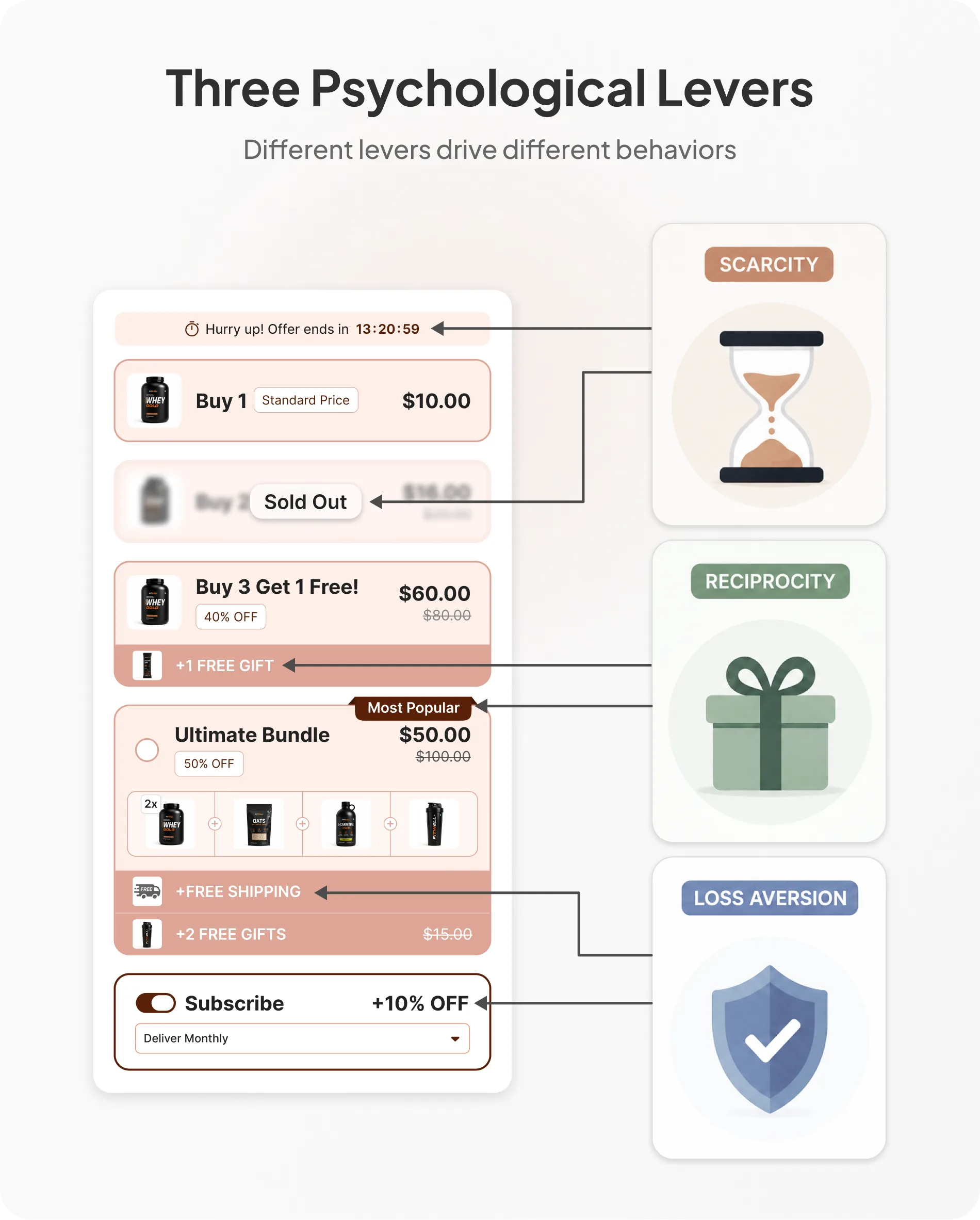
- Three psychological drivers explain most of why promotions work: reciprocity (a free gift creates a sense of obligation), loss aversion (losing a deal you already have feels worse than never having it), and scarcity (a closing window increases perceived value).
- Different offer mechanics lean on different drivers. A free gift threshold leans on reciprocity; a subscribe-and-save discount leans on loss aversion once it's active; a post-purchase upsell leans on momentum right after a "yes."
- Matching offer type to customer segment beats running one promotion storewide, because the psychological trigger that moves a first-time visitor often isn't the one that moves a repeat buyer.
- Track which offer type each segment actually responds to, not just whether a promotion "worked" in aggregate, since a storewide average can hide a mechanic that's working well for one group and doing nothing for another.
Why the Same Promotion Doesn't Work on Every Customer
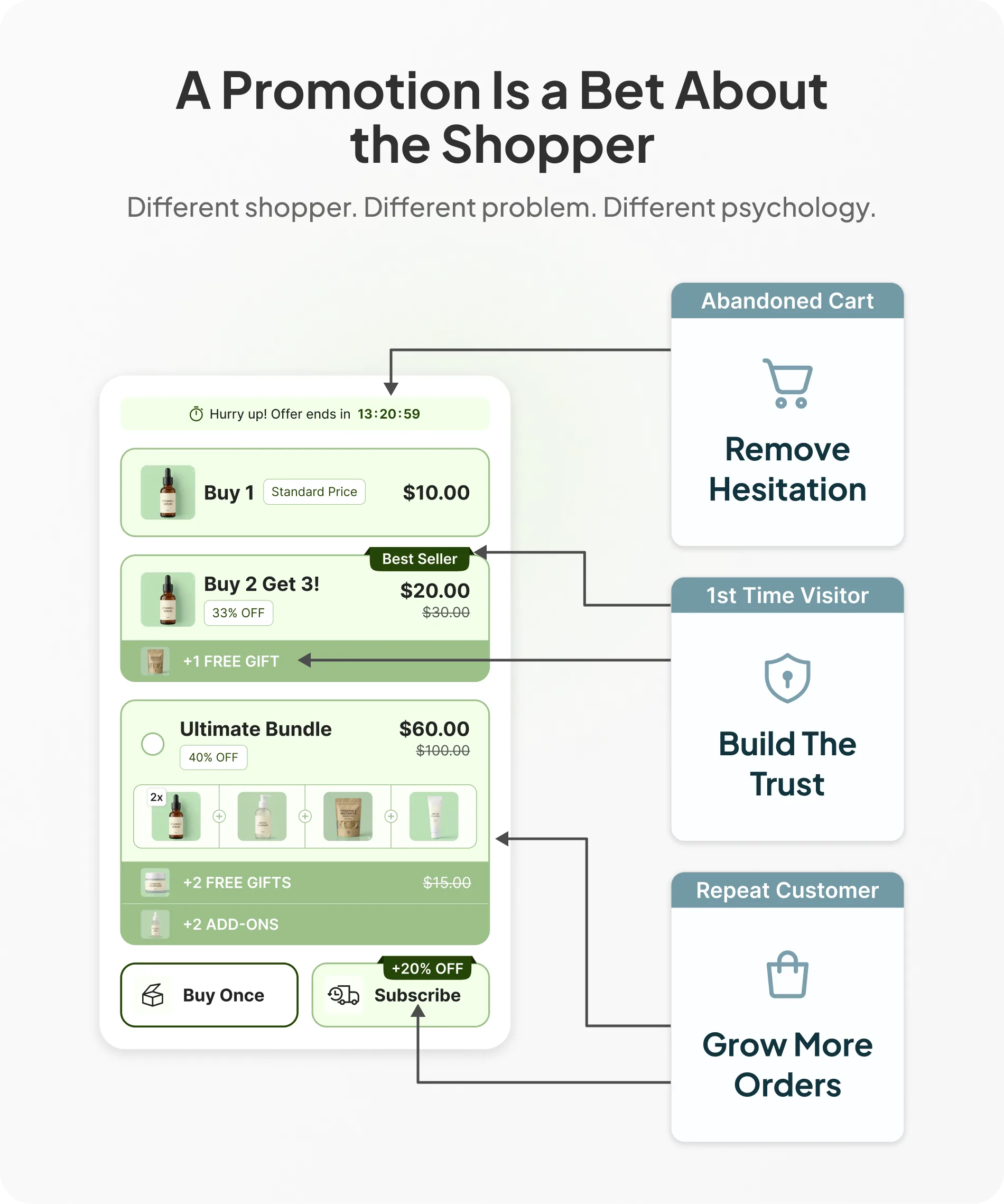
A promotion is really a bet about what a specific shopper needs to feel confident enough to buy. A first-time visitor needs a reason to trust an unfamiliar store. A repeat customer already trusts you; they need a reason this particular order should be bigger than usual. A shopper who abandoned a cart yesterday needs something different again, usually a nudge that addresses whatever made them hesitate in the first place.
Running the same promotion at all three treats a trust problem, a size problem, and a hesitation problem as if they were the same problem. They aren't, and the psychological lever that resolves one rarely resolves the others.
The Three Psychological Drivers Behind Most Promotions
Almost every promotion type, once you strip away the specific mechanic, is leaning on one of a small number of well-documented psychological drivers. Understanding which one a given offer type activates makes it much easier to predict who it'll actually work on.
1. Reciprocity: Give First, Get a Response
Reciprocity is the tendency to feel obligated to return a favor once one has been given to you, and it's one of the more consistently replicated findings in social psychology.
A well-known field study at a restaurant measured this directly: in the study's first experiment, average tips rose from 15.06% with no candy to 17.84% when servers gave diners a piece of candy along with the check, an 18% relative increase, purely from the unprompted gift. Nothing about the meal changed. Only the sense that something had been given first.
A free-gift-with-purchase threshold works on the same principle. The shopper hasn't earned a discount through negotiation; they've been given something unprompted once they crossed a spend line, and that framing tends to land differently than a straightforward percentage off the same dollar amount would.
2. Loss Aversion: Losing Feels Worse Than Never Having
Loss aversion, a core finding from Daniel Kahneman and Amos Tversky's prospect theory, describes how losing something tends to register more strongly than gaining an equivalent amount.
Once a shopper has something, whether it's a cart full of items or an active subscription discount, the prospect of losing it carries more psychological weight. Gaining that same thing in the first place never carried that weight to begin with.
This is why a subscribe-and-save discount usually gets stickier once it's active. The comparison a subscriber makes at renewal isn't "should I start saving money" it's "am I willing to give up the discount I already have," and those two framings pull in different directions even though the dollar amount is identical.
3. Scarcity: A Closing Window Raises Perceived Value
Scarcity, whether framed around time, stock, or availability, generally increases how valuable an offer feels, independent of any change in the offer itself. Industry-reported figures suggest meaningful conversion lifts from time-limited framing, though the exact size of the effect varies by category and methodology and should be treated as directional rather than a fixed number to expect on any given store.
A post-purchase upsell borrows a version of this. It isn't usually framed around a countdown timer, but it does use a real, structural closing window: the offer is only available in the moment right after checkout, before the shopper leaves the confirmation page. That's genuine scarcity, not manufactured urgency, and it's part of why the mechanic converts at a meaningfully higher rate than a follow-up email asking the same question a day later.
Matching Offer Type to Customer Segment
Once you know which psychological driver a promotion type leans on, matching it to a customer segment becomes a more deliberate decision than a guess.
Customer segment | What they need | Offer mechanic that fits | Psychological driver |
First-time visitor, price-comparing | A reason to trust an unfamiliar store | Threshold-based free gift | Reciprocity |
Repeat customer, buys the same product regularly | A reason to size up this specific order | Quantity break (Buy More Save More) | Anchoring against their own usual order size |
Gift shopper, buying for someone else | Confidence the gift feels complete and considered | Mix and match bundle | Preference fit and perceived personalization |
Shopper who just completed checkout | A relevant next step while momentum is still high | Post-purchase upsell | Structural scarcity (the moment closes) |
Subscriber or repeat-cycle buyer | A reason not to lapse | Subscribe & save | Loss aversion on an active discount |
Shopper comparing two similar products | A clear reason to pick the higher-value option | BOGO | Comparison framing (a visible second option makes the deal concrete) |
Also Read: Shopify Product Bundling Strategies That Actually Increase Revenue
This mapping is a starting point. A gift shopper might respond well to a free gift threshold too, since gifting itself has a reciprocity dimension to it. The point isn't that each segment has exactly one correct mechanic. It's that starting from "what does this shopper actually need right now" produces a better first guess than starting from "which promotion do we usually run."
|
Six mechanics, six segments, one dashboard. Pumper Bundles covers every row in that table. Start for Free Explore Pumper Bundles 2 min setup · No code required · Free plan |
A Practical Way to Segment Without Overbuilding It
You don't need a sophisticated customer data platform to start applying this. Three signals most Shopify stores already have access to cover the majority of the segmentation above.
1. New vs. Returning, From Order History
This is the simplest split and usually the highest-leverage one. A first-purchase customer and a fifth-purchase customer are behaviorally different shoppers, and treating them identically in your promotion strategy leaves the reciprocity opportunity on the table for new visitors and the loss-aversion opportunity on the table for existing subscribers.
2. Cart Behavior, From Abandonment Patterns
A shopper who added an item and left without completing checkout is signaling hesitation, not disinterest. The right response depends on what the hesitation likely was. Price hesitation responds to a savings-framed nudge; a shopper who seemed unsure about which variant to pick may respond better to a bundle that removes the decision than to a straight discount that doesn't address the actual uncertainty.
3. Purchase Pattern, From Order Composition
A customer whose past orders consistently include multiple units of the same product is a strong quantity-break candidate. A customer whose orders tend to include a spread of different, complementary products is a better fit for a bundle offer, since their buying pattern already shows they're inclined toward variety rather than depth.
Where Merchants Get the Match Wrong
1. Offering a first-purchase discount to a loyal repeat customer.
This is the single most common mismatch. A discount clearly designed to attract new shoppers, when it shows up for someone on their sixth order, reads less like a reward and more like a sign that loyalty isn't worth anything extra.
2. Using urgency framing on a considered, high-ticket purchase.
Scarcity works best on lower-consideration decisions. A countdown timer on a $600 item a shopper is still researching often reads as pressure rather than a genuine reason to act, and can undermine the trust-building work the rest of the page is doing.
3. Running a quantity break on a gift-purchase product.
A shopper buying a single item as a gift isn't looking to buy three of it at a discount. A quantity break widget on that product page is simply irrelevant to what they're trying to do, and a mix and match or bundle framing usually serves that shopper better.
4. Treating a subscribe-and-save discount as a one-time acquisition tool.
The loss-aversion effect behind subscribe and save only kicks in once the subscription is active. A merchant who stops thinking about it after the first sign-up is leaving the mechanic's real strength, retention, unused.
How to Tell Which Offer Is Actually Winning With Which Segment
A single storewide conversion number can hide a lot. A promotion that's doing well with returning customers and doing nothing for first-time visitors can still show a mediocre blended result. That blended number won't tell you which half of the story is which.
- Segment-level take rate, not just an overall offer take rate. If you can view engagement with a specific offer separately for new versus returning traffic, do that before deciding whether the offer itself is working.
- Which mechanic each segment actually chooses when more than one is available. If both a quantity break and a bundle are live on related products, watching which segment gravitates to which one over time tells you more than either offer's standalone performance does.
- Repeat engagement with the same mechanic, since a segment that keeps engaging with the same offer type across multiple visits is a stronger signal than a single conversion, particularly for loss-aversion-driven mechanics like subscribe and save.
Per-offer analytics that break results down by offer, not just by storewide AOV, is what makes this kind of segment-level read possible without manually cross-referencing order data.
|
You cannot read segments off a blended number. Pumper Bundles reports each offer separately. Start for Free Explore Pumper Bundles 2 min setup · No code required · Free plan |
Matching the Offer to the Moment
The promotion that converts a first-time visitor is rarely the one that keeps a loyal customer coming back, and treating them as interchangeable wastes the psychological leverage each one actually has. Reciprocity works on someone who hasn't decided to trust you yet. Loss aversion works on someone who already has something to protect. Scarcity works on a real, closing window, not a manufactured one.
Start by mapping your own customer base against the three drivers in this guide, pick one segment where the current promotion clearly doesn't fit the underlying need, and test a better-matched promotion there first. Pumper Bundles is built so that swapping mismatched promotions for a better-fit one- quantity break for bundle, free gift for subscribe and save, doesn't mean adopting a whole new app just to test the theory.
Set up Shopify promotions for free with Pumper!
Frequently Asked Questions
How do I know which psychological driver applies to my customers?
Start with where they are in the relationship, not with a personality profile. A first-time visitor almost always responds better to a reciprocity-based offer (a free gift, a welcome incentive) than a loss-aversion one, since they don't have anything active to lose yet. An existing subscriber is the reverse.
Can one customer respond to more than one driver?
Yes, and this is common rather than an edge case. A gift shopper might respond to both a bundle (preference fit) and a free gift threshold (reciprocity) on the same order. The segment-to-mechanic table earlier in this guide is a starting hypothesis to test, not a fixed rule that excludes other combinations.
Does scarcity ever backfire?
It can, particularly on higher-consideration purchases or with shoppers who've seen the same "limited time" framing repeated without an actual deadline passing. Reserve genuine time or stock-based framing for situations where it's structurally true, like a post-purchase upsell that really does close when the shopper leaves the page, rather than applying it to every offer by default.
Is it worth running different offer types on the same product for different segments?
Often, yes, as long as the combination discount settings are configured so the offers don't stack in unintended ways. A product page can reasonably support a quantity break for repeat buyers and a bundle option for gift shoppers without either one interfering with the other, provided they're set up deliberately rather than layered on without a plan.
What's the biggest mistake in applying psychology to promotions?
Treating the tactic as more important than the fit. A free gift threshold doesn't automatically trigger reciprocity if the gift feels irrelevant or cheap relative to the purchase; a loss-aversion frame doesn't work if the customer never valued what they'd be "losing" in the first place. The mechanic only works when the underlying need it's addressing is real for that specific shopper.