



A flash sale and a bundle promotion can bring in the same revenue on the same day and leave you with very different profit by the end of the week. One cuts the price of what a shopper was already going to buy. The other changes what goes into the basket and prices the combination.
Merchants usually treat them as interchangeable promotional tools and pick whichever feels faster to launch. That works until margin gets tight, or until the customers a sale attracts stop coming back at full price.
This comparison covers how each promotion works, what each does to margin and customer quality, the risks that rarely make the sales deck, and a set of rules for choosing between them. It ends with the case for running both in the same campaign.
Key Takeaways
- A flash sale discounts units you were already selling. A bundle discounts a combination, so the saving can attach to extra units instead of to the first one.
- A 2004 Marketing Science field study found deeper discounts raised later purchases from first-time customers and lowered them from established ones.
- Van Heerde, Leeflang, and Wittink (2004) found about one third of a typical promotion bump came from demand pulled forward from other periods.
- The strongest campaigns often combine the two: a time-boxed bundle gives you urgency without cutting the price of every unit.
What Each Promotion Is
A flash sale is a short, deeply discounted window, usually announced with a deadline and applied to a product, a collection, or the whole store. The mechanism is urgency plus a lower price. For the research on whether deadlines work and how to run them honestly, see Pumper's guide to limited-time offer strategies for Shopify.
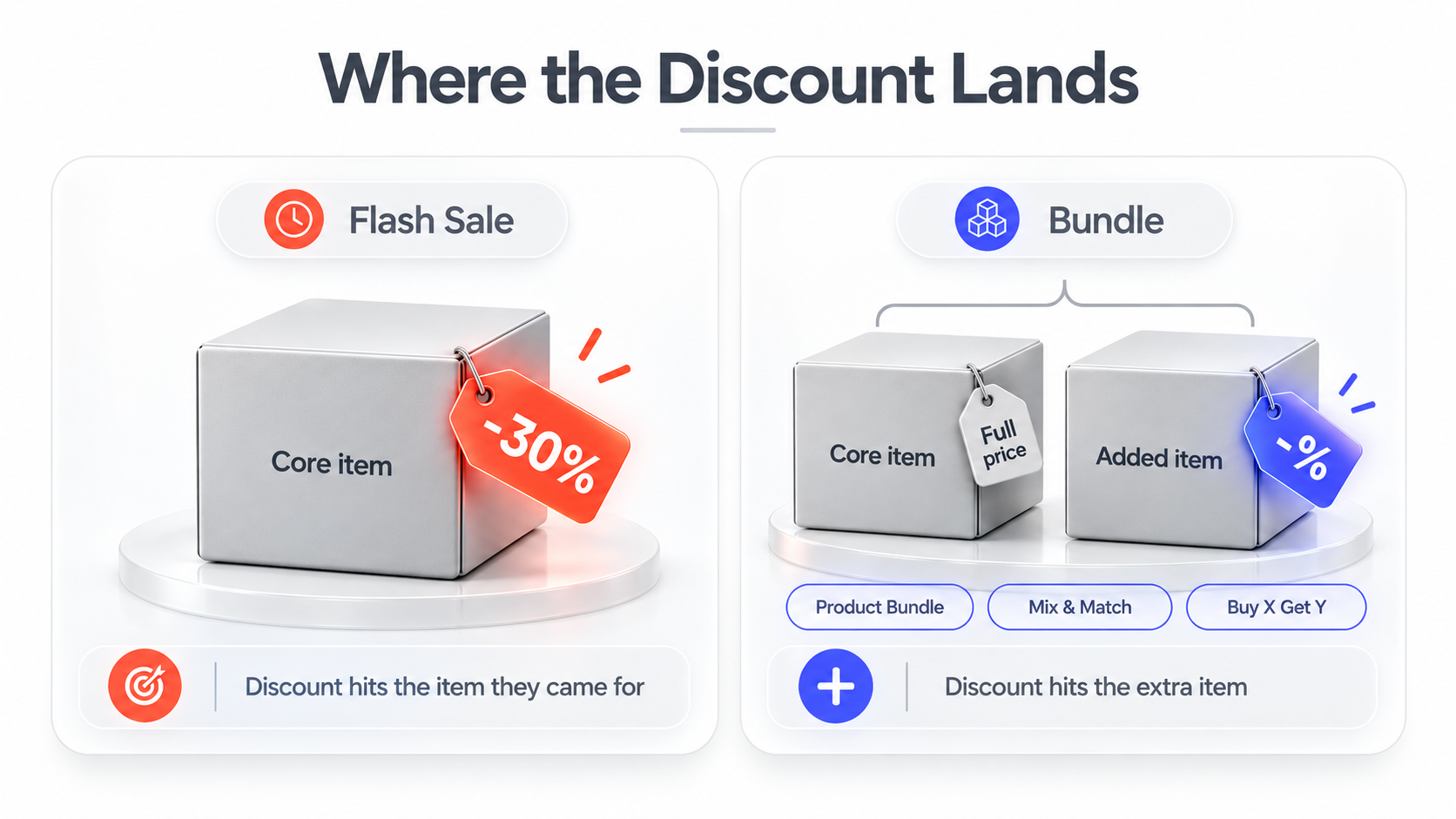
A bundle promotion prices a combination of products together. In Pumper, that takes three forms. A Product Bundle sells up to three different products as one discounted combo. A Mix & Match offer lets the shopper pick from a pool, and a Buy X Get Y offer gives a free or discounted second product for buying the first.
The distinction matters because of where the discount lands. A flash sale lowers the price of the item the shopper came for. A bundle puts the discount on the extra items, which are units you might not have sold at all.
Side-by-Side Comparison
Flash Sales: Where They Earn Their Keep
Flash sales fit when the goal is volume in a hurry, and each of the cases below has a clear logic.
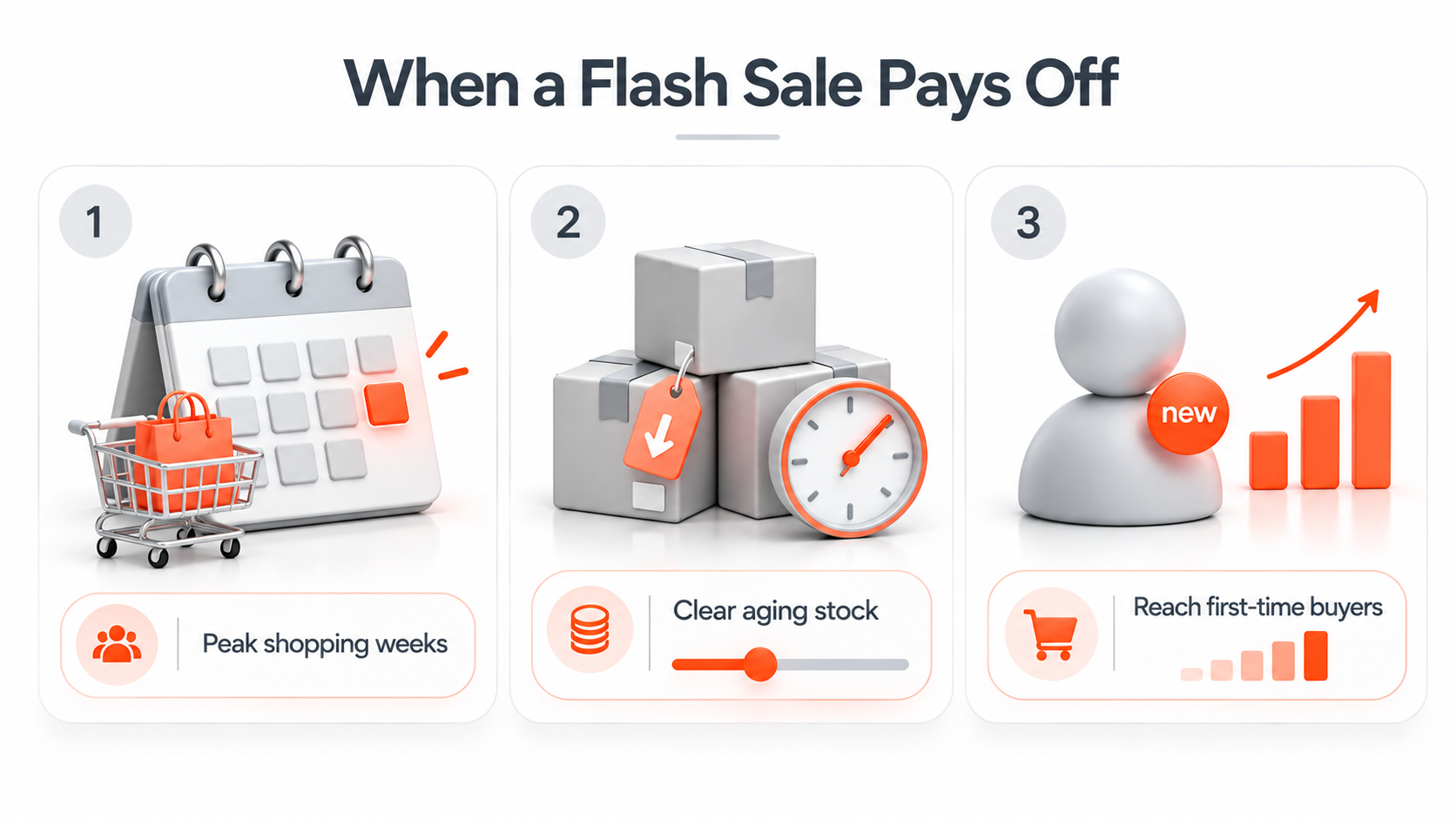
Riding peak shopping weeks. The big sale calendar moments reward stores that arrive with a clear offer, because shoppers are already looking for one and have set aside budget for it. Black Friday and Cyber Monday are the clearest cases, and a sale that ends on a stated date fits the way shoppers behave in those weeks.
Retail history argues against dropping sales entirely. J.C. Penney removed coupons and most sales in 2012 in favor of everyday low prices, and same-store sales fell 19%, 21.7%, 26.1%, and 31.7% across the four quarters. The chain later announced a return to weekly sales events, with its chief executive acknowledging that customers prefer them (Christian Science Monitor, February 2013). Sales events have pull of their own.
Clearing stock. Aging or seasonal inventory loses value daily, so the true cost of a deep discount is lower than its book cost. A deadline gets the stock out before it loses more, and a flash sale is the simplest way to attach one. Price the sale above landed cost, because clearing at a loss on top of a write-down compounds the damage.
Reaching people who haven't bought. Anderson and Simester ran three field experiments with a catalog retailer. Deeper current discounts raised later purchases from first-time customers, and they lowered later purchases from established customers (Anderson & Simester, 2004). A sale aimed at people who haven't bought before is the use case that this result supports.
Bundle Promotions: Where They Pull Ahead
Bundles earn their place when the goal is profit per order instead of orders per hour.
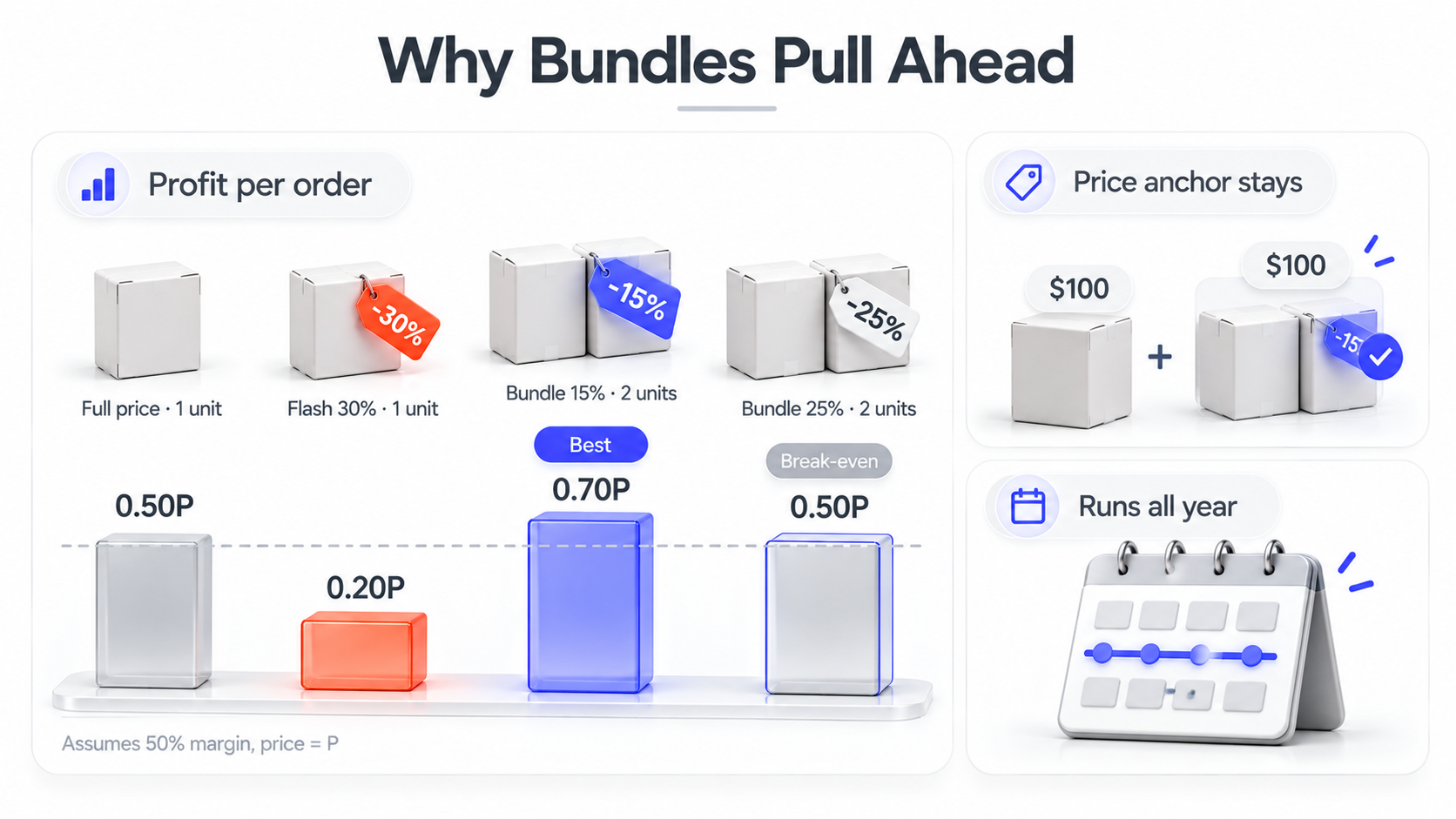
They discount the added units, not the first one. Take a product with a 50% contribution margin and a price of P. Assume the flash-sale shopper buys one unit and the bundle shopper buys two. The arithmetic below uses only those assumptions:
The flash sale gives up 30% on a single unit and leaves 0.20 P. A 15% bundle sells two units and earns 0.70 P, more than the full-price single unit. A bundle only matches the full-price single order once its discount reaches 25%, which marks its break-even point at this margin.
They don't reset the price anchor. The full price of each item stays visible next to the bundle, so shoppers keep the reference price that makes the bundle look like a saving. A flash sale does the opposite, because the discounted price becomes the number shoppers remember. Each later visit then gets compared with that lower figure, and the full price starts to look like a markup instead of the real price. A bundle avoids that comparison, since no single item was ever repriced. Pumper's guide to Shopify product bundling strategies walks through pricing logic for common bundle shapes.
They run all year. A flash sale loses force with repetition, because shoppers stop reacting to a deadline they've seen five times. A bundle sits on the product page as part of the normal offer, so it can build a steady lift instead of a spike followed by a hangover, and it asks nothing of your calendar or your email schedule. Leaving the single-unit option visible next to the bundle usually lifts order value faster than forcing the bundle, which the comparison of pure versus mixed bundling explains in detail.
Costs That Rarely Make the Sales Report
Both promotions carry costs that don't show up in the revenue line. The flash sale's costs are larger and harder to see, because they land weeks after the revenue does and often get filed under a different cause. A slow January or a dip in repeat orders rarely gets traced back to a November promotion, which is why the three costs below deserve a place in your post-sale review.
What a Flash Sale Costs Beyond the Discount
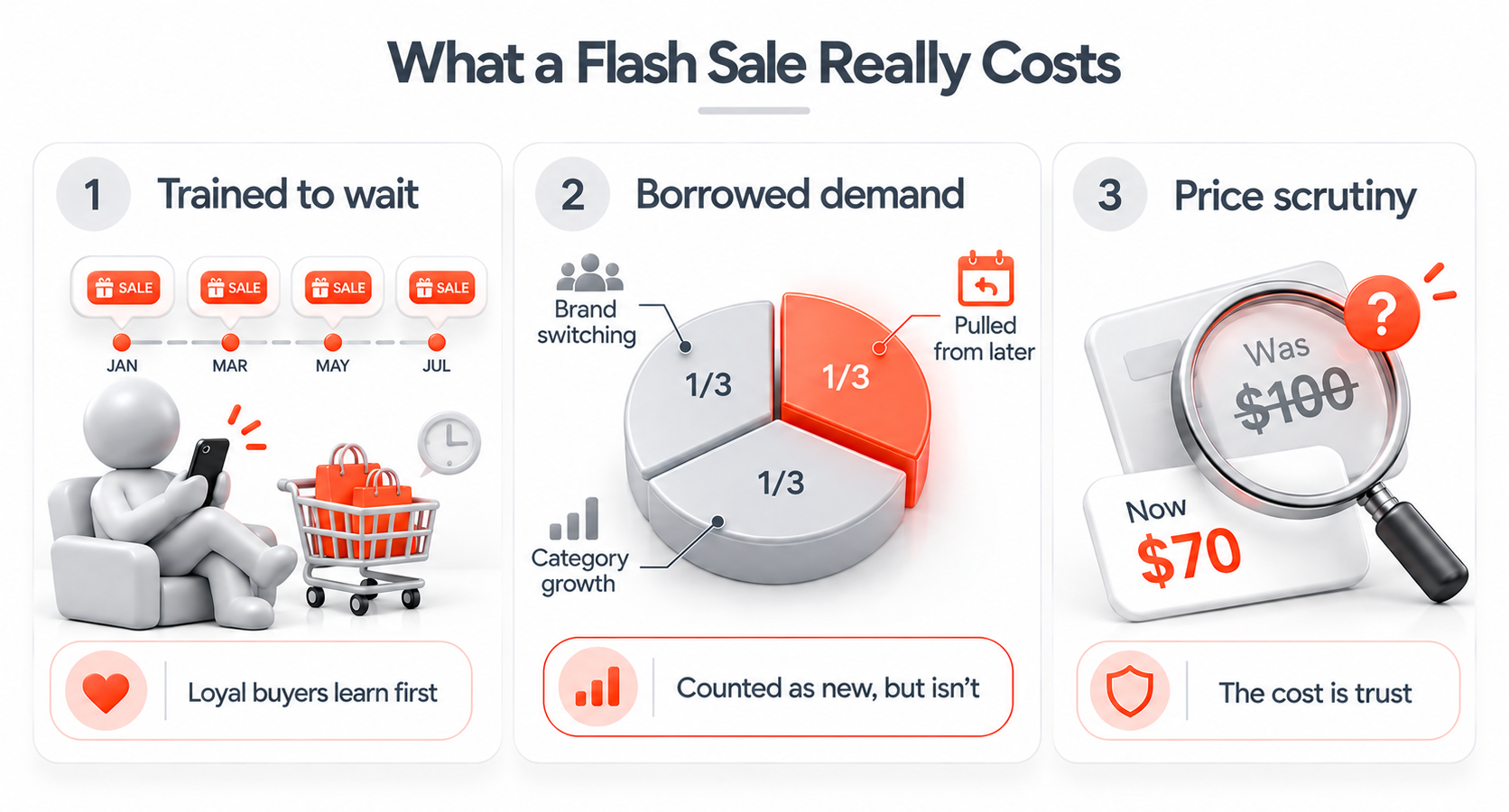
A trained audience. Repeated deep discounts teach buyers when the next one arrives, and shoppers who learn the pattern wait for it. Your most loyal customers are the quickest to learn it, since they see every email and every banner. The effect varies by shopper type, and Pumper's piece on the psychology of Shopify promotions covers how to match offers to different customers.
Demand borrowed from later. A post-sale report that counts every order in the window as new overstates the result. Shoppers who switched from a competitor are new, while shoppers who would have bought next month are not. Van Heerde, Leeflang, and Wittink split the sales bump from store promotions into these parts using four scanner datasets. On average, one third came from brand switching, one third from sales pulled from other periods, and one third from category expansion (van Heerde, Leeflang & Wittink, Marketing Science, 2004). Online stores will differ, but the borrowed-demand share is the part a flash sale report counts as new revenue.
Pricing scrutiny. A sale only reads as a sale if the "was" price was real. If your reference price never existed as a regular price, shoppers and regulators can notice, and the cost is trust.
What a Bundle Costs Beyond the Discount
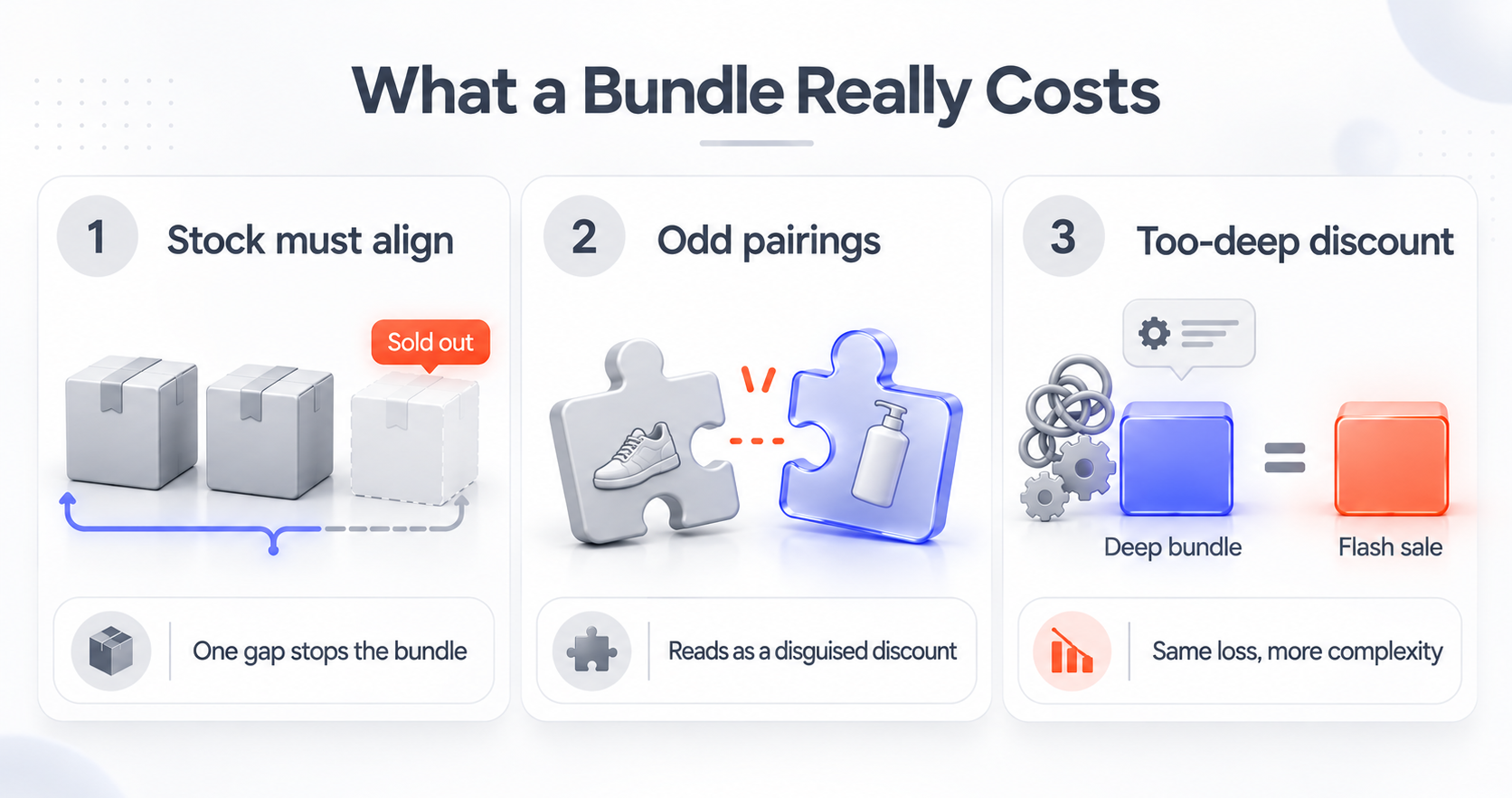
Bundles carry their own risks. Components must be in stock together, so one sold-out item can pull the whole bundle down. A bundle of products that don't belong together reads as a disguised discount. And a bundle priced so deeply that it matches a flash sale delivers the same margin loss with more complexity.
How to Choose Between Flash Sale and Bundle Promotions
Put these questions to your own numbers.
- Is the goal to clear stock by a date? Run a flash sale, and set the floor price at your landed cost plus a minimum return. For peak-week formats, Pumper's Black Friday promotion ideas list ten.
- Is the goal a higher order value without cutting the first unit? Run a bundle.
- Are most buyers returning customers? Favor the bundle, since deep discounts lowered later purchases from established customers in the Anderson and Simester work.
- Do you have slow-moving SKUs next to bestsellers? Pair them in a bundle so the bestseller carries the slow mover.
- Is contribution margin under 40%? Keep flash discounts shallow, and put the savings into bundles, where the math above favors you.
For a broader view of how these two fit with volume discounts, BOGO, and free gifts, the guide to Shopify promotion strategies compares all five levers.
Add a Bundle That Stays on All YearPumper's Product Bundles let you sell up to three products as one discounted combo, displayed above the Add to Cart button. Create evergreen bundle offers that encourage shoppers to add more products to their carts.
|
A Hybrid: The Time-Boxed Bundle
The two aren’t mutually exclusive. A bundle with a deadline gives you the urgency of a flash sale while keeping the discount on the added units. Use Pumper’s countdown timer in Deadline mode, which counts to a fixed end date and hides when it passes.
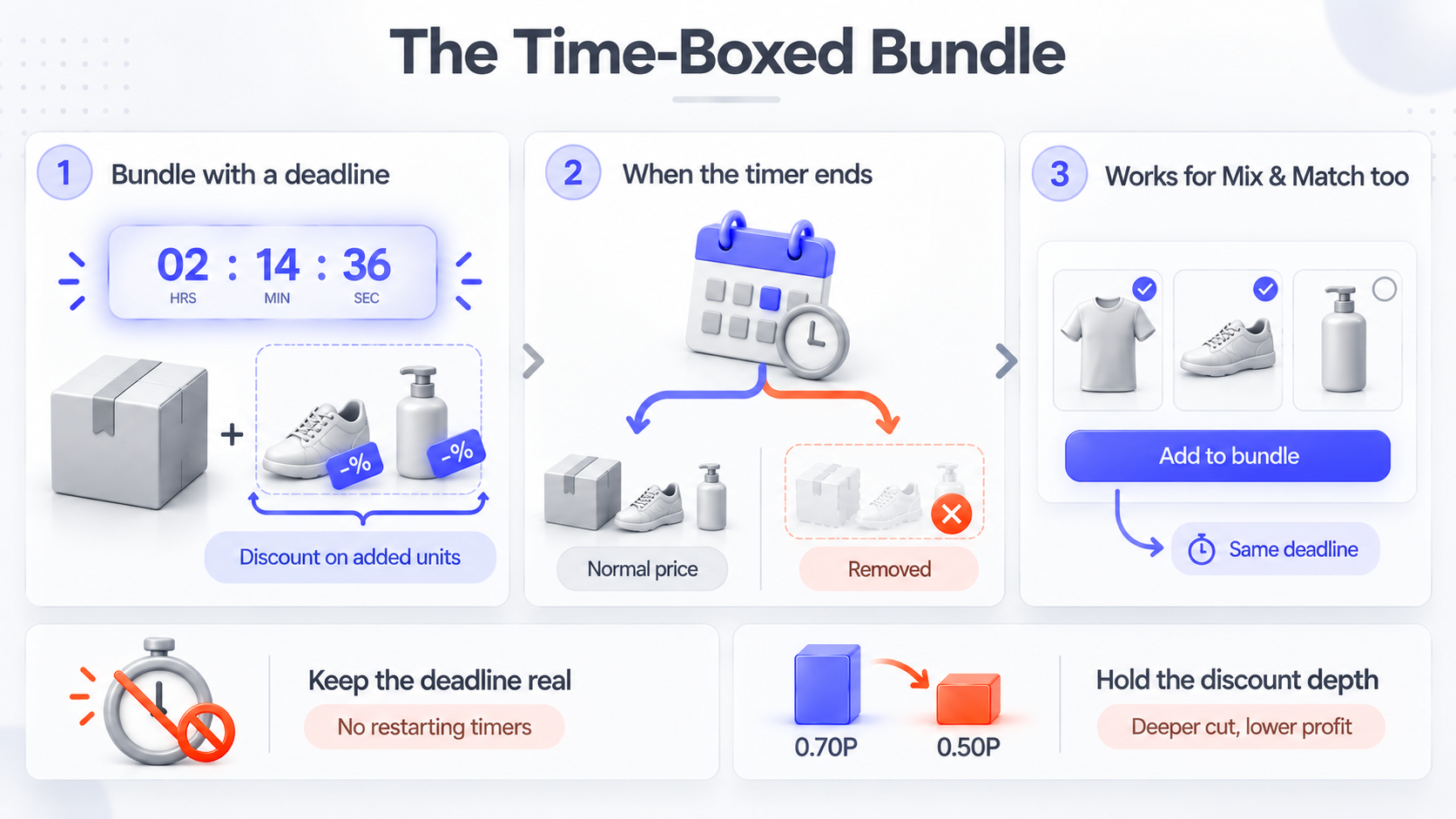
Structure the hybrid in three steps. Pick a bundle you'd be glad to sell at the window price, set the end date before launch, and decide in advance whether the bundle returns at a normal price or goes away. Writing those three decisions down keeps a good first day from stretching the window.
Keep the deadline real, because shoppers who catch a fake clock stop believing the next one. The Federal Trade Commission's 2022 dark patterns report described countdown timers designed to make shoppers believe they have limited time when the offer is not time-limited (FTC, September 2022). Set an end date, end the offer on it, and avoid timers that restart. If you plan a recurring bundle, say so rather than implying scarcity that doesn't exist.
Check the bundle against your margin before the window opens, using the same arithmetic as the table above. A bundle that earns 0.70 P at one discount can fall to 0.50 P at a deeper one, and a deadline tempts merchants to deepen the discount for the last day. Hold the depth you chose.
A mix-and-match pool also suits the hybrid, since the shopper chooses the combination and the deadline applies to the whole pool. The mix-and-match guide covers pool design.
Measuring the Result
Judge both promotions on profit per visitor over a window that extends past the sale. For a flash sale, add the two weeks after the deadline, when pulled-forward demand shows up as a dip. For a bundle, compare units per order and attach rate against the same product before the offer.
Pumper's analytics report impressions, add-to-carts, orders, revenue, and conversion rate per offer, so each promotion carries its own numbers.
Frequently Asked Questions
Is a flash sale or a bundle better for a new store?
A bundle, in most cases, because a new store has no established customer base to protect and needs a higher order value to cover acquisition cost. The guide to increasing average order value lists other levers to pair with it. Use a flash sale selectively to reach first-time buyers.
Can I run a bundle during a flash sale?
You can, but check how the discounts combine. Discounts stack only where their combination settings allow it, and Pumper has its own switches for stacking with Shopify's product, order, and shipping discounts.
How long should a flash sale run?
Long enough to reach your audience and short enough that the deadline is believable. Set the end date before launch and keep it.
Where the Discount Lands Decides the Choice
A flash sale spends margin to buy speed. A bundle spends margin to buy extra units. When you need stock out by a date, the flash sale earns its cost, and when you need a higher order value, the bundle does.
Most stores benefit from running a bundle as the standing offer and keeping flash sales for specific, dated reasons. Test the pairing on one product before you commit a campaign to it.
Start With a Bundle That Stays on All YearCreate a Product Bundle with up to three products or build a Mix & Match pool with Pumper's free plan, which covers up to $300 in extra revenue. Set up your offer and keep it running all year.
|