



Every Shopify merchant has run some version of the same experiment: add a countdown timer, slap "24 hours only" on a banner, and wait for sales to spike. Sometimes it works. Sometimes shoppers scroll right past it, and sometimes it quietly erodes trust in the store for good.
The difference between a limited-time offer that converts and one that gets ignored usually comes down to mechanics most merchants never test: which offer type they picked, where it sits on the page, how the deadline is communicated, and whether the scarcity is real.
This guide breaks down what the research shows about urgency and scarcity marketing, which limited-time offer formats hold up under scrutiny, and how to build a program that lifts average order value without training shoppers to distrust your deadlines. You'll also see where the data gets murky, including a well-documented finding that contradicts a popular assumption about countdown timers.
Key Takeaways
- Loss aversion, not the discount itself, is what makes urgency work. People weigh the fear of missing out roughly twice as heavily as the pleasure of gaining something equivalent (Kahneman and Tversky's prospect theory, cited via Nielsen Norman Group).
- A census-weighted academic study of nearly 3,800 US adults found generic countdown timers did not significantly increase purchases, a direct challenge to the marketing-blog claims of automatic double-digit conversion lifts (Luguri and Strahilevitz, Journal of Legal Analysis, 2021).
- 34% of shoppers say fear of a product selling out is a reason they pay full price instead of waiting for a discount, and 31% cite "limited edition" status specifically (Attentive, 2025).
- Automated, trigger-based email flows convert far better than one-off blast campaigns: Klaviyo's 2026 benchmark data puts flow-driven placed-order rates at 2.11% on average versus 0.16% for standalone campaigns.
- Post-purchase, one-click upsells convert at a 4.7% average take rate, with the top 5% of offers converting at 28.3% (Upsell.com/ReConvert), making the moment right after checkout one of the highest-leverage places to add a time-boxed offer.
- Real, verifiable scarcity (actual low stock, an actual calendar deadline) consistently outperforms fabricated urgency, and shoppers are increasingly able to tell the difference.
Why Limited-Time Offers Work: The Psychology Behind Urgency
Limited-time offers are not just a pricing tactic. They tap into a well-documented cognitive bias called loss aversion: the tendency to feel the pain of losing something more intensely than the pleasure of gaining something equivalent.
Daniel Kahneman and Amos Tversky's prospect theory, the foundational research behind this idea, found that losses are felt roughly twice as intensely as equivalent gains (Nielsen Norman Group, summarizing the original Kahneman and Tversky research). When a shopper sees a deadline attached to a discount, free gift, or bundle, their brain does not process it as "I could save money." It processes it as "I am about to lose this opportunity," and that reframing is what pushes hesitant browsers toward a decision. Straightforward "sale ends Friday" framing tends to outperform vague "limited time" language for the same reason: the more concrete the deadline, the more real the potential loss feels.
Scarcity and Urgency Are Not the Same Lever
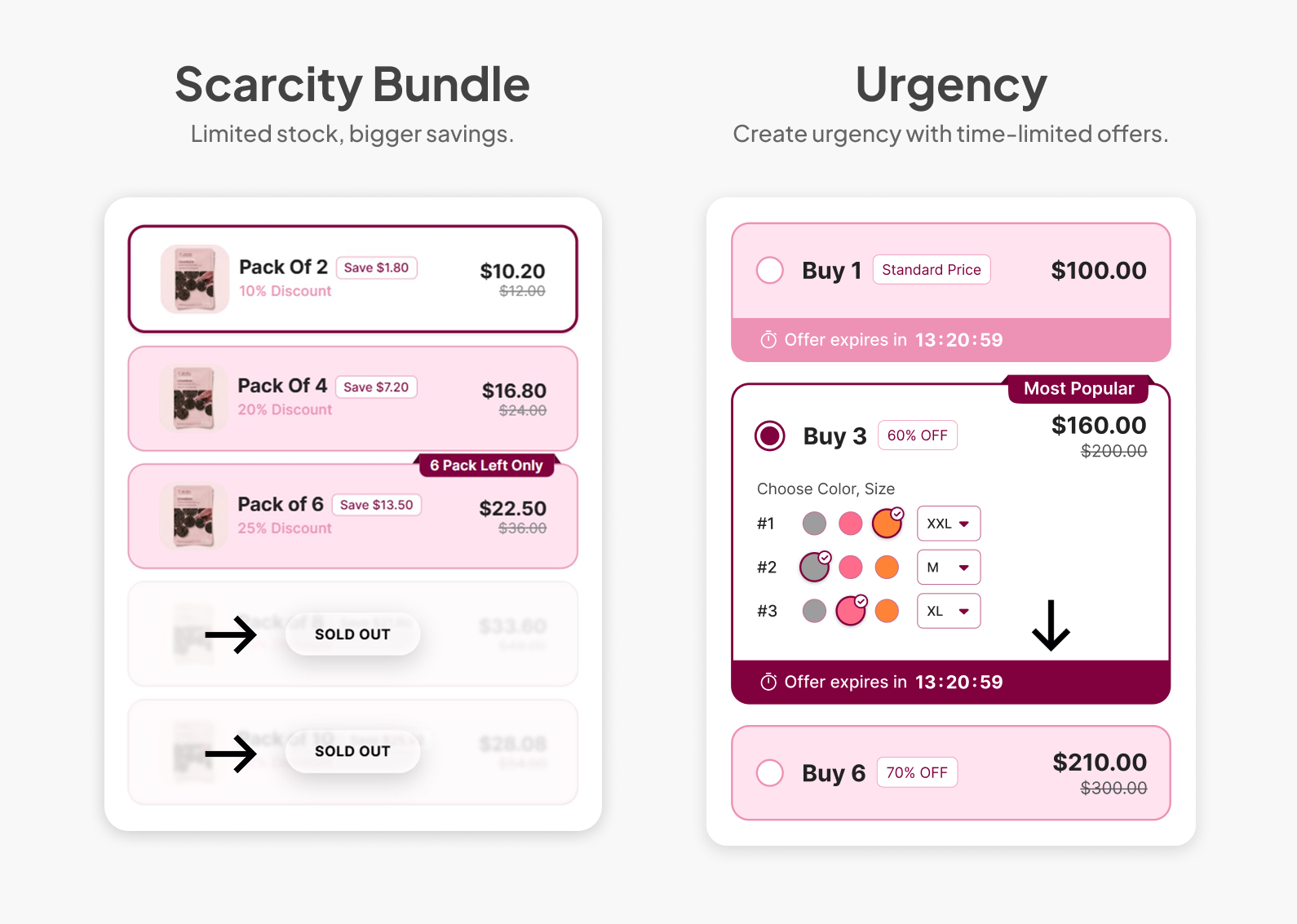
Scarcity is about limited supply: only 12 units left, a capsule collection that will not be restocked, a bundle built from products already low in inventory. Nielsen Norman Group's research on the scarcity principle in ecommerce notes that scarcity messaging is most persuasive when it reflects genuine, verifiable constraints rather than manufactured ones.
Urgency is about limited time: a discount that expires at midnight, a free-gift threshold only active this weekend, a bundle price that reverts after 48 hours. It works through the same loss-aversion mechanism, but puts pressure on the decision timeline rather than the decision itself. The strongest offers often stack both: a quantity-break discount on a genuinely fast-selling product, running for a fixed 72-hour window, combines real supply pressure with a real deadline instead of relying on either alone.IMAGE 8A
Do Countdown Timers Actually Work? What the Research Says
This is the part of urgency marketing where the popular advice and the academic evidence diverge sharply, and merchants deserve to see both sides before they build a strategy around it.
The Case Marketing Blogs Make
Search for "countdown timer conversion rate" and you'll find dozens of posts claiming specific lift percentages, often attributed to vague "A/B tests" or unnamed studies. Most of those numbers could not be traced back to a named source, methodology, or sample size during research for this article, which is worth taking seriously before you repeat them to your own team.
The Academic Counter-Evidence
A 2021 peer-reviewed study published in the Journal of Legal Analysis took a more rigorous approach. Jamie Luguri and Lior Jacob Strahilevitz surveyed a census-weighted sample of 3,777 US adults and found that generic countdown timers did not significantly increase consumer purchases (Journal of Legal Analysis, Oxford Academic, 2021). The study examined "dark patterns," manipulative UX tactics designed to pressure users, and countdown timers were one of the patterns tested.
This does not mean urgency messaging is useless. It means generic, unexplained, or obviously fake timers, the kind that reset every time you refresh the page, have lost their power on a shopper base that has seen the tactic overused for a decade. What the study does not contradict is urgency tied to something real and specific.
How to Use Deadlines Without Losing Credibility
- Tie the deadline to something verifiable. A "flash sale ends at 11:59 PM tonight" claim only works if the price genuinely reverts at that time. If shoppers catch the timer resetting, every future countdown from your store loses credibility.
- Explain the reason for the window. "48-hour restock celebration" or "back-to-school weekend only" gives the deadline a logical anchor instead of an arbitrary number.
- Avoid a permanent timer on every page. A countdown that always runs stops registering as urgency and starts registering as decor.
- Pair the timer with a genuine incentive, not just the clock. A quantity-break offer or a free-gift threshold gives shoppers something concrete to lose.
IMAGE 8B
Types of Limited-Time Offers That Drive Real Results
Not every urgency tactic fits every store. Here is how the main formats work, and which store types tend to see the strongest results from each.
Time-Boxed Flash Sales
A flash sale drops prices sitewide or on a specific collection for a short, clearly bounded window, typically 24 to 72 hours. Flash sales work best for stores with enough traffic to generate momentum quickly and enough margin to absorb a temporary sitewide discount.
The risk with flash sales is frequency. Run them too often and shoppers learn to wait for the next one instead of buying at full price, which is part of why some merchants prefer targeting the discount to a specific mechanic (like a quantity tier or bundle) rather than a blanket percentage off everything.
Limited-Time BOGO Offers
Buy-one-get-one offers remain one of the most recognized promotion formats in ecommerce. Capital One Shopping's research hub reports that 93% of shoppers have used a BOGO discount at least once, and roughly half of shoppers say they would switch to a different retailer specifically to get a BOGO deal (Capital One Shopping, updated May 2026).
That same research found BOGO's standing as shoppers' single favorite discount format has slipped over the past decade, from 66% in a 2012 survey down to 36% by 2024, as free shipping has become a more universally preferred incentive. The takeaway is not that BOGO stopped working. It is that a plain, un-timed BOGO no longer stands out on its own. Framing it as time-limited ("Buy One Get One free, this weekend only") reintroduces the urgency that a standing, always-on BOGO offer loses over time.
For Shopify stores selling apparel, accessories, or anything shoppers naturally buy in pairs or as gifts, a time-boxed BOGO offer tends to outperform an evergreen one, because the deadline gives shoppers a reason to act during the campaign window instead of bookmarking the page for later.
Limited-Time Quantity Breaks (Buy More, Save More)
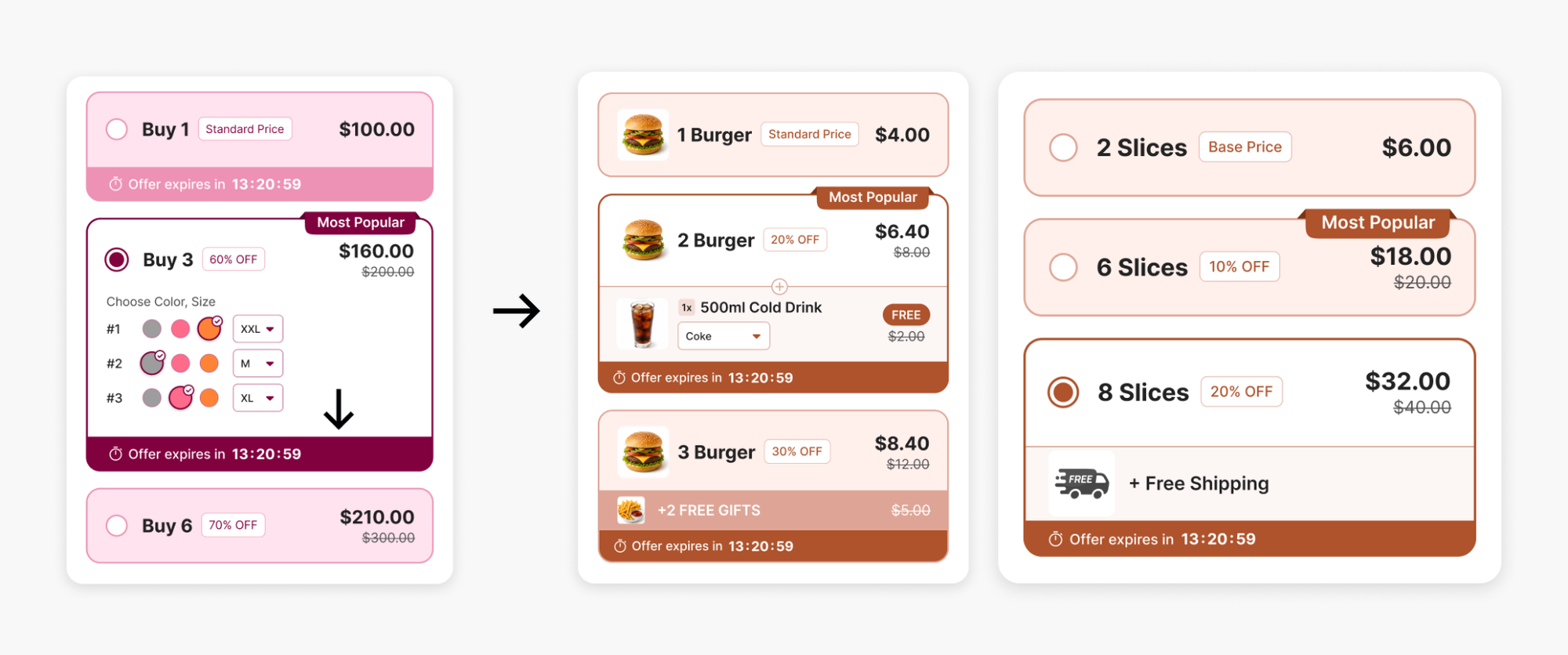
Quantity-break offers, sometimes called "buy more save more," present tiered discounts that increase as shoppers add more units to their cart. Turning a standing quantity-break offer into a limited-time one (higher discount tiers active only during a specific week, or a bonus tier that disappears after 72 hours) adds urgency on top of an already-proven AOV mechanic.
This format works especially well for consumables, supplements, and skincare, categories where a shopper buying more now genuinely saves them a future trip, rather than encouraging pure impulse stockpiling.
Free Gift With Purchase, Time-Gated
Unlocking a free gift at a spending threshold is one of the gentler urgency mechanics, since the shopper is not losing money if they miss the deadline, just a bonus. That makes it a lower-pressure entry point for stores that want to test urgency without leaning on discount language at all.
Making the gift threshold time-gated ("free gift with orders over $75, this week only") gives shoppers a reason to hit the threshold today rather than next time they happen to be shopping.
Limited-Time Bundle Pricing
Mix-and-match or pre-built bundles priced below the sum of their parts already give shoppers a reason to buy more per order. Adding a time window ("this bundle price available through Sunday") answers the shopper's natural hesitation of "should I wait to see if it gets cheaper." It closes the loop instead of leaving the decision open-ended.
Bundling is also one of the more durable AOV tactics because it does not train shoppers to expect a sitewide discount. The value trade is: buy more items together, save more on the combination, within a defined window. See our guide to Shopify product bundling strategies for more on structuring bundles that convert.
Post-Purchase, Time-Limited Upsells
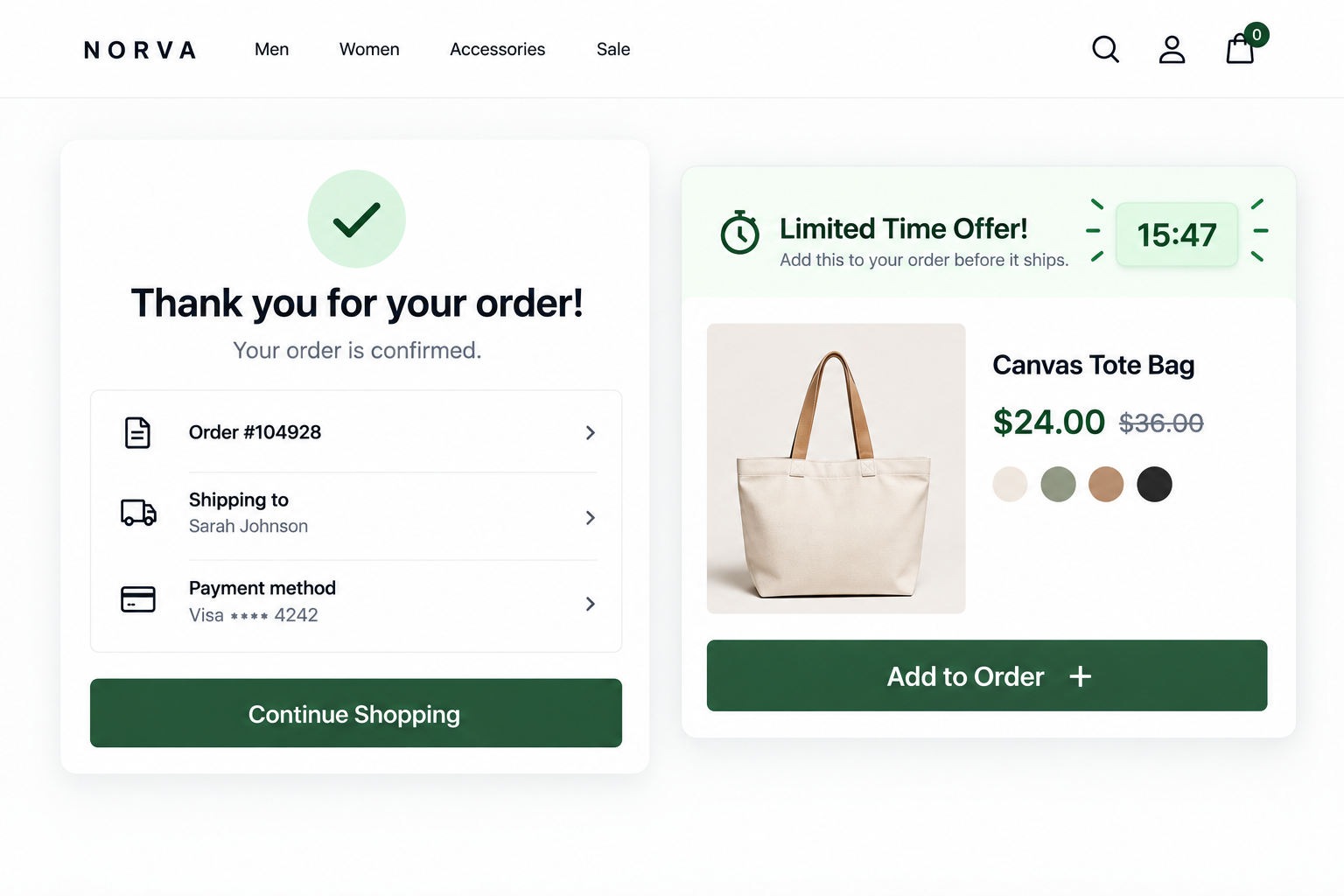
The highest-leverage moment for a limited-time offer might not be pre-purchase at all. It is the few seconds right after checkout, when a customer has already committed to buying and their guard is down.
Post-purchase upsell data from Upsell.com's ReConvert platform, based on more than 40,000 merchants across 12 countries, shows one-click post-purchase offers converting at a 4.7% average take rate, with average order value lifting 5.6% and top performers seeing a 12.7% AOV lift (Upsell.com/ReConvert). The same report found that 73% of merchants say post-purchase upsells convert better than their other marketing channels, and stores generate an average of $686 in additional sales for every $1 spent on the tactic.
A short countdown on a post-purchase offer ("add this to your order in the next 5 minutes at 20% off") works differently than a pre-purchase timer, since the shopper is reacting to a fresh, real deadline rather than a generic sitewide one. Pumper's post-purchase upsell use case covers how to set this up on a Shopify store.IMAGE 8C
Where to Place Limited-Time Offers on Your Store
Placement changes how a limited-time offer performs almost as much as the offer type itself.
Product Page: Above the Add-to-Cart Button
The product page is where a shopper is closest to the decision, making it the highest-intent placement for a time-limited quantity break, BOGO, or bundle offer. Offers that render above the add-to-cart button, rather than in a popup the shopper has to dismiss first, get seen before the shopper mentally commits to a single-unit purchase.
Cart and Checkout
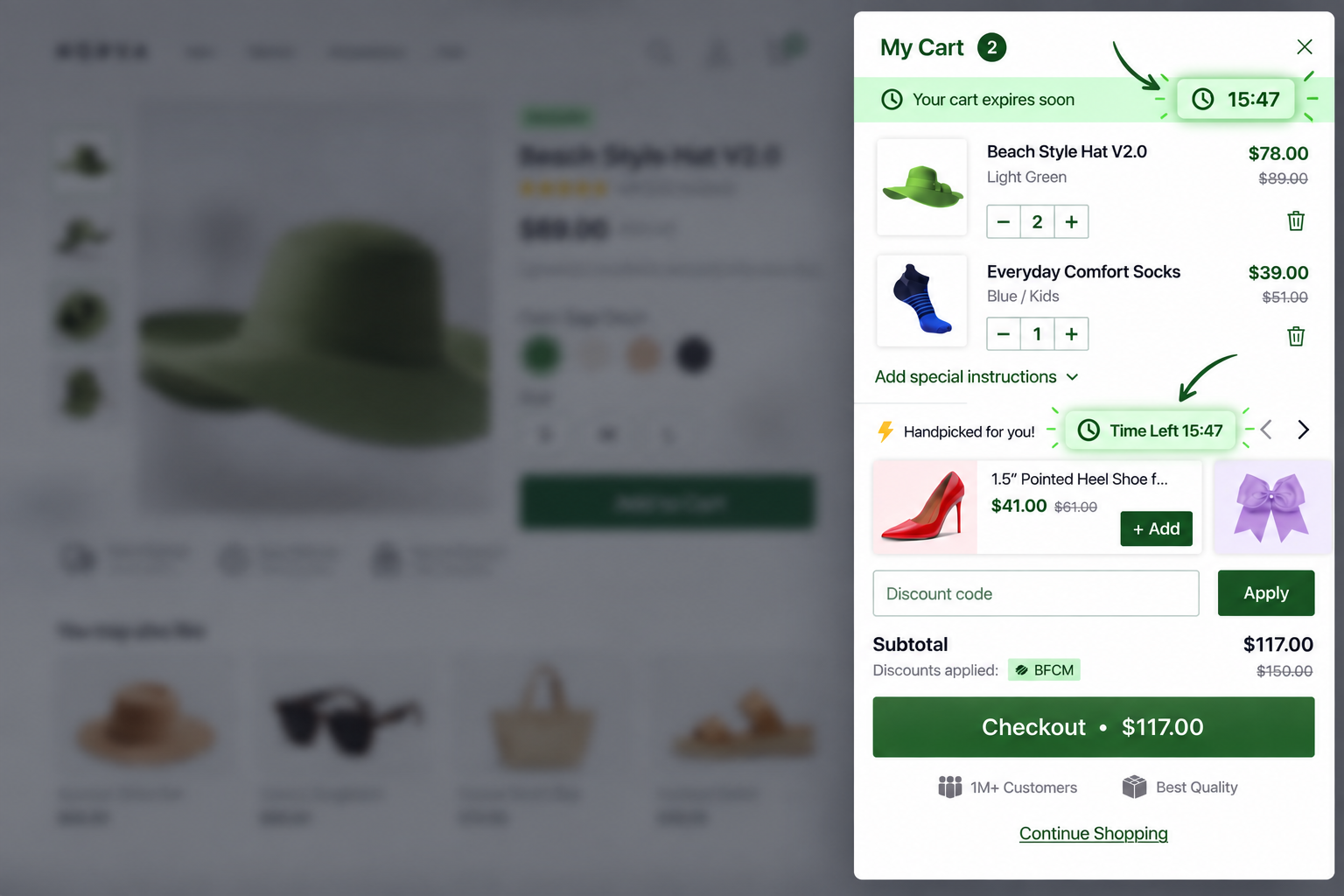
A limited-time free-gift threshold or a final countdown reminder in the cart works as a last nudge before checkout, especially for shoppers who are close to a spending threshold but have not quite crossed it. Given that the average cart abandonment rate across ecommerce sits at 70.22%, based on a meta-analysis of 50 separate studies by the Baymard Institute (Baymard Institute, updated September 2025), even a modest reduction in abandonment from a well-placed urgency nudge is worth testing. Baymard's research also found that checkout usability fixes alone, unrelated to price, could recover a 35.26% uplift in conversion across the US and EU markets studied, a reminder that urgency messaging works best alongside a checkout flow that already removes friction, not as a substitute for one.
Post-Purchase (Thank You Page or Order Confirmation)
This is where time-boxed upsells see some of the strongest take rates in ecommerce, because the shopper has already converted once and the ask is small relative to the order they just placed.IMAGE 8D
Using Email and SMS to Extend Urgency Beyond the Storefront
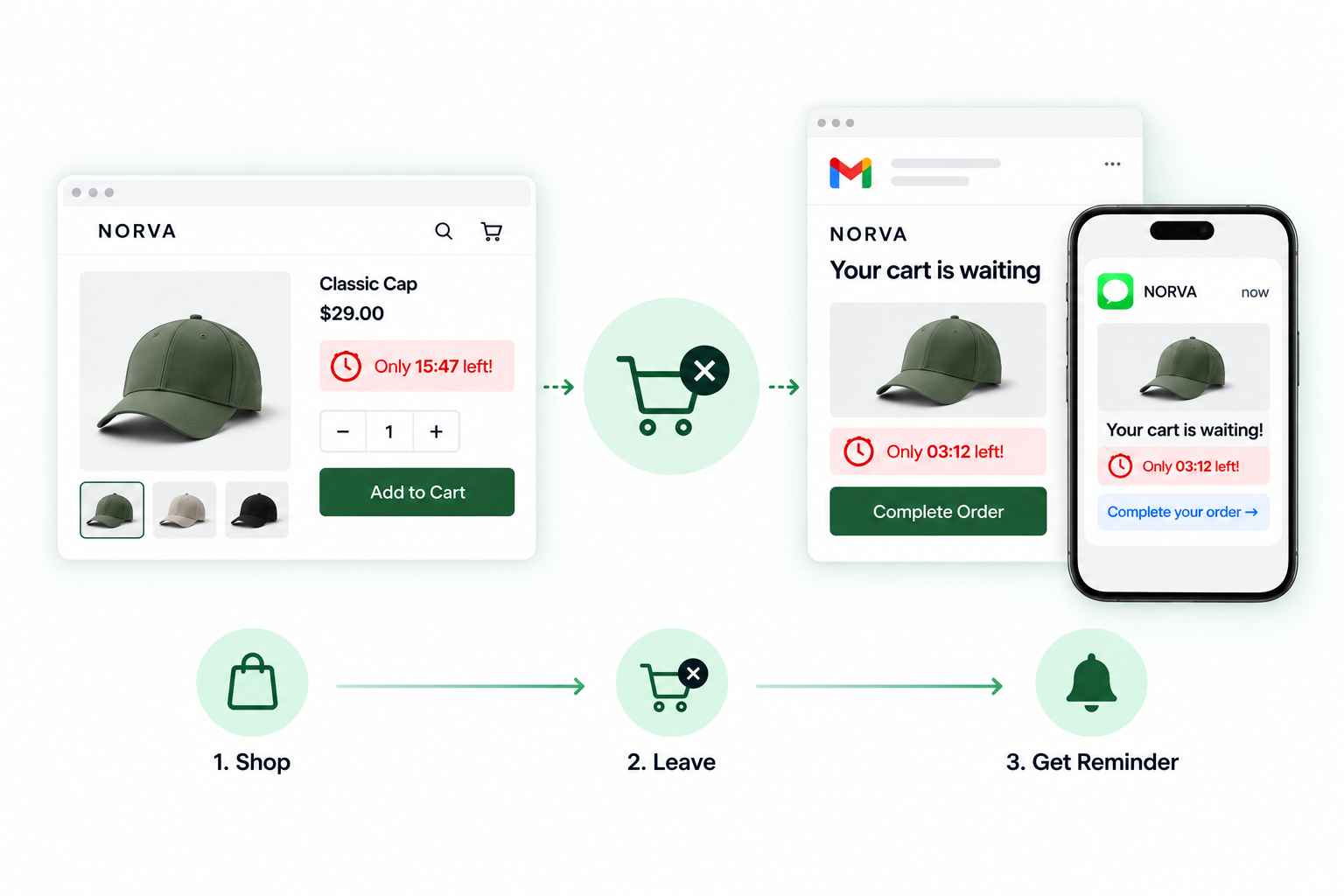
A limited-time offer that only lives on the product page misses shoppers who already left the site. Email and SMS extend the deadline into the inbox, where a well-timed reminder can recover interest that would otherwise disappear.
Automated Flows Outperform One-Off Campaigns
Klaviyo's 2026 email marketing benchmark data, drawn from more than 205,000 brands, found that automated flows (welcome series, abandoned cart, post-purchase) average a 2.11% placed-order rate, with the top 10% of senders reaching 4.3%. Standalone campaign sends average just 0.16%, and flows get roughly three times the click rate of one-off campaigns (Klaviyo, 2026 report).
Omnisend's 2026 ecommerce marketing report found a similar pattern: automated flows generate $2.87 in revenue per email sent, compared to $0.18 for one-off campaigns, roughly 16 times more, despite flows making up only about 2% of total send volume (Omnisend 2026 Ecommerce Marketing Report, analysis of 27 billion emails across 150,000-plus brands). The same report found ecommerce email open rates rose to 30.7% in 2025, up from 26.6% the year before.
The practical implication: a countdown or deadline reminder embedded in an automated abandoned-cart flow will outperform the same message sent as a one-off blast, because it reaches the shopper when their intent is highest, not on a fixed sending schedule.IMAGE 8E
Building Urgency Into Subject Lines and Timing
- Be specific about the deadline. "Ends tonight" outperforms "sale ending soon" because it gives a concrete window rather than a vague one.
- Send the final reminder close to the actual deadline, not a full day ahead, so the message matches the moment.
- Reserve SMS for the shortest windows. Because SMS interrupts immediately, it fits a 2 to 4 hour final-call message better than a multi-day sale announcement, which suits email better.
How to Run Limited-Time Offers Without Triggering Discount Fatigue
The biggest long-term risk with urgency marketing is not that any single offer fails. It is that repeated, low-credibility urgency trains your customer base to stop believing your deadlines.
Set a deliberate cadence. Running a "limited time" sale every week eventually means nothing is actually limited. Reserving urgency messaging for a smaller number of genuinely time-boxed moments- a seasonal window, a restock, a specific bundle launch- keeps the signal meaningful when it appears.
Segment urgency instead of blasting it sitewide. A first-time visitor browsing a product page benefits from a different cue (limited stock, a free-gift threshold) than a returning customer with items sitting in an abandoned cart, who may respond better to a short, personal deadline reminder by email.
Anchor urgency to something real. The offers that hold up best over time are tied to an actual constraint: real inventory levels, a real calendar event, a real restock date. Shoppers notice when a "24 hours only" banner has been running for a month, and once they notice, the tactic stops working on that customer for good.
Measuring Whether Your Limited-Time Offer Is Actually Working
A limited-time offer can look successful on the surface- a sales spike during the window- while quietly underperforming on the metrics that actually matter.
Track conversion rate and AOV separately
A discount-heavy flash sale can lift conversion rate while dragging average order value down, if shoppers only buy the discounted item and nothing else. A well-structured quantity break or bundle offer is designed to lift both at once, since the incentive only pays off when the shopper adds more to the cart.
Watch for pull-forward, not just lift
Some of the revenue in any flash sale is not new demand. It is demand pulled forward from shoppers who would have bought anyway, just not on that specific day. Comparing the two to three weeks after a sale against your pre-sale baseline helps reveal whether the promotion generated incremental revenue or simply moved it around on the calendar.
Segment results by offer type
A store running multiple limited-time formats should track them separately rather than looking at one blended "promotions" number. Post-purchase upsells convert at meaningfully different rates than pre-purchase offers, as the Upsell.com/ReConvert data above shows, so lumping them together hides which mechanic is actually earning its place in the funnel.
Common Mistakes That Undermine Urgency Marketing
- Using vague deadlines instead of specific ones. "Limited time" with no date attached carries almost none of the weight of "ends Sunday at midnight."
- Applying the same urgency tactic to every offer. A countdown fits a flash sale. It fits less naturally on a loyalty-driven free-gift program, where the incentive should feel like a reward, not a race.
- Ignoring the post-checkout moment. Many stores put all their urgency effort pre-purchase and skip the post-purchase window entirely, despite it converting at some of the strongest rates in the data above.
Seasonal Planning for Limited-Time Offers
Holiday and seasonal windows are the most natural home for time-boxed promotions, since the deadline is already built into the calendar rather than manufactured by the merchant.
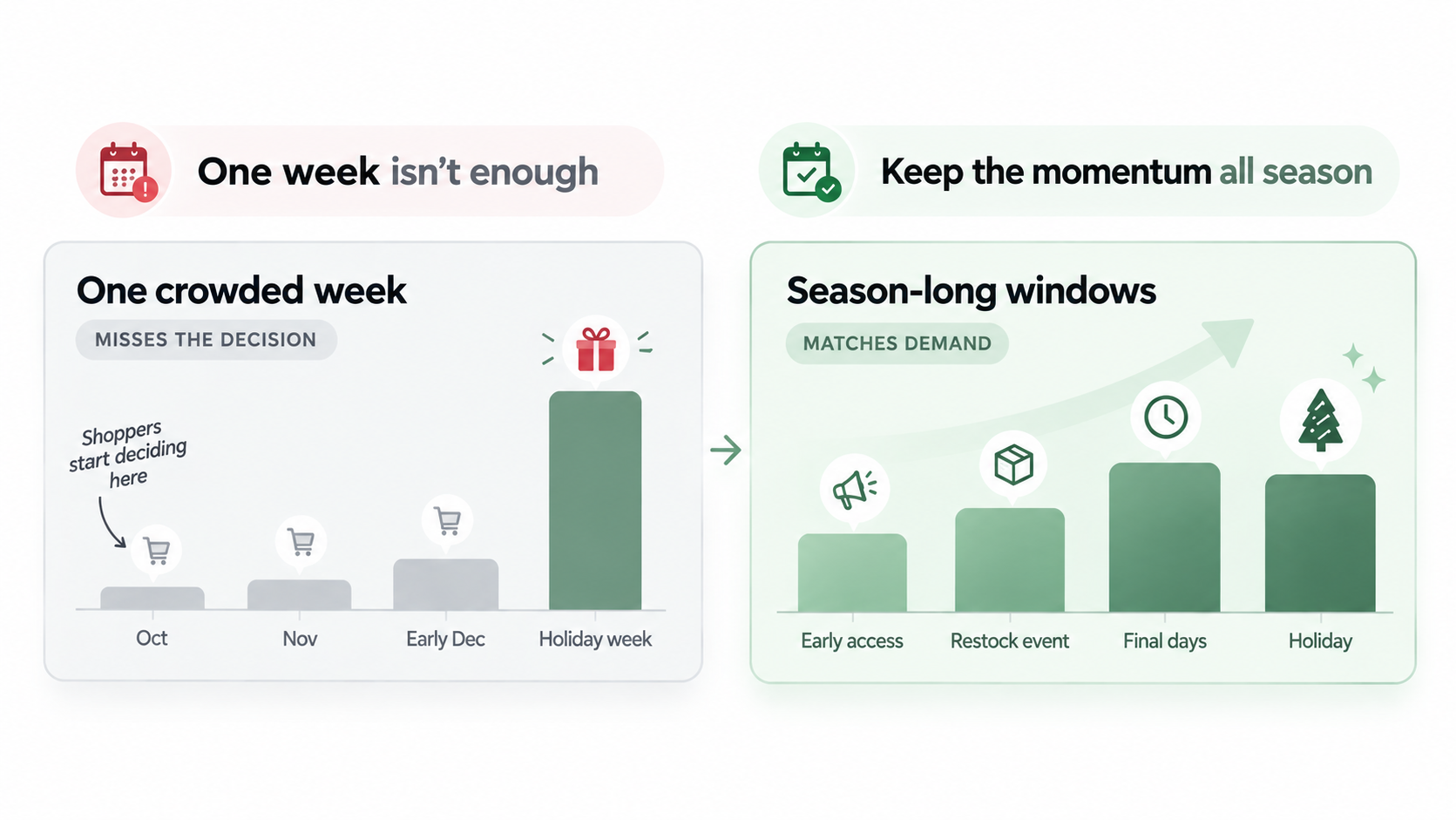
The National Retail Federation reports that 2025 winter holiday online and non-store sales grew 8 to 9%, reaching $312 to $315 billion, and that 51.9% of holiday shoppers now start browsing or buying in October or earlier, largely to spread out their budget and avoid last-minute stress (National Retail Federation, 2025 data). A limited-time offer that only launches the week of a major holiday is competing for attention with shoppers who already made their decisions weeks earlier.
Building a calendar of smaller, genuinely time-boxed windows across the season, an early-access sale in October, a mid-season restock event, a final-days push before the holiday itself, spreads urgency across the full buying period instead of concentrating it in one crowded week. For more on building that calendar, see our broader guide to Shopify promotion strategies.IMAGE 8F
Bringing It Together
Limited-time offers work because they tap into loss aversion, a documented cognitive bias, not because a countdown widget is inherently persuasive on its own. The research is clear that generic, unexplained timers have lost much of their power, while specific, verifiable deadlines tied to real scarcity still move shoppers to act.
The formats that hold up best on Shopify stores share a common thread: they give the shopper something concrete to lose (a free gift, a bundle price, a quantity-tier discount, a post-purchase add-on) and pair it with a deadline the shopper can trust. Placement matters as much as the offer itself, with the product page, cart, and the moments right after checkout each earning a different kind of urgency treatment.
If you are ready to put these mechanics to work without building custom code for every campaign, Pumper Bundles lets you Pumper Bundles lets you launch quantity breaks, BOGO offers and free-gift tiers directly on your product pages, above the add-to-cart button, and show a countdown with its Urgency Timer, no developer required.
Try Pumper Bundles free and start testing which limited-time format moves your average order value first.
Frequently Asked Questions
How long should a limited-time offer run?
Most flash sales and time-boxed discounts run between 24 and 72 hours. Shorter windows create stronger urgency but reach fewer of your total visitors, while longer windows reach more shoppers but dilute the sense of pressure. Seasonal or restock-based offers can reasonably run a full week if the deadline is tied to something specific, like a calendar event or an actual inventory cutoff.
Do countdown timers actually increase sales?
The evidence is mixed. A census-weighted academic study of 3,777 US adults, published in the Journal of Legal Analysis, found that generic countdown timers did not significantly increase purchases (Luguri and Strahilevitz, 2021). Many of the specific conversion-lift percentages circulated in marketing content could not be traced to a credible, named source. Timers tied to a real, explained deadline appear to perform better than generic or unexplained ones, though merchants should test rather than assume a fixed lift.
What's the difference between scarcity and urgency in marketing?
Scarcity refers to limited supply, such as low stock or a capped quantity. Urgency refers to limited time, such as a discount that expires at a set hour. Both work through the same loss-aversion mechanism, but scarcity pressures the decision itself while urgency pressures the timeline for making it. Combining a genuinely low-stock item with a real deadline tends to outperform either lever used alone.
Which limited-time offer type works best for a Shopify store?
It depends on the product category and the shopper's stage in the funnel. Quantity breaks and BOGO offers tend to work well on the product page for consumables and apparel. Free-gift thresholds work well in the cart as a lower-pressure nudge. Post-purchase, one-click upsells have shown some of the strongest take rates in the data, since they reach a shopper who has already committed to buying.
How do I avoid training customers to wait for a sale?
Keep the frequency of sitewide discounts limited, and anchor urgency to something specific and verifiable rather than running a vague "limited time" banner continuously. Rotating between offer mechanics (a quantity break one month, a bundle deal the next, a free-gift threshold after that) also helps, since it keeps any single discount from becoming an expected baseline price.
Can I run a limited-time offer without hurting my profit margin?
Yes. Quantity breaks, bundles, and free-gift thresholds increase how much a customer buys per order rather than discounting every item sitewide, which tends to protect margin better than a blanket percentage-off flash sale. Pairing the offer with a deadline adds urgency without requiring a deeper discount than the mechanic already provides.