



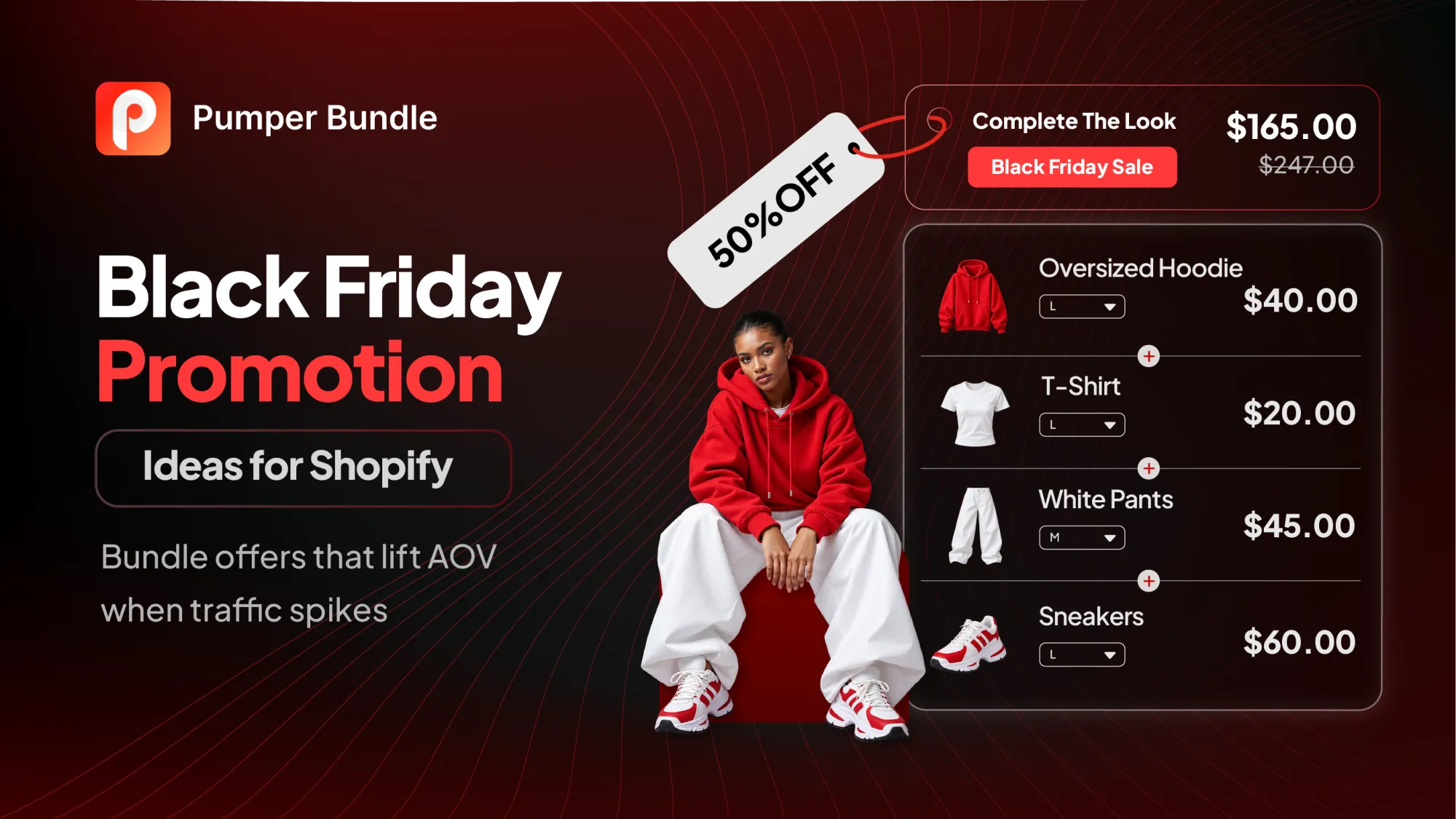
Black Friday 2025 pulled $11.8 billion in US online sales, up 9.1% from the year before (Adobe Analytics, 2025). The National Retail Federation counted 85.7 million people shopping online that day against 80.3 million in stores (NRF, 2025). Online is now the bigger half of Black Friday, and every Shopify store you compete with knows it.
This year's date is Friday, November 27, 2026, but the day no longer starts on Friday. Amazon, Walmart, and Target all run October deal events, so shoppers arrive in November already holding price expectations. A flat "20% off sitewide" banner gives away margin on orders you'd have won anyway, and it disappears in the noise. The stores that do well tend to run a handful of specific promotion strategies that fit what they sell, instead of one blanket discount.
This guide covers 10 Black Friday promotion ideas for Shopify. Some are offer mechanics you can run on a product page, and a few are deliberately unusual: a price promise, a bonus gift card, and a no-discount Friday. Below the ideas you'll find the core context: what a Black Friday sale is, when it starts, the 2025 data, and what shoppers expect before they pay.
TL;DR
- Black Friday 2025 reached $11.8 billion in US online spend, up 9.1%, and online shoppers (85.7 million) outnumbered in-store shoppers (80.3 million) (Adobe and NRF, 2025).
- Black Friday 2026 is Friday, November 27. October retailer events mean shoppers start comparing prices weeks earlier.
- The strongest promotions grow basket size instead of cutting price across the board: quantity tiers, BOGO, free gifts, build-your-own boxes, and post-purchase upsells.
- Real scarcity beats fake urgency. A capped doorbuster with a true stock count gives shoppers a reason to move without costing you trust.
- Three unconventional ideas are worth testing: a price promise that answers "will it get cheaper later?", bonus gift cards that defer your discount cost, and a no-discount Friday built on value-adds.
- Extra costs at checkout are the top reason carts get abandoned, cited by 40% of shoppers in Baymard Institute's research. Show shipping early.
- Check margin on every offer before you publish it. A promotion that lifts revenue and shrinks profit per order hasn't worked.
10 Black Friday Promotion Ideas for Shopify
The first two ideas build demand before the day arrives. Ideas 3 through 7 are on-page offer mechanics that raise order value. Ideas 8 through 10 are the unconventional ones, for stores that want to stand apart from a feed full of identical percentage-off banners. Pick three or four that fit your catalog.
1. Open a Black Friday waitlist in October
Most stores announce their sale a few days out. A waitlist flips that: you collect email addresses and SMS opt-ins from October, and the people who join get the first look when the sale opens. By the time the public launch arrives, you've built an audience that has already told you it's interested.
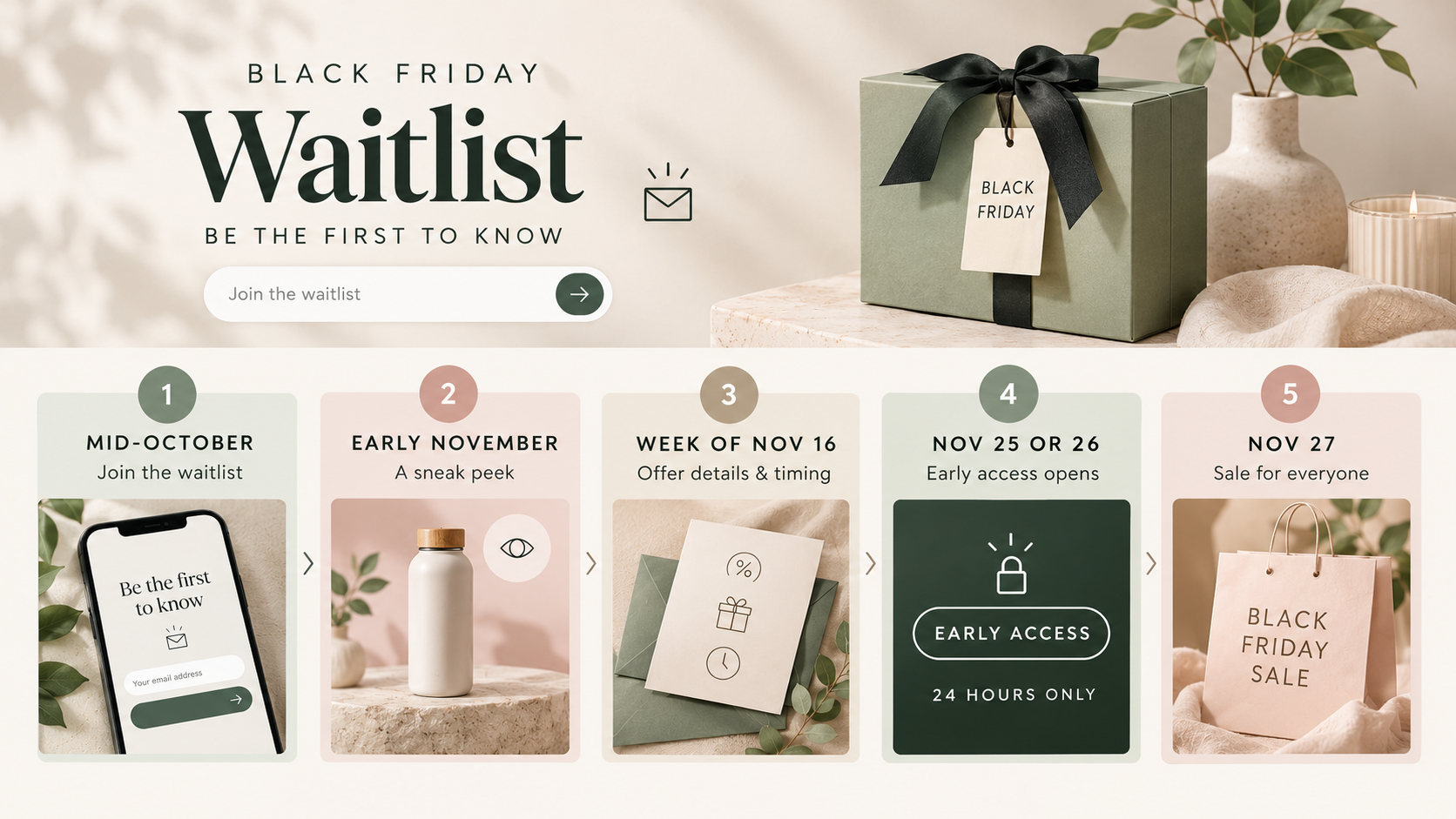
A timeline that works:
- Mid-October: a simple landing page with one promise ("first access, 24 hours before everyone else") and a single form field.
- Early November: a teaser email showing one product from the sale without the price.
- Week of November 16: reveal the offer structure and tell the list when access opens.
- November 25 or 26: open early access to the waitlist, with a clear end time.
- November 27: open the sale to everyone.
The strongest reward is access to something scarce, such as first pick of a limited-stock doorbuster or an extra gift tier. A deeper discount than the public gets teaches your best customers to wait for the next VIP window. Get explicit consent before sending SMS, and keep the list warm with one or two useful emails between sign-up and launch.
Common mistake: collecting emails in October and sending nothing until the sale. By November 27, a subscriber who hasn't heard from you in six weeks treats your message like any other promotion.
2. Drop a capped-inventory doorbuster with a live stock count
A doorbuster is one product at a price low enough to bring traffic, with a hard limit on units. The cap does the persuading. Shoppers have learned to distrust deadlines that move, but a stock count that falls as orders come in is a deadline they can watch. That's the same logic behind the better limited-time offer strategies: the scarcity has to be real.
Choose one or two products, not ten. Good candidates are your best-selling entry product, a limited-edition colorway, or a discontinued variant. Set the cap by what you can afford to lose on the discount, not by what you hope to sell, and add a quantity tier or a free-gift threshold on the same page so the traffic the doorbuster brings has something else to buy.
Practical rules:
- Turn on inventory tracking and set the exact available quantity.
- Limit units per customer through your theme or an app, so resellers can't clear the stock.
- Show remaining stock on the product page and in emails, using real numbers.
- When it sells out, leave the page up with a waitlist form for the next drop.
Common mistake: setting the cap so high that the doorbuster never sells out. At that point, it's an ordinary discount with a nervous banner on it.
3. Build a margin ladder with Buy More Save More tiers
Quantity breaks suit Black Friday because they ask for something small, one more unit, and show the reward right on the product page. The part most stores skip is setting tier depth from unit economics. Start with landed cost and a gross-margin floor you won't go below, work backward to the deepest discount you can afford, and then set your tiers well inside that ceiling. That's the logic behind good quantity break pricing.
Name the tiers for what they mean to the shopper ("Most popular," "Best value") and keep the copy short enough for a phone. Because margin percentage drops a little at each tier while profit per order climbs, judge the ladder on profit per order, not on discount depth.
Also check how the tiers interact with everything else you're running. A quantity tier stacked on a sitewide code can cut your margin twice, so decide in advance whether automatic discounts are allowed to combine.
Pumper's Buy More Save More tiers sit above the Add to Cart button, so shoppers compare the whole ladder before they scroll.
Set Up Buy More, Save More With PumperBuild quantity-break tiers above your Add to Cart button and apply discounts automatically at checkout, with no theme code or discount codes for shoppers to enter.
|
4. Pair a hero product with your dead stock using cross-product BOGO
Every store has inventory that sits: a bet that didn't land, or last year's seasonal item. Discounting it alone rarely moves it. Black Friday gives you a better route, which is to attach it as the free or discounted item in a BOGO deal on a product people already want. The shopper sees a free product, and you convert stock that's tying up cash and shelf space.
A few rules keep it clean:
- Pair by relevance. A dead-stock candle bundled with a skincare hero looks random, while a matching travel-size item looks like a thoughtful gift.
- Cap by inventory. Count what you have and limit the deal to that quantity.
- Name the free item and show its value in the offer copy.
- Use Buy 2 Get 2 for cheap consumables, where the per-unit cost is low, and a bigger order is the goal.
The cost comparison is simple: a free item costs you its landed cost, while a markdown on the hero costs you margin on every unit. Most BOGO sale ideas work for this reason, since the shopper sees a gift and your margin on the main product stays intact.
Pumper's BOGO offers cover same-product and cross-product pairings, so the dead-stock version runs from the same place as a standard Buy One Get One.
Set Up Cross-Product BOGO With PumperPair a hero product with a free or discounted second item, or run Buy 2 Get 2 offers. Display your deals as clear tier cards on your product page to help shoppers understand the offer and buy more.
|
5. Offer a mystery-gift ladder that unlocks as the cart grows
A free gift gives a shopper a reason to add one more item, and a mystery gift adds curiosity. Instead of announcing exactly what the top tier includes, you name it "Surprise Founder's Gift" and describe the range ("a full-size product worth $20 to $45").
Set the tiers a little above your current average order value, so each one asks the shopper for a realistic step:
- Tier one: a sample set or small add-on, named and shown.
- Tier two: a full-size item from a slower-moving product, named and shown.
- Tier three: the surprise gift, a single product you fulfill from a rotating pool.
For the surprise tier, create one gift product, track inventory against it, and have your packing team pull from the pool. Every item must carry a retail value at or above what you promised on the page, because shoppers who feel shorted by a mystery gift don't come back. Add the landed cost of each gift to the order cost before you set thresholds.
Pumper's Unlock Free Gifts lets each tier unlock a different gift with a visible FREE label, so the reward shows before checkout.
Set Up Tiered Free Gifts With PumperLet shoppers unlock a different free gift at each spend or quantity threshold, displayed with a clear FREE label on your product page to make every reward easy to understand.
|
6. Let shoppers build their own Black Friday box
Gift shoppers know the recipient but not which of your 40 products fits. A build-your-own bundle turns that into a bounded choice: "Pick any 4 for one price," chosen from a collection you curate.
Three formats to test:
- Pick any 4 from 12. Works for products that sit well together, such as candles, teas, snacks, or skincare minis.
- Complete the routine. A mix-and-match format where the shopper picks one item from each of three steps, such as cleanser, serum, and moisturizer.
- The host box. Built around an occasion, where every pick suits the theme.
A shopper who has spent five minutes choosing items has made a small investment and is more likely to check out, which also helps with the "I'll come back later" problem. Check packaging and shipping weight, since a four-item box ships heavier than a single product.
Pumper's Bundle & Save gives shoppers a product picker inside a bundle, with the combined discount applied once the set is complete.
Set Up Build-Your-Own Boxes With PumperLet shoppers choose the products they want in a bundle, with a combined discount applied to the full set. Create flexible bundle offers that give customers more control over what they buy.
|
7. Add a one-click "gift add-on" after checkout
On Black Friday, checkout speed matters, and you don't want extra steps in the way. A post-purchase upsell waits until the order is paid, so the shopper has already committed and the offer can't lower the conversion rate of the main order.
The strongest formats build on the fact that many shoppers are buying for someone else:
- "Sending this as a gift? Add a second one." A repeat of the product they just bought, at a discount, for a second recipient.
- The complement. The refill, the travel size, the case, or the matching accessory, similar in spirit to a frequently bought together pairing.
- The personalization add-on. Gift wrap, a handwritten card, or engraving if you offer it.
Keep the offer small, relevant, and acceptable in one click, and price it below what the shopper would pay on the product page, since a visible lower price elsewhere invites them to wait and reorder. Check results the next morning and swap weak offers for stronger ones.
8. Sell bonus gift cards that defer your discount
Gift cards ranked among the top four gift categories in NRF's 2025 survey, at 26% of shoppers. A bonus gift card promotion taps that habit: "Buy a $100 gift card, get a $20 bonus card for January."
The appeal is timing. A standard discount costs you margin today, while a bonus card costs you nothing until it's redeemed, and then it's spent on products that carry your normal margin. Some bonus cards are never redeemed at all, though you shouldn't plan around that.
Design it around the calendar:
- Start the bonus later. A bonus card valid from early January pulls revenue into a slow month.
- Use spend steps. Higher steps encourage larger cards.
- Offer instant delivery. Gift cards by email suit last-minute shoppers.
- Keep the terms plain in checkout copy, and check local gift card expiry rules before setting dates.
Common mistake: letting the bonus card be redeemed immediately on sale items. That turns it into a stacked discount.
9. Offer a Black Friday price promise
Shoppers wait. Salesforce analyzed 1.5 billion shoppers in 2023 and found them holding off on non-urgent purchases until major sales events, with early-season US holiday sales down 2%. The question in their heads is "will this get cheaper if I wait?" A price promise answers it directly, and it works on the same loss aversion that drives most of the psychology of Shopify promotions.
The promise: "Buy during our Black Friday sale, and if the price drops further before the end of the year, we'll credit you the difference." Publish it on the product page, in the email, and at checkout. Then control the downside:
- Use store credit, not cash, so the credit brings the shopper back for another order.
- Set a window, such as through December 15.
- Cap it per order.
- Decide your calendar first. If you already know you won't go deeper than Black Friday pricing, the promise costs almost nothing. If you plan a deeper offer later, don't make it.
Make claiming easy with a short form or an email reply, with a quick check before credits issue.
10. Run a no-discount Black Friday built on value
Some of the most memorable Black Friday campaigns skipped the discount. Patagonia ran its "Don't Buy This Jacket" ad on Black Friday 2011, and REI launched #OptOutside in 2015 by closing its stores on the day (Fast Company, 2015). Those are large brands, but the principle scales down: if your brand stands for something other than price, a day of discounts can undercut it.
A small Shopify store can run a version without closing its doors:
- Add value instead of subtracting price. Free engraving, free gift wrap, extended returns through January, or a shipping upgrade.
- Give with every order. Donate a stated amount per order to a cause your customers care about, and say exactly how it's calculated.
- Offer repair, refill, or trade-in, which suits sustainable brands.
- Turn the day into content: how a product is made, a behind-the-scenes video, a founder note.
Value-adds usually cost less than the percentage discount they replace, as long as shoppers see them as worth more. This fits brands with a clear point of view, premium positioning, or a loyal audience, and it fits less well when shoppers expect you to match market prices on commodity items. Test it on part of your catalog before betting the whole day on it.
What Is a Black Friday Sale?
A Black Friday sale is a promotional event held on the Friday after US Thanksgiving, when retailers cut prices on a wide range of products to start the holiday buying season. The name dates to Philadelphia in the late 1950s, where police used it to describe the crowds (Shopify, 2018). Today it's mostly an online event: 85.7 million people shopped online on Black Friday 2025, compared with 80.3 million in stores. For Shopify merchants, it's the anchor of the holiday season, and many stores now run it as a multi-week campaign that builds toward the day itself.
When Does Black Friday Sale Start?
Black Friday is Friday, November 27, 2026, but sales start earlier. Amazon, Walmart, and Target now run October deal events, as NBC News noted. Plan a teaser in early November, early access days before, and a public launch at 12:01 a.m. Friday.
Why Black Friday Matters for Shopify Merchants
Black Friday gives you the largest concentration of holiday buyers on a single day, and what you learn from it shapes the weeks after. Adobe measured $11.8 billion in US online spend on the day in 2025, a record, and the full November and December season came to $257.8 billion, up 6.8%.
For a Shopify store, the day matters beyond its own revenue. Shoppers acquired on Black Friday are your December repeat buyers and your January subscribers. Gift buyers make up much of the demand, since NRF found that about two-thirds of the average $337.86 spent per shopper over the holiday weekend went to gifts, which means more items per order and more reason to offer bundles and gift-ready options. It also shows which offers work while there's still time to adjust before Christmas.
Thanksgiving vs. Black Friday
Thanksgiving and Black Friday sit one day apart but behave differently on a Shopify store. Thanksgiving Day is early-bird and mobile-heavy, while Black Friday is where price comparison peaks and the biggest share of online shoppers arrives. The table below compares them on numbers and on what to run.
Black Friday Shopping Trends for Shopify Stores
- Black Friday keeps growing. The day reached $11.8 billion online in 2025, up 9.1%, with online shoppers (85.7 million) outnumbering in-store shoppers (80.3 million).
- Mobile is the default. It hit 61.6% of Thanksgiving Day online spend, and a September 2026 summary of holiday forecasts expects about 58% of online holiday sales on mobile, with total online sales passing $300 billion for the first time.
- The season starts in October. Large retailers run early events, and NRF found 84% of shoppers had begun holiday shopping by Thanksgiving weekend 2025.
- Value drives decisions. Deloitte expects 67% of retail executives to raise free-shipping thresholds in 2026, per Total Retail, which gives stores with fair shipping terms an edge.
- Gifts shape the basket. About two-thirds of NRF's 2025 average spend per shopper went to gifts, and gift cards ranked among the top four categories.
What Customers Expect From Black Friday Sale
Baymard Institute research on why people abandon carts gives the clearest picture of what shoppers expect.
- A deal they can read in seconds. "Buy 2, save 15%" works, and a paragraph of terms doesn't.
- No surprise costs. Forty percent of abandoners cite extra costs, and 12% say they couldn't see the total upfront.
- Fast checkout. Eighteen percent abandon over forced account creation and 17% over a long process.
- Trust and payment choice. Nineteen percent worry about card security, and 9% cite too few payment methods.
- Delivery they can count on. Twenty percent cite slow delivery, so publish cutoff dates for orders to arrive before December 25.
- Sensible returns. Thirteen percent cite an unsatisfactory returns policy, and extended holiday returns reassure gift buyers.
- An honest deadline. If the offer ends Friday at midnight, it should end then.
Plan Your Black Friday 2026 Promotions With Pumper
The ten ideas above share one principle: raise what each shopper buys without discounting everything you sell. Black Friday rewards stores that plan specific offers, check margin before every publish, and put the offer where shoppers can see it on a phone.
Pumper Bundles is one of several bundle apps for Shopify, and it covers the offer types used here- Buy More Save More, BOGO Offers, Unlock Free Gifts, and Bundle & Save in one app, with offers placed above the Add to Cart button and no theme code. It holds a 4.9-star rating across more than 3,500 reviews on the Shopify App Store, and the free plan covers up to $300 in extra revenue, enough to test an offer before you scale it.
Get Your Black Friday 2026 Offers Live With PumperBuild quantity breaks, BOGO deals, free gifts, and bundles from one Shopify app. Set up your offers and publish when you're ready. Start on the free plan.
Install from Shopify App Store → Start on the free plan. Publish when you're ready. |
Frequently Asked Questions
When is Black Friday 2026?
Black Friday 2026 is Friday, November 27, the day after Thanksgiving on November 26. Many stores open early access earlier in the week, and large retailers have run October events, so plan around a multi-week window instead of a single day.
How early should I start my Black Friday promotions on Shopify?
Start collecting a waitlist in October, send a teaser in early November, and open early access in the days before November 27. Build and test offers well before then, so you aren't changing prices during Black Friday week.
What discount should I offer on Black Friday?
There's no universal number. Set tier depth from your landed cost and a gross-margin floor, and favor tiered offers, since 10% off two units and 15% off three often protect margin better than one flat percentage, which is why most volume discount apps are built around tiers.
Should I discount my whole store or just selected products?
Selected products and threshold-based offers usually protect margin better. A sitewide code discounts orders that would have happened anyway, while tiers, gift thresholds, and bundles reward the behavior you want, which is a bigger basket.
Do BOGO and bundle offers work on Black Friday?
Many shoppers are buying gifts and want a clear, visible deal, which is why BOGO offers and bundles fit the day. Cross-product BOGO is also a good way to move slow inventory. Test them on separate products, then compare average order value and profit per order.
How do I protect margin during a Black Friday sale?
Work out gross profit per order for each offer before publishing, including the landed cost of any free gift and shipping. Limit your deepest discounts to a short list of products, confirm Shopify discounts don't stack unexpectedly, and compare profit per order, not just revenue, afterward.
Is Black Friday worth it for a small Shopify store?
It can be, if you compete on something other than the lowest price. Small stores do well with waitlists, bundles, value-adds, and a clear point of view, since they can't win a price war against large retailers. A no-discount Friday is a legitimate option.