



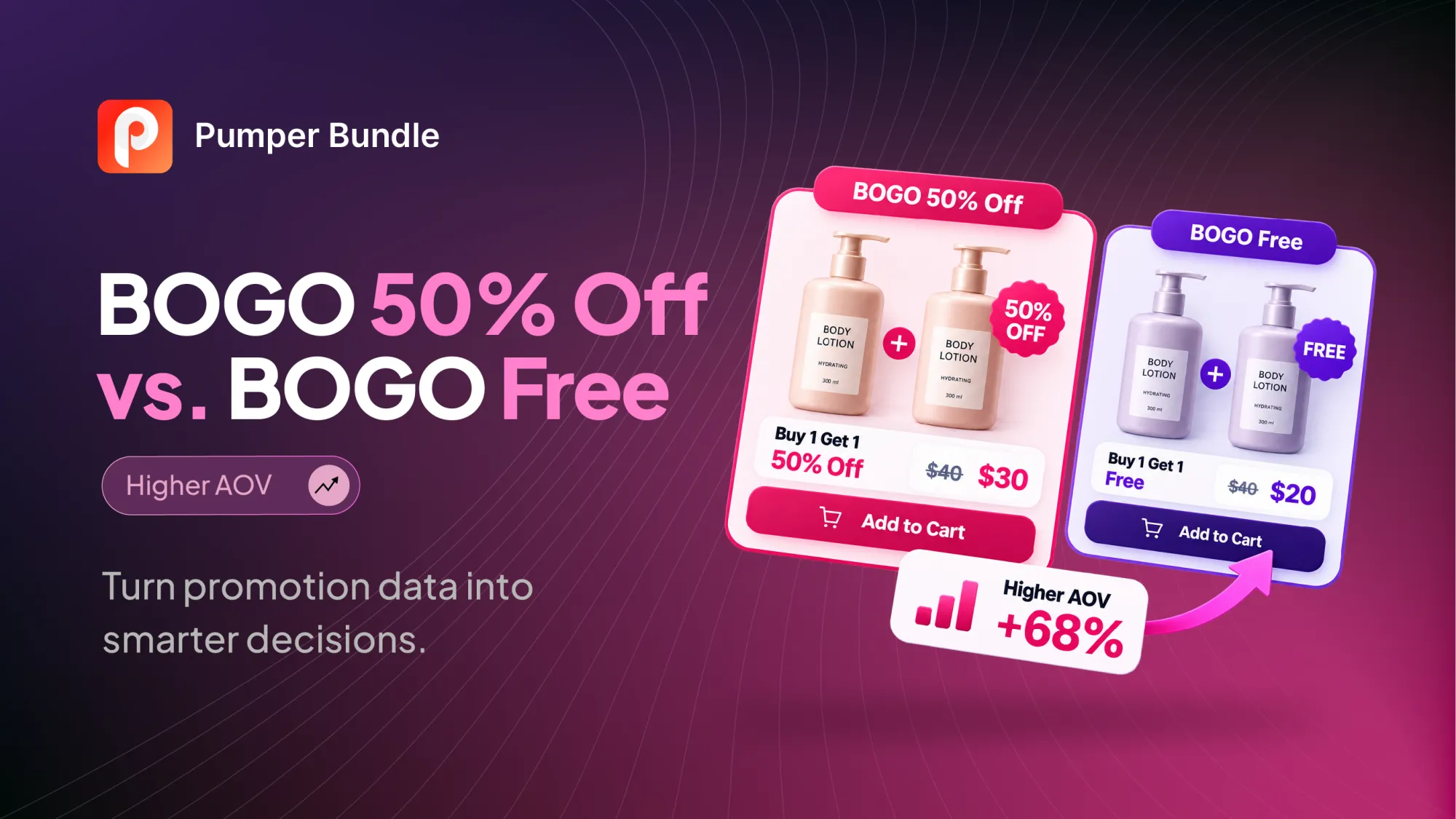
Two offers sit side by side in almost every promotion calendar. One says "Buy one, get one free" and the other says "Buy one, get one 50% off." They look like cousins, and plenty of merchants pick between them based on which headline feels more exciting.
The two offers carry very different price tags. Free means the pair costs the shopper half of list price. Half off means the pair costs three-quarters of list price. That gap decides whether a promotion adds profit or quietly subtracts it.
This guide compares the two on the numbers that matter: effective discount, margin break-even, shopper psychology, and what happens to demand after the promotion ends. You'll also get a clear set of rules for choosing between them, and a simple way to test your choice in your own store.
Key Takeaways
- Buy one get one free is a 50% discount on the pair. Buy one get one 50% off is a 25% discount on the pair, so the free version gives away twice as much margin per redemption.
- Below 50% margin, a free second unit loses money on every pair. Above 50%, half off earns more than a single full-price sale. At 50% or above, half off on the second unit earns more than selling a single unit at full price.
- A 2020 Journal of Business Research study found shoppers preferred BOGO deals over equal-value percentage discounts, and the pull grew with the size of the discount. Free draws attention, but you pay for that attention in margin.
- A 2004 Marketing Science field study found deeper promotions lowered later purchases from established customers. Reserve the deepest deal for people you're trying to win, not the ones already buying.
- Test the two offers head to head and judge them on profit per visitor, not conversion rate alone.
The Real Cost Behind Two Offers That Sound Alike
Start with what each offer does to the price of a two-unit purchase. Assume both units sell at the same list price, which we'll call P.
The headline percentage on the second unit tells you very little. "50% off" appears in the name of the half-off offer, yet it delivers a 25% discount across the order. "Free" sounds like 100% off, and across the pair it delivers 50%.
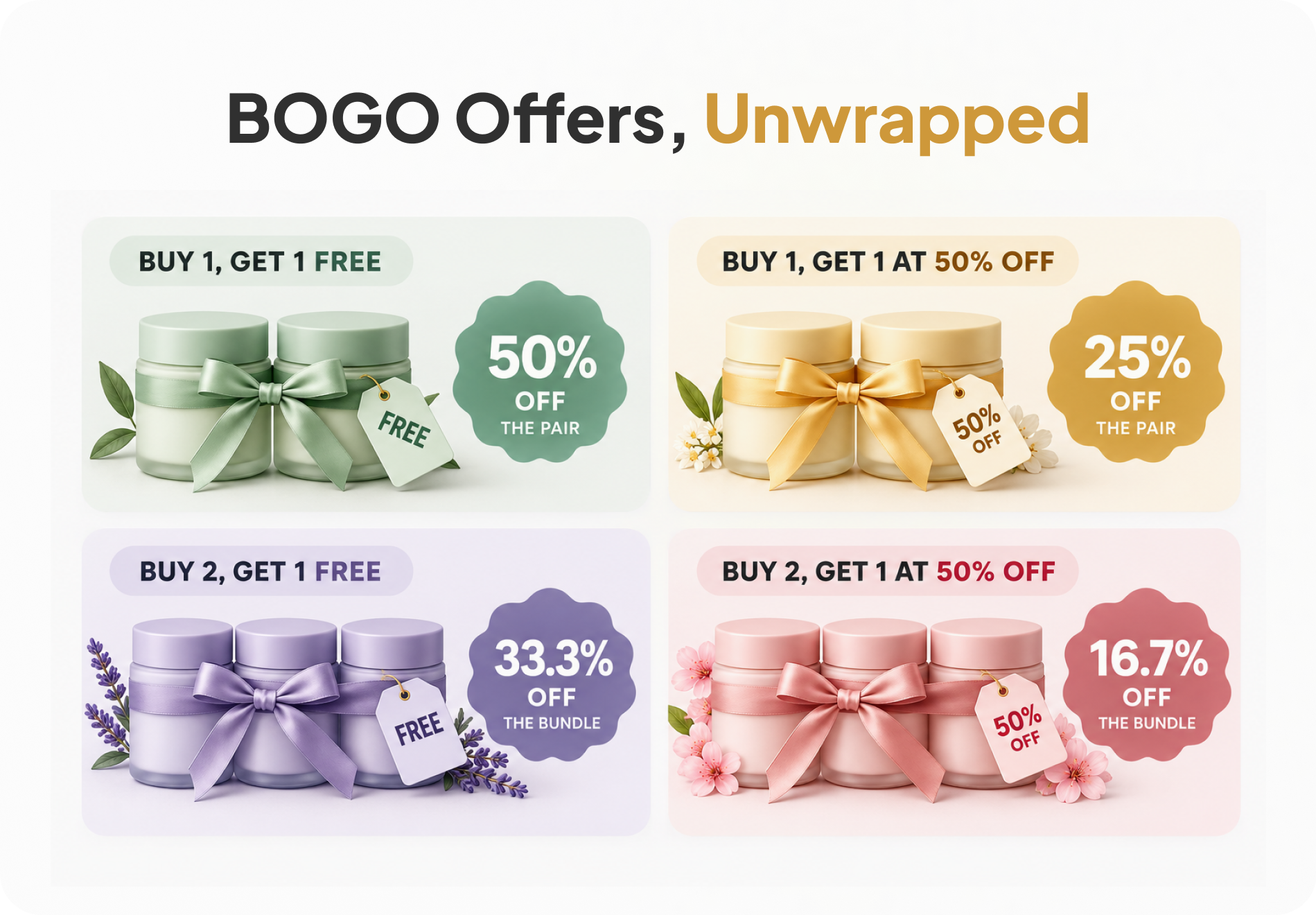
That matters because shoppers rarely do this arithmetic at the product page. They see the label on the second unit and react to it. The merchant is the only person in the transaction who sees the effective discount, which makes the merchant the only person who can choose it on purpose.
Why the Same Price Can Hide Different Economics
The table above assumes identical units. Real catalogs rarely work that way, and the rule that decides which unit is free or discounted changes the cost of the deal. Shopify's native Buy X get Y discount, for example, applies the reward to the lower-priced item when the same product or collection appears in both the "buys" and "gets" sections (Shopify Help Center).
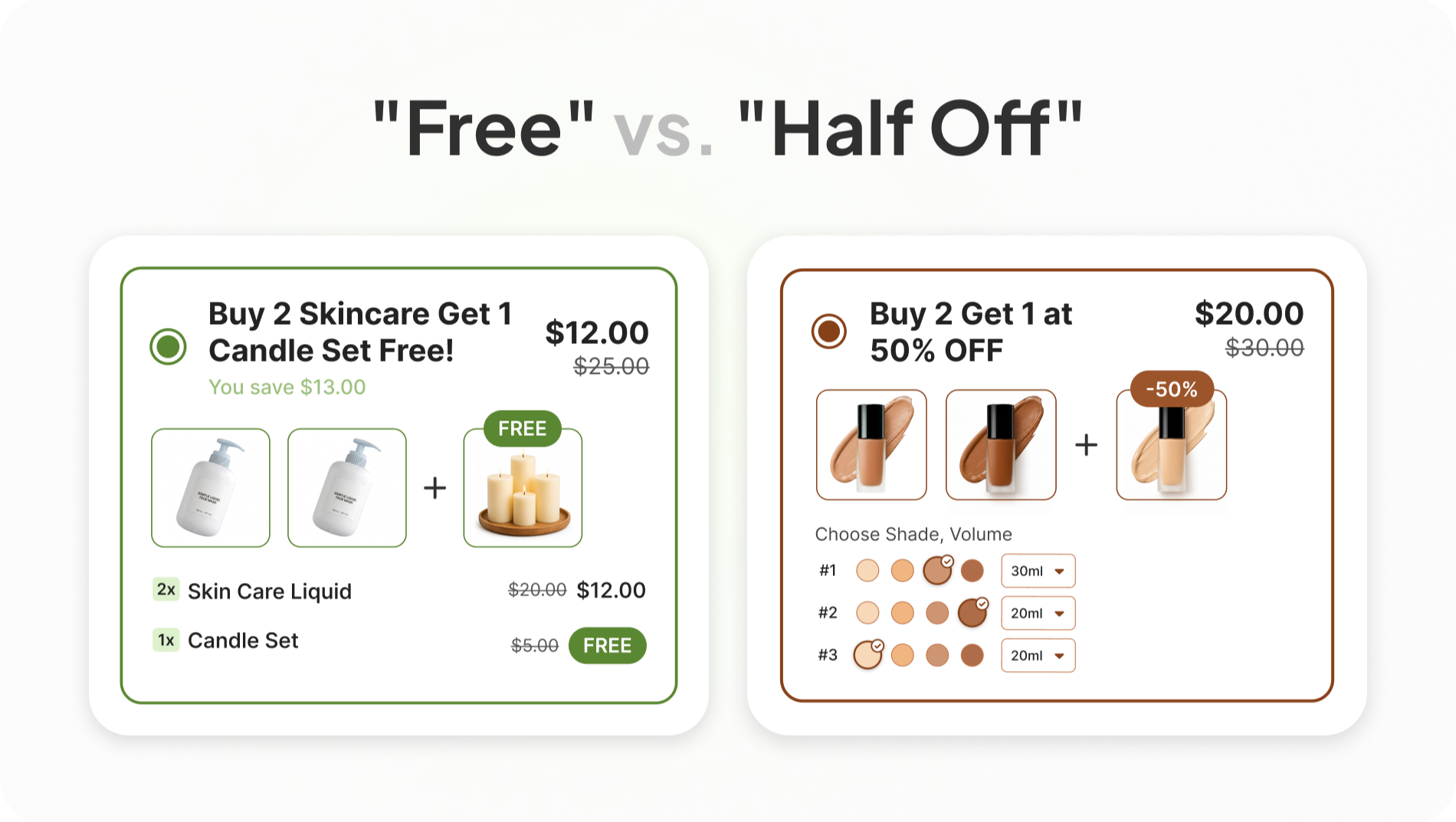
So a shopper who adds one low-priced and one high-priced item from the collection gets the low-priced item as the reward. Your cost is the cheaper unit, which is usually the outcome merchants want. If you intend the reward to be a specific product, set the qualifying and reward products separately instead of relying on the cheapest-unit rule.
Margin Break-Even: What Each Offer Demands From Your Volume
Gross margin is the number that separates a smart BOGO from an expensive one. Use contribution margin per unit here, which means price minus product cost, payment processing, packaging, and the share of shipping you absorb. Call it m, expressed as a share of the selling price.
Selling one unit at full price earns you m × P. A two-unit pair under each offer earns:
- Buy one, get one free: P − 2C, which works out to (2m − 1) × P
- Buy one, get one 50% off: 1.5P − 2C, which works out to (2m − 0.5) × P
Two conclusions fall out of those formulas, and neither depends on your category. Pricing each unit from its true marginal cost is the subject of Pumper's quantity break pricing guide, and the same discipline applies here.
First, a free second unit only earns a positive profit when your contribution margin is above 50%. At exactly 50%, the pair earns nothing. Below that, every pair loses money before you count a single dollar of advertising.
Second, compare each pair with the single-unit sale it replaces. Free never beats a single full-price sale for a shopper who would have bought one unit anyway, because (2m − 1) is always smaller than m when m is below 100%. Half off beats the single sale only when margin is above 50%, since (2m − 0.5) exceeds m once m passes 0.5.
How Many More Buyers Each Offer Needs
Plenty of BOGO shoppers are people who wouldn't have bought at all, and that's the whole reason to run the promotion. The question becomes how many extra buyers you need to make up for the margin you give away on the buyers you already had.
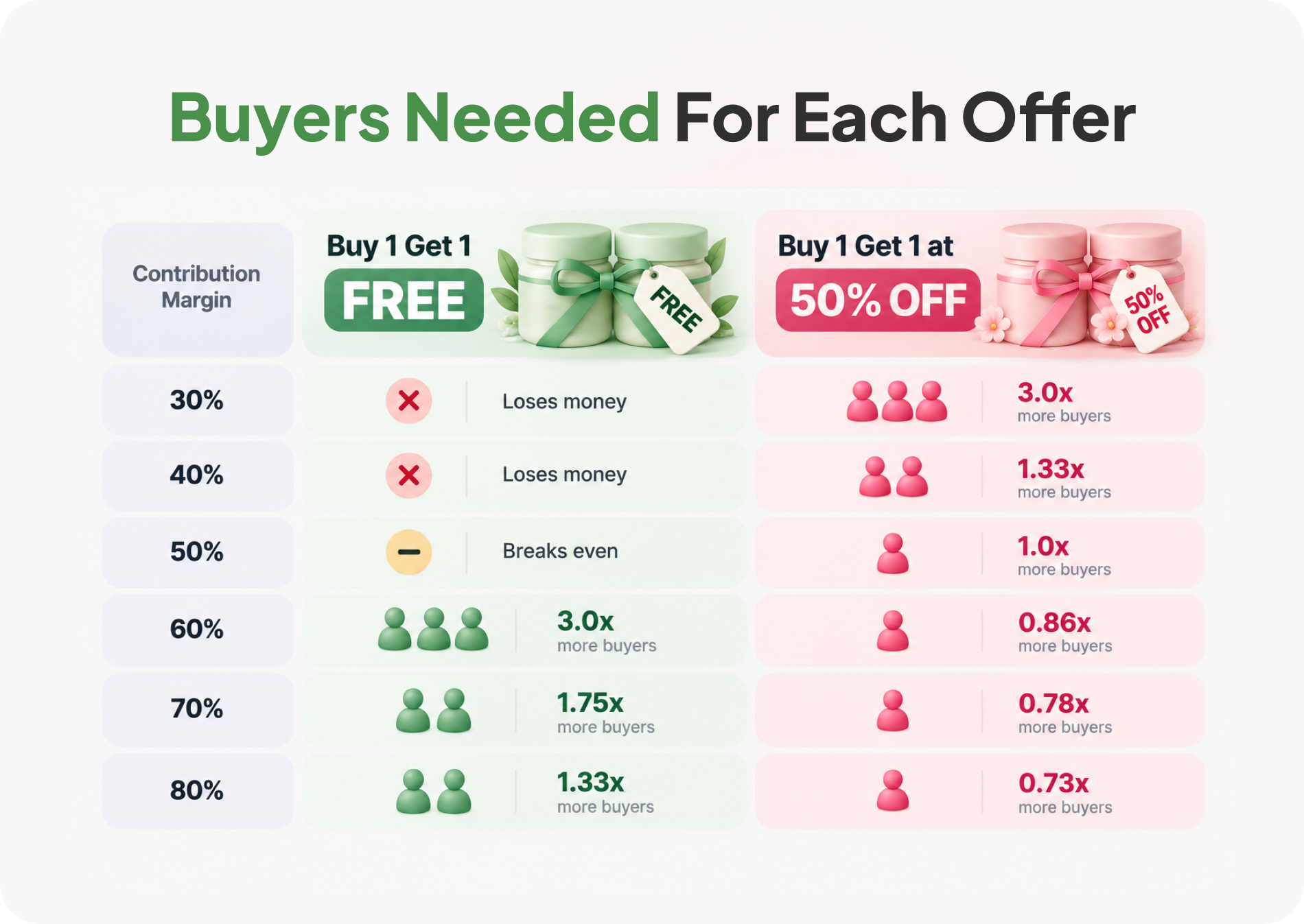
The table below shows the buyer multiplier needed to hold gross profit flat, assuming every existing buyer takes the two-unit deal. That assumption is generous to the offer, so treat each figure as a floor. In practice some buyers will keep buying one unit, which changes the answer in your favor for half off and against you for free.
The multiplier comes from a single formula: today's profit per buyer, m × P, divided by the profit per buyer under the offer. A multiplier below 1.0 means you could lose some buyers and still come out even. Above 1.0, the offer has to attract new buyers to break even.
At a 60% margin, a free second unit needs three times today's buyers to hold profit flat, while half off holds profit flat even if you lose about one buyer in seven. Those two offers behave like different products, and the margin line on your P&L is what tells you which one you're running.
Set the Reward Product, Discount, and Tiers YourselfPumper's BOGO feature lets you choose the qualifying product, reward product, and discount depth separately. Offer the reward for free or at 50% off, and customize your deals to fit your store's promotions.
|
The Costs the Margin Formula Leaves Out
Contribution margin captures the costs that scale with each unit, but a two-unit order adds some costs the formula only partly covers. A heavier parcel can push a shipping rate up a weight band. Returns also multiply with unit count: the National Retail Federation and Happy Returns projected that 19.3% of online sales would be returned in 2025 (NRF, October 2025), so a pair has two chances to come back.
Decide before launch how a returned free unit gets refunded. Refunding the amount paid, divided across the two items, is a common approach, but whichever rule you pick, put it in the offer terms so support doesn't improvise it order by order.
How Shoppers Read "Free" Versus "Half Off"
The numbers favor half off for most merchants with margins under about 60%. The research on shopper behavior explains why free keeps winning the headline vote anyway.
Free Wins on Attention
A team of four researchers ran an eye-tracking study of BOGO deals against percentage discounts of equal value. Participants preferred the BOGO offers even when the net value matched. The preference grew stronger when the discount was large, and BOGO deals drew more visual attention in those cases (Gordon-Hecker et al., Journal of Business Research, 2020).
Their finding applies to the free version directly. A "get one free" label reads as a gift, while "50% off" reads as a markdown. If your priority is getting a shopper to stop and look, free has a measurable edge.
That edge matters most where attention is scarce, such as a collection page full of competing tiles or a paid ad that gets one second of a scroll. It matters less on a product page, where the shopper has already decided to look and is weighing price against need.
Free Also Distorts Judgment
An earlier line of work gives a reason. A Marketing Science paper by Sha
mpanier, Mazar, and Ariely found that when the price gap between two products stayed fixed, and the cheaper one dropped to zero, far more people chose it (Shampanier, Mazar & Ariely, 2007). The authors attribute the pull to an emotional response to the word "free" rather than a cost-benefit calculation.
Together, these findings describe a trade. Free can lift attention and choice because of how it feels, and half off lets you keep more of the price. Whether the trade makes sense depends on what you need the promotion to do.
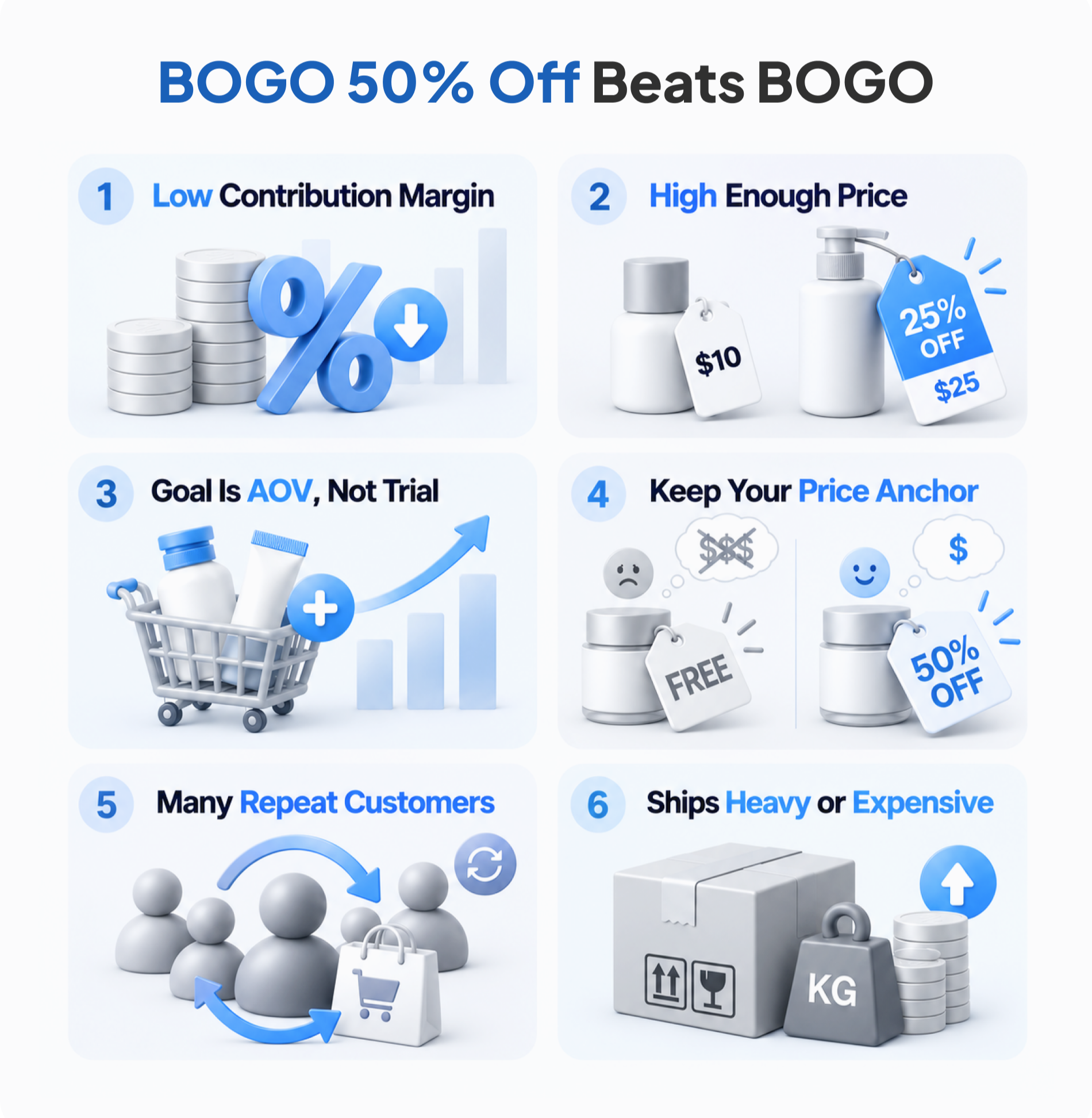
Six Situations Where BOGO 50% Off Beats Buy One Get One Free
Here are the conditions under which the cheaper offer is the better one. Most real stores meet at least two.
1. Your Contribution Margin Is Under 60%
This is the cleanest rule. Below a 50% margin, a free unit loses money on every pair. Between 50% and 60%, it earns so little per pair that you'd need a large jump in new buyers to justify it. Half off stays profitable down to a 25% margin, and it needs few or no additional buyers once margin passes 50%.
2. The Product Is Priced High Enough for a 25% Discount to Register
A 25% discount on a high-priced pair produces a dollar figure shoppers can see. The same 25% on a low-priced item may amount to a couple of dollars, which is easy to overlook. Pumper's {Savings} variable shows the dollar savings on each tier automatically. Shoppers judge the size of a saving against a reference point, and Pumper's guide to matching promotions to customer motivations explains how those reference points form.
3. Your Goal Is AOV, Not Trial
Half off pulls a second unit into the basket from shoppers who were already planning to buy one. Because the margin on that second unit stays positive, the offer lifts order value and profit together.
4. You Don't Want to Reset Your Price Anchor
A "free" unit lets a shopper decide the product's real price is half of what you list. Half off leaves the full price intact as the reference point, because the shopper still pays full price for the first unit and sees a modest saving on the second. Stores that sell mainly at list price have more to protect.
5. Your Repeat Customers Make Up Much of the Order Volume
Anderson and Simester ran three field experiments with a catalog retailer of books and software. Deeper current discounts raised later purchases from first-time customers and lowered them from established customers (Anderson & Simester, Marketing Science, 2004).
The authors point to forward buying, customer learning, and rising deal sensitivity as the reasons. A shallower promotion is a safer default when most of your orders come from returning buyers, because those buyers are the group that reacted badly to depth in that study.
6. The Item Ships Heavy, Fragile, or Expensive
Every extra unit adds fulfillment cost. A cheaper second unit leaves you more room to absorb that cost, which is the main reason half off holds up better on bulky goods.
When Buy One Get One Free Is Still the Better Call
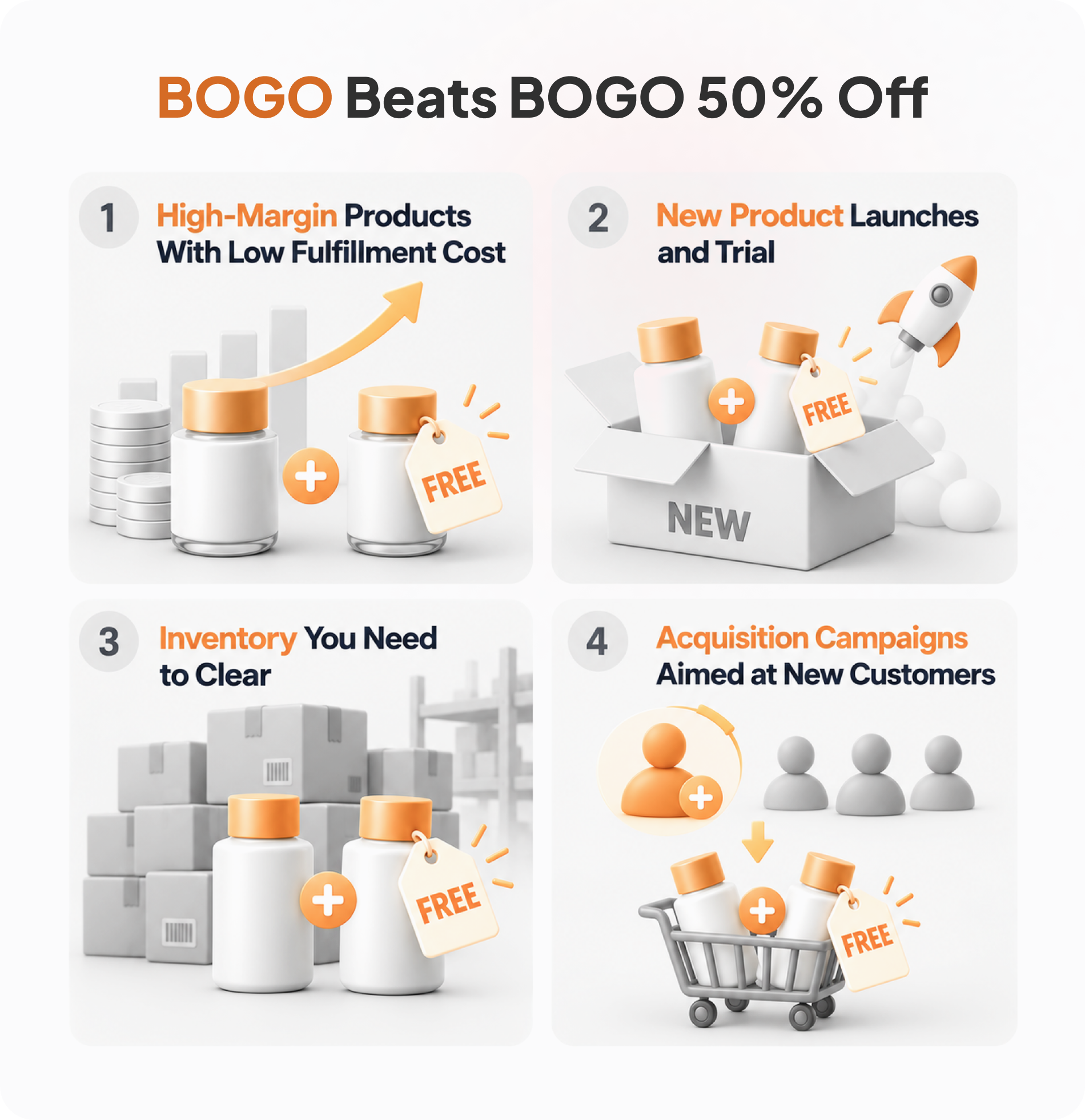
Free is a legitimate choice for merchants who can afford it, and four situations favor it.
High-Margin Products With Low Fulfillment Cost
Any product with a large markup over its landed cost can carry a free second unit. At a 70% contribution margin, the free version needs 1.75 times today's buyers to hold profit flat. That's a reachable target for a store with real top-of-funnel traffic, and the free headline can provide the volume.
New Product Launches and Trial
When the goal is getting a product into hands, a free second unit doubles as a sample. Shoppers who like the product have a spare to share or a reason to reorder, which can carry value beyond the first order.
Inventory You Need to Clear
Aging, seasonal, or soon-to-expire stock has a lower real cost than its book value, since it will otherwise sell at a deeper discount or not at all. In that case, the "cost" of the free unit is whatever you'd recover through a clearance sale, and free can be the faster route.
Acquisition Campaigns Aimed at New Customers
First-time buyers behaved differently from established buyers in the Anderson and Simester experiments, with deeper discounts raising their later purchases. If you can show the free offer mainly to people who haven't bought before, the depth works in your favor. Shopify's native Buy X get Y discount lets you limit eligibility to specific customers, customer segments, or markets, which gives you a starting point for that targeting.
Variations to Weigh Before You Commit
BOGO has more shapes than the two headline versions, and Pumper's roundup of BOGO sale ideas for Shopify lists fifteen of them. Each shape moves the effective discount, so check the math before copying a format you saw elsewhere.
Buy two, get one at 50% delivers a 16.7% discount on three units and keeps your price anchor nearly intact. It works well for consumables and sets, since a shopper who wants two often has room for a third.
Pumper’s Buy X Get Y offer works like this: the shopper buys the main product and gets a different product free or at a discount. Pairing a bestseller with a slower mover moves stock without discounting the bestseller itself, and the margin math uses the cost of the reward item instead of the qualifier.
Tiered rewards layer several offers into one widget, such as buy one get one at 50%, buy two get two at 50%. Pumper's BOGO feature page lists structures like buy 1 get 1, buy 2 get 1 free, buy 2 get 2, and buy 3 get 2 free, each with its own reward and savings shown on tier cards.
Whichever format you pick, run its effective discount through the table at the top of this guide first.
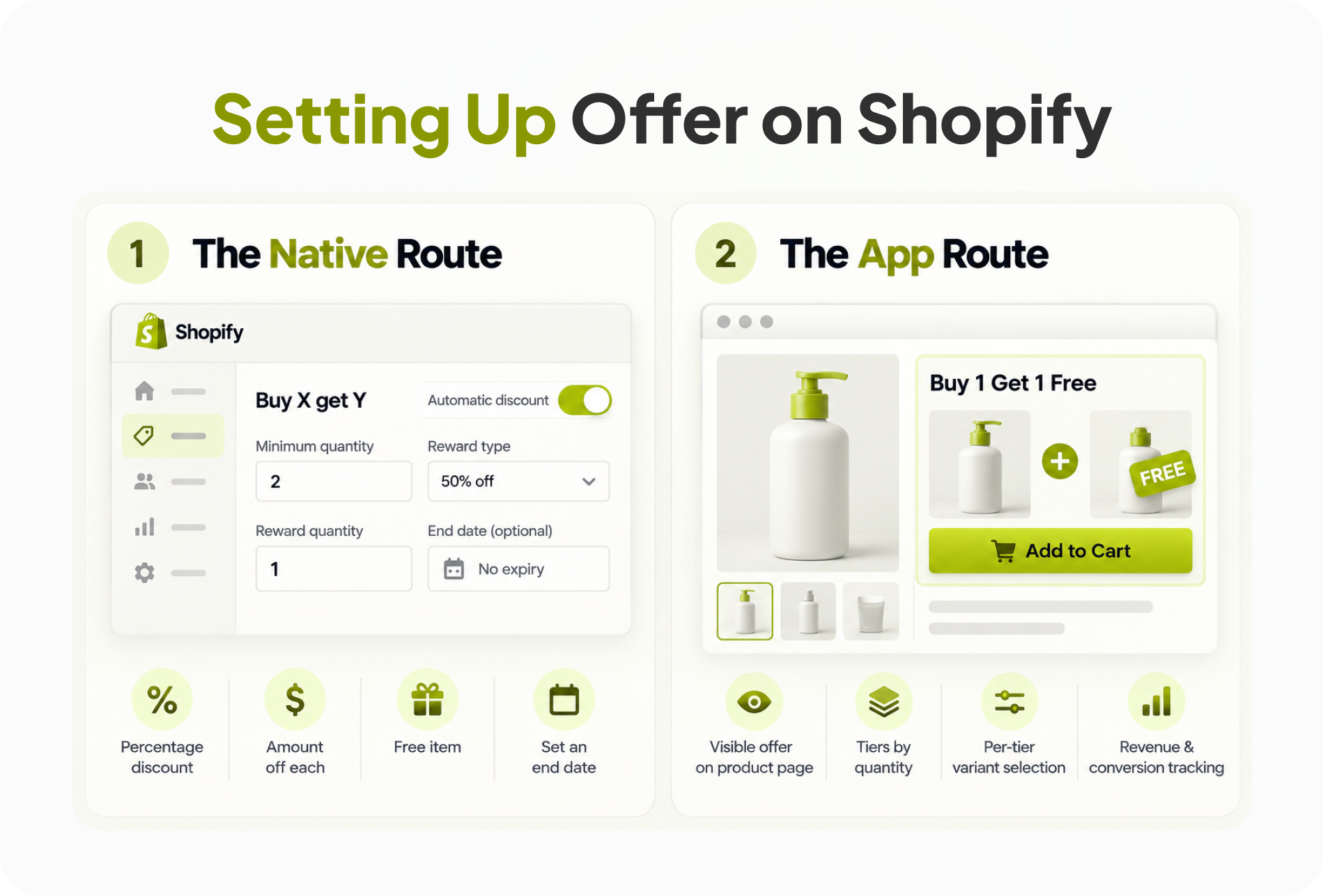
Setting Up Either Offer on Shopify
You have two routes: Shopify's native discounts or a dedicated app. Both can run either offer, and the differences lie in how the offer appears to the shopper.
The Native Route
Shopify's Buy X get Y discount takes a minimum quantity or spend for the "buys" side and a reward quantity for the "gets" side. Reward options are a percentage, an amount off each, or free. You can run it as a code or an automatic discount, and an optional end date controls expiry. Without one, the discount doesn't expire.
The native setup has limits worth knowing. Shopify states that customers must add all qualifying and free items to the cart themselves, since free items are never added automatically. The discount also doesn't apply on the post-purchase page at checkout. If free-product inventory reaches zero, the item shows as sold out, and the discount can't be used.
The App Route
A BOGO app like Pumper Bundles adds a visible offer on the product page, so the shopper sees the deal before reaching the cart. Pumper places its widget above the Add to Cart button and supports free or percentage rewards on a different product, tiers by quantity, per-tier variant selection, and a free-gift display. Revenue and conversion appear per offer in its dashboard, which helps when you're comparing two BOGO versions.
If you're comparing tools, the roundup of Shopify BOGO apps lines up pricing and features across ten options.
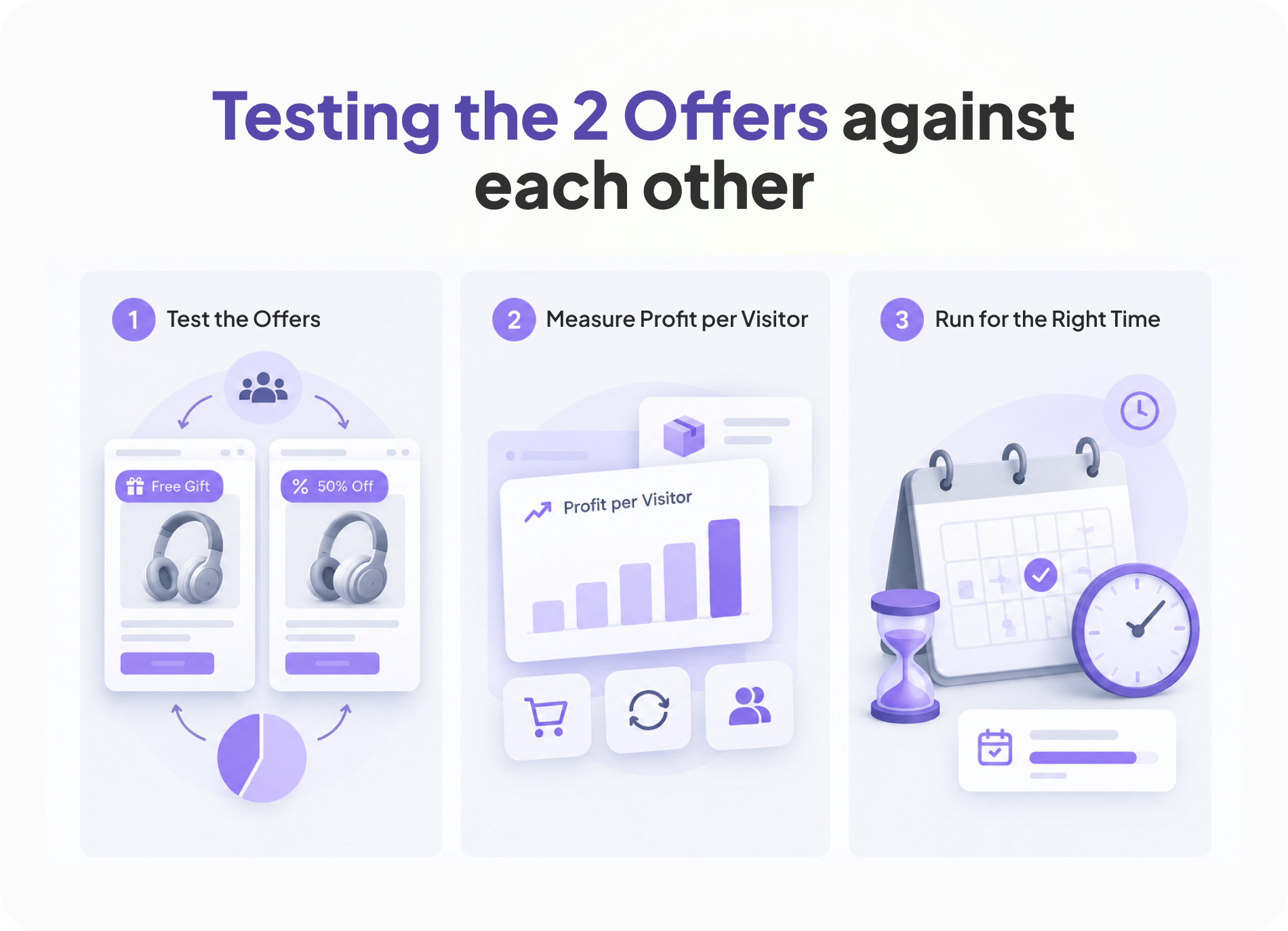
Testing the Two Offers Against Each Other
Choosing from a formula is a good start. A test settles it for your store, since your shoppers may respond to free or half off differently than the studies suggest.
Design the Test So It Isolates the Offer
Run both offers on the same product for the same period, and split traffic instead of running them one after another. Sequential tests mix in seasonality, ad spend changes, and email sends. If your setup can't split traffic, pick two comparable products with similar price and margin, and run one offer on each.
Keep the headline, imagery, and placement identical, and change only the offer. A different layout turns a two-variable test into a coin flip.
Judge the Result on Profit Per Visitor
Conversion rate favors the free offer almost by definition, since it is the more generous deal. Compare gross profit per visitor instead, which is revenue minus product cost, shipping absorbed, payment fees, and refunds, divided by the number of sessions on that product page. The offer with the higher number wins even when its conversion rate is lower.
Also track the share of orders that took the two-unit deal, and the repeat purchase rate over the following 60 to 90 days. Both numbers tell you what the discount did beyond the first order.
Give the Test Enough Time, and a Clear End
Run the test through at least one full purchase cycle for your product, so repeat buyers have time to appear. Set a firm end date up front, and keep the comparison window identical for both offers. The guide to limited-time offer strategies covers how to time-box a promotion honestly.
Resist the urge to stop early when one offer pulls ahead on day three. Early gaps often close once the novelty fades, and calling a winner before the window ends is how a coin flip gets mistaken for a result. Decide the sample size or the end date before launch, then read the numbers once.
See Which Offer Earns More Per VisitorPumper's dashboard tracks revenue, AOV lift, and conversions for each active BOGO offer. Compare offer performance side by side and identify which deal drives better results without relying on spreadsheets.
|
What Happens After the Promotion Ends
A promotion's sales bump overstates its value. Van Heerde, Leeflang, and Wittink broke the sales bump from store promotions into three parts using scanner data from four datasets. On average, one third came from shoppers switching brands, one third from demand borrowed from other time periods, and one third from genuine category expansion (van Heerde, Leeflang & Wittink, Marketing Science, 2004).
Those numbers come from grocery-style retail, and online stores will differ. The lesson carries over: part of any BOGO spike is purchases that would have happened later. A free second unit makes this worse, because a shopper with two units at home has no reason to reorder for a while.
Check your own data for this. After the promotion ends, compare reorder volume among buyers of the two-unit deal against buyers of a single unit over the same window. If two-unit buyers return later by about the length of the extra supply, you pulled demand forward, and the real return on the promotion is smaller than the bump suggests. You can find sales grouped by discount name in Shopify's sales-by-discount report, though an order with combinable discounts can appear in more than one row (Shopify Help Center).
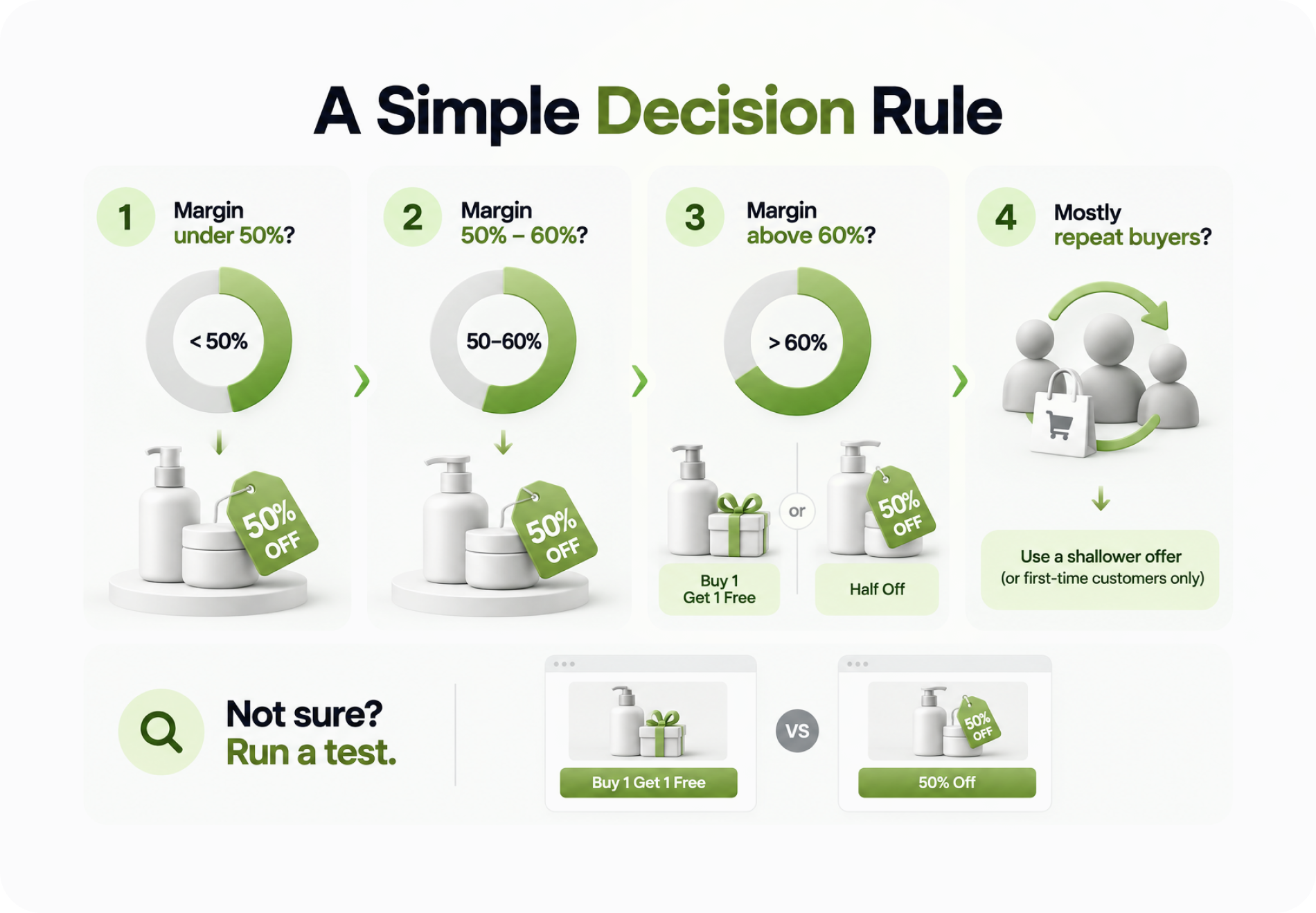
A Simple Decision Rule
To choose between the two offers, put your numbers through four questions, in order.
- Is contribution margin under 50%? Use half off, or don't run a BOGO on that product at all.
- Between 50% and 60%? Use half off unless you have a specific reason, such as acquisition or clearance, to go free.
- Above 60%? Both work. Pick free for acquisition, trial, or clearance, and half off when the priority is AOV or protecting your price anchor.
- Mostly repeat buyers? Lean shallower, or limit the deeper offer to first-time customers.
If your margin sits in the gray zone, run the test described above instead of guessing. For a wider view of how BOGO fits beside volume discounts, bundles, and free gifts, the guide to Shopify promotion strategies compares all five levers in one place.
Frequently Asked Questions
Is buy one get one 50% off the same as 25% off?
For two units at the same price, yes. The shopper pays 1.5 times the unit price for two units, which is 25% less than 2 times the unit price. The offer looks like a 50% deal on the second unit but averages out to 25% across the pair.
Does BOGO free lose money?
It loses money below a 50% margin and breaks even at exactly 50%. It earns a profit above 50%, though still less per pair than selling one unit at full price, which means the offer has to bring in new buyers to pay off.
Which converts better, free or half off?
Research on shopper preference points to free, with BOGO formats drawing more attention than equal-value percentage discounts in the Journal of Business Research study. Higher conversion doesn't guarantee higher profit, so measure profit per visitor.
Can I run both offers at the same time?
You can run both on different products. Running both on one product splits attention and muddies your read on which one worked.
What if my products have different prices?
Decide which unit gets the discount before you launch. Native Shopify Buy X get Y rules discount the lower-priced item when the same product or collection sits on both sides. An app that lets you name the reward product gives you more control.
Half Off for Most Margins, Free for Specific Goals
Buy one get one 50% off wins for most Shopify merchants because it protects margin, holds the price anchor, and still lifts order value. Buy one get one free earns its place when contribution margin is comfortably above 60% or when the goal is acquisition, trial, or clearing stock.
Whichever you pick, the label on the second unit is the least important part of the decision. Pair it with the other basket-building tactics in the Shopify AOV guide once the offer is earning its keep. The effective discount, the margin underneath it, and what the offer does to later purchases matter more, and all three can be checked before launch with the arithmetic in this guide.
Launch Your BOGO Offer Above the Add to Cart ButtonGet started with Pumper's free plan, covering up to $300 in extra revenue. Create BOGO offers with free, percentage-based, flat, or fixed-price rewards and display them directly on your product page.
|