




Nearly half of small businesses, 46%, said at least 5% of their inventory was dead stock in 2025, and 17% said more than 10% was, up from 12% the year before. 55% of SMBs were sitting on at least 20% excess stock, up from 48% in 2024. If that's your store heading into the stock check that follows the holidays, the usual fix is a clearance banner: 40% off, 50% off, everything must go.
That reflex is expensive in a way the revenue number hides. The National Retail Federation projects shoppers will return 15.8% of everything they buy in 2025, worth $849.9 billion, with holiday-specific returns running closer to 17%. A chunk of your January stock problem is last year's gifts coming back, landing right as you're trying to clear the shelf for new inventory, at the exact moment a blanket discount does the most damage to margin on products that were never the problem in the first place.
Bundling a slow mover into an offer, instead of marking the whole catalog down, moves the same dead stock while protecting the price (and the perceived value) of everything else you sell. This guide covers how to tell which SKUs actually qualify as slow-moving, which Pumper offer type fits which clearance scenario, the margin math behind pairing a weak seller with a strong one, and how to check whether the bundle actually worked once it's live.
Key Takeaways
- A blanket percentage-off clearance sale discounts your bestsellers along with your dead stock, and trains shoppers to wait for the next markdown instead of buying at full price (Netstock, 2025; Centric Market Intelligence, 2025).
- Identify slow movers by sales velocity over a defined window (90 days is a common screen), not by how much stock is sitting on the shelf or a manager's gut feel.
- Pumper’s offer types map onto different clearance jobs: Product Bundles to pair a slow mover with a bestseller, Buy X Get Y to attach the slow mover as the free or discounted item, Free Gift add-on to give the slow mover away free on a higher tier of your bestseller’s offer (for example, buy 2 of the bestseller, get the slow mover free), and Quantity Breaks to move a large excess of one SKU on its own.
- Carrying costs for unsold inventory typically run 15-30% of the inventory's value per year, a widely used supply chain rule of thumb; every month a slow SKU sits unsold is a real, ongoing cost, not just a missed sale.
- Price the pairing against your combined landed cost, not a round discount percentage, so the healthy product in the bundle keeps its margin even while the slow mover clears.
- Track unit movement on the slow SKU specifically after launch, not just bundle revenue. A bundle that sells well but barely touches the dead-stock unit count hasn't solved the actual problem.
Why a Blanket Clearance Sale Costs More Than It Looks Like
A sitewide markdown feels like the fastest way to turn slow stock into cash, and it is fast. It's also the most expensive way to do it, for reasons that don't show up until later.
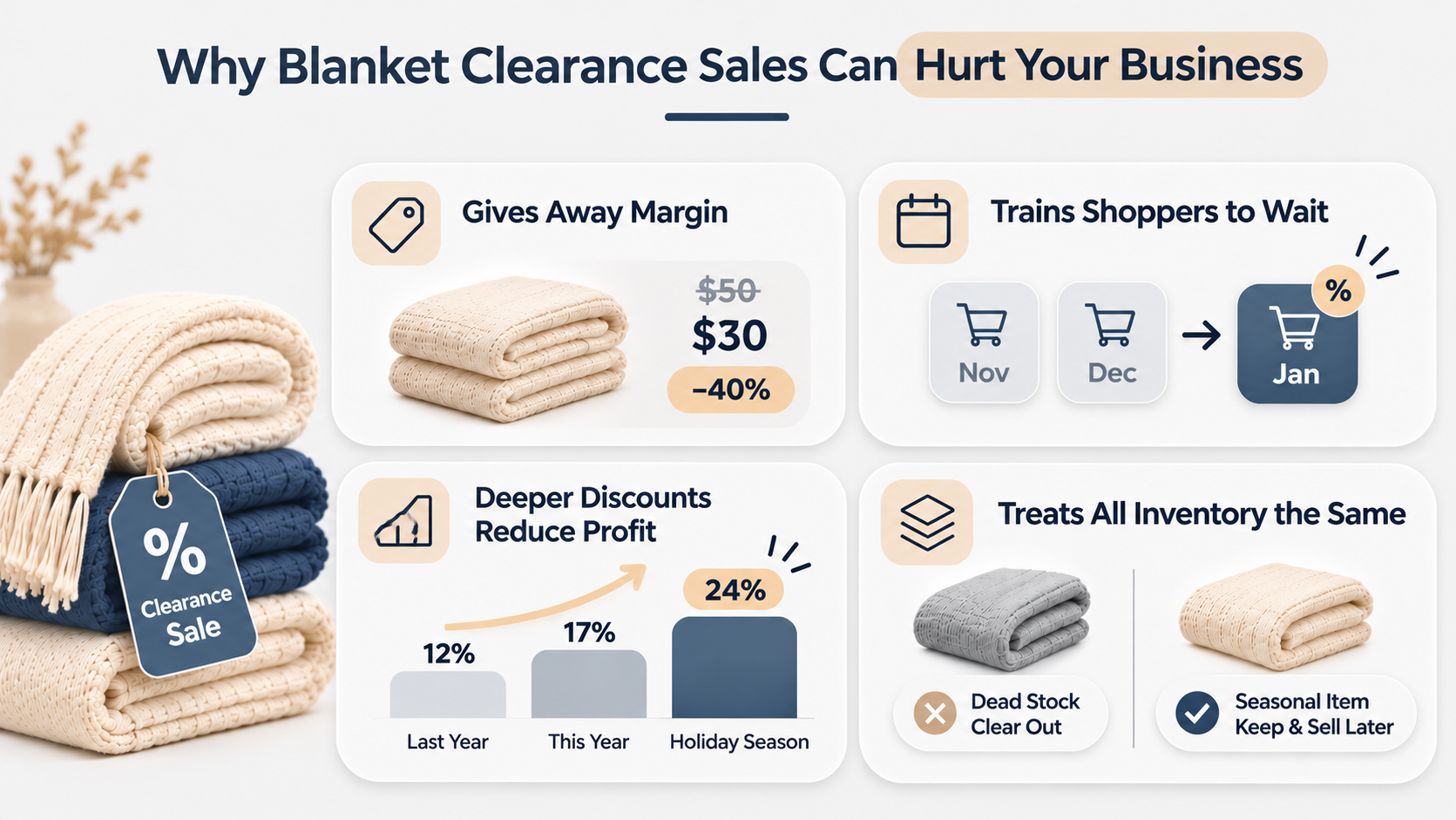
- It discounts inventory that was already moving. A 40% banner applies to your bestseller too, which means you're giving away margin on units a shopper would have bought at full price anyway.
- It trains repeat shoppers to wait. Once a customer learns your store runs a clearance every January, they hold off buying in November and December, which pulls demand forward into your lowest-margin period.
- Discount depth keeps climbing industry-wide, which erodes the tactic's own effectiveness. US mall-store discounts averaged 17% in 2025, up from 12% the year before, and during the holiday season 69% of merchandise was on sale at an average discount of 24% (Centric Market Intelligence, 2025). A deeper discount than that to stand out just erases more margin for the same attention.
- It doesn't distinguish between SKUs that need to move and SKUs that don't. A flat percentage off treats a true dead-stock item and a seasonal item that will sell again next year identically, when they call for different fixes.
Pair slow movers with bestsellers instead of discounting everythingPumper's Product Bundles combine up to three products into one priced combo, so you can clear excess stock without touching the price on what's already selling.
|
Find Out Which SKUs Actually Qualify as Slow-Moving
Bundling the wrong products wastes the tactic. Before you build anything, screen your catalog properly.
Run the Turnover Math First
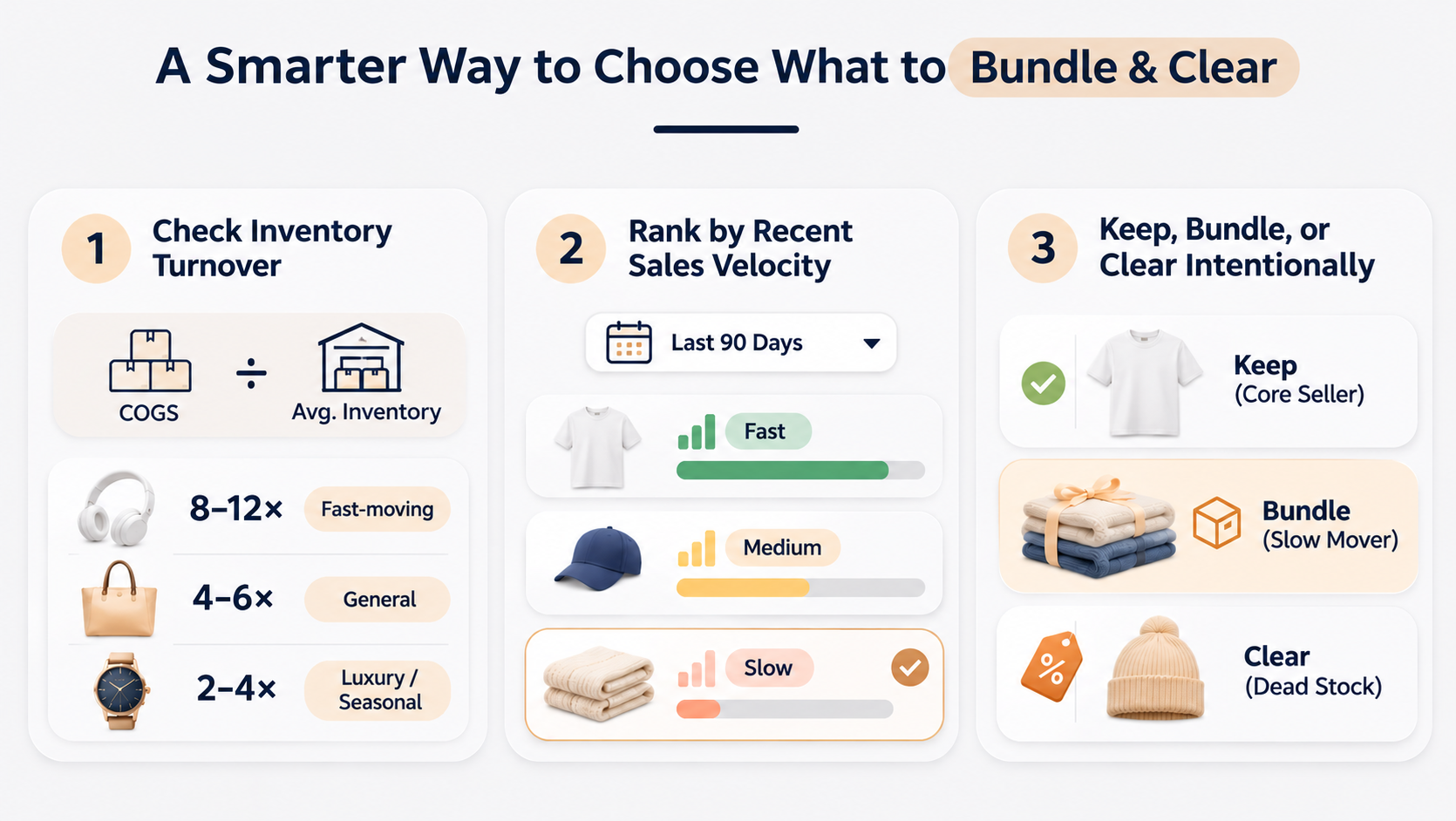
Inventory turnover, cost of goods sold divided by average inventory value, is the baseline number. Most sources put a healthy ecommerce turnover somewhere between 4 and 6 times a year, though the right target shifts by category: fast-moving consumer goods run closer to 8 to 12 times a year, while luxury or seasonal goods can sit at 2 to 4 times a year and still be healthy. Don't apply one benchmark across your whole catalog if it spans more than one of those categories.
Screen by Recent Velocity, Not Total Stock on Hand
A SKU with 200 units sitting in the warehouse isn't automatically slow; it might just be a big restock of something that sells fine. Rank products by units sold over a fixed recent window; 90 days is a common screen, and split them into fast, medium, and slow tiers (an ABC analysis). The slow tier, not your total inventory count, is your clearance bundle candidate list.
Separate True Dead Stock From Intentionally Slow SKUs
Some low-turnover SKUs are slow on purpose: a niche accessory that completes a product line, a low-volume variant you keep for customer retention, or a seasonal item that will sell again next year. Bundling those away at a discount can cost you future full-price sales for no real benefit. Reserve the clearance treatment for SKUs that are actually dead weight, excess stock from a discontinued line, a buying mistake, or a true one-off, not everything that happens to rank low this quarter.
Which Pumper Offer Type Fits Which Clearance Scenario
Once you know which SKUs qualify, match the mechanic to the specific problem each one presents.
Product Bundles: Pair a Slow Mover With a Bestseller
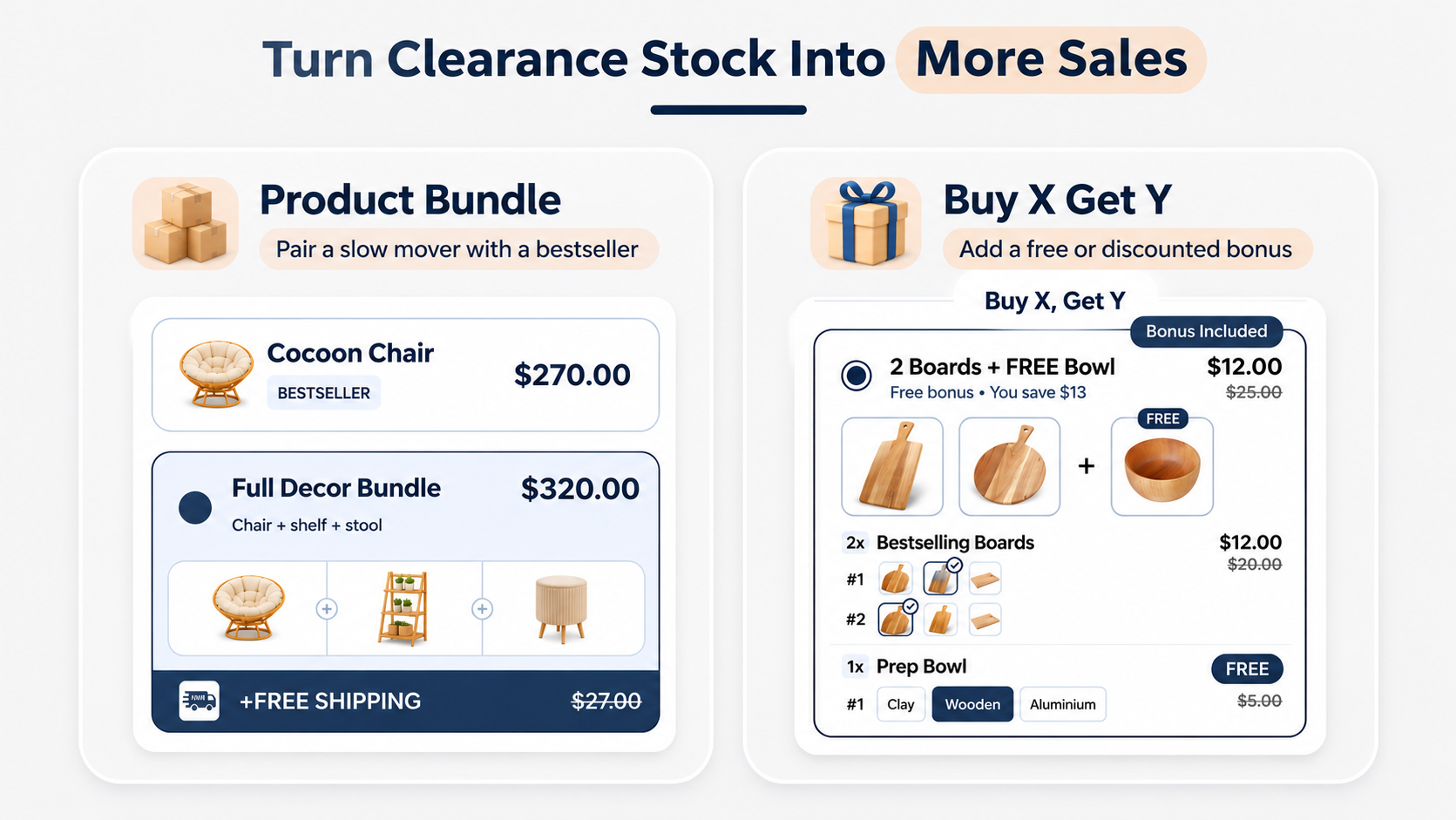
Combine up to three products into one priced combo. Pairing a slow seller with a genuine bestseller works because the shopper is drawn in by the product they already wanted, and the bundle price absorbs the clearance item without putting a visible discount sticker on it. This is the strongest option when the slow SKU is a reasonable complement to something you sell a lot of.
Buy X Get Y: Attach the Slow Mover as the "Y"
If the slow-moving product doesn't naturally sit in a combo but can plausibly ride along with a popular one, structure it as Buy X Get Y: buy the bestseller (X), get the slow mover (Y) free or at a steep discount. Framed this way, the shopper reads it as a bonus attached to a purchase they already wanted, not as a markdown on a product nobody was asking for.
Free Gift or Progressive Free Gifts: Give the Slow Mover Away Entirely
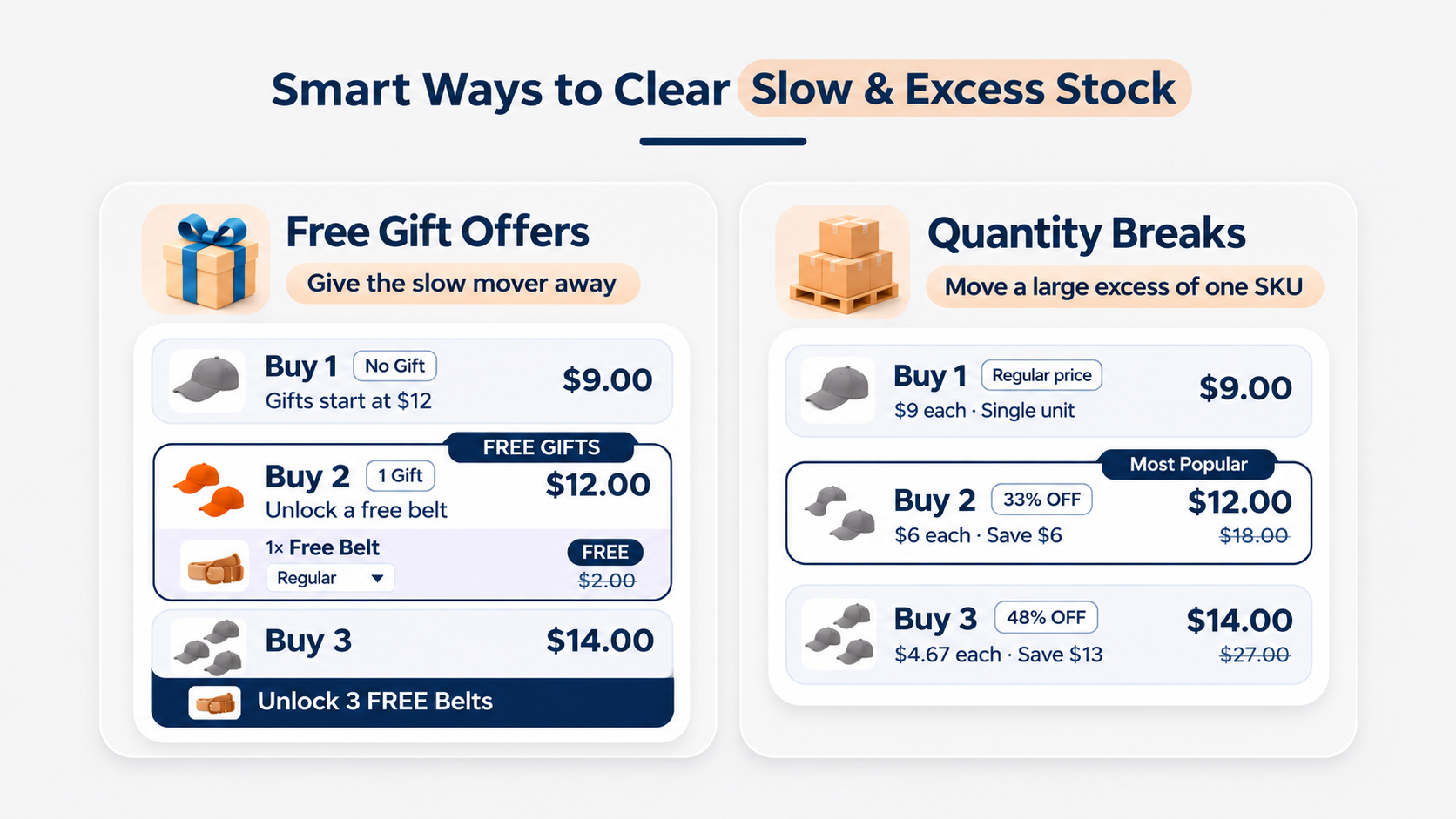
When a SKU has essentially no standalone demand left, the cleanest move is often to stop trying to sell it and give it away instead. Set it as a free gift unlocked at a spend threshold, or, if you have several different dead-stock items, use progressive free gifts so each threshold unlocks a different one. You lose the unit's sale price, but you clear the shelf space and the carrying cost without discounting anything else in the process.
Quantity Breaks: Move a Large Excess of One SKU on Its Own
Sometimes the issue isn't variety; it's volume: you're overstocked on one specific product and don't need a pairing mechanic at all. A quantity break ("buy 3, save more per unit") rewards shoppers for taking more of the same item, which is the direct fix when the problem is too many units of a single SKU rather than a slow seller that needs a bestseller to carry it.
Give away dead stock instead of discounting itSet a slow-moving SKU as a free gift or progressive free gift unlocked at a spend threshold, so it clears without a visible markdown anywhere else.
|
Price the Pairing So the Margin Survives
The entire point of bundling instead of discounting is to protect margin on the healthy product. That only works if you price the combo correctly.
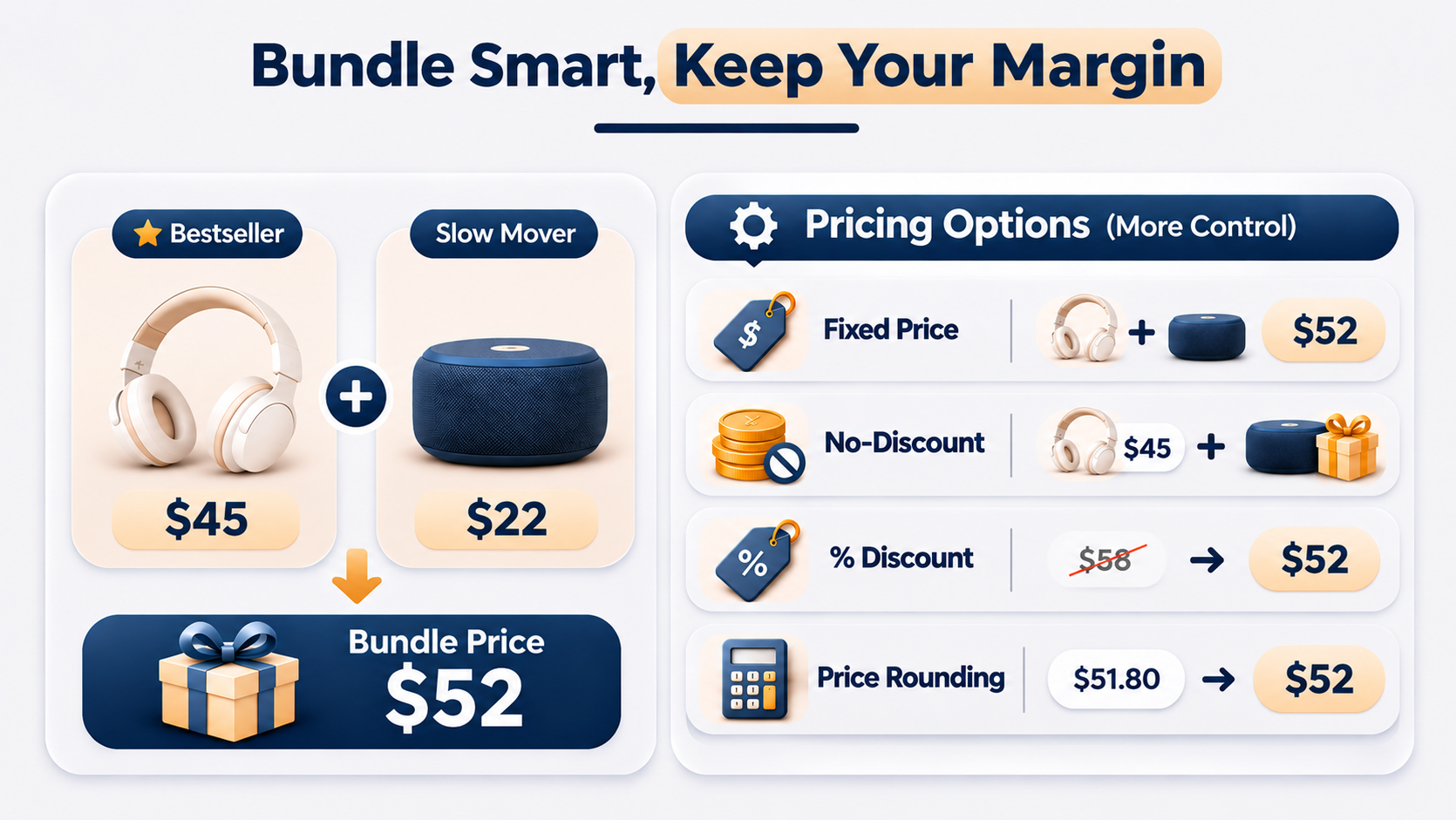
Pumper's discount types give you more control than a flat percentage off:
- Specific price (fixed price) sets the whole combo at one number, "the bestseller plus the clearance item, $52," which locks your margin on the bestseller regardless of how aggressively you price the slow mover inside it.
- No-discount tier lets the main product keep its full price while the slow mover rides along as a free add-on, so you're not discounting the thing that was already selling at all.
- Percentage discount on the combo as a whole, rather than on either product individually, spreads the appearance of a deal across the pairing without a line-item markdown on the bestseller.
- Price rounding keeps the combo's final price consistent with the rest of your store.
Price against your actual combined landed cost, not a round number. If your bestseller costs $18 and normally sells for $45, and your dead-stock item costs $9 and would otherwise sell for $22, a $52 combo price still clears $25 in margin before fulfillment and ad spend, while moving a unit that was costing you storage space every month it sat unsold. Carrying costs on unsold inventory typically run 15-30% of the item's value (according to commonly cited estimates) annually under common supply chain planning guidance, so clearing that $9 item even at a thin margin beats paying to store it through another quarter. Pumper's guide to Shopify product bundling strategies covers combo pricing logic in more depth if you're setting this up across several pairings.
A Worked Example: Clearing a Slow-Moving Accessory Against a Bestseller
This is an illustrative walkthrough, not a documented case study, to show how the pieces fit together.
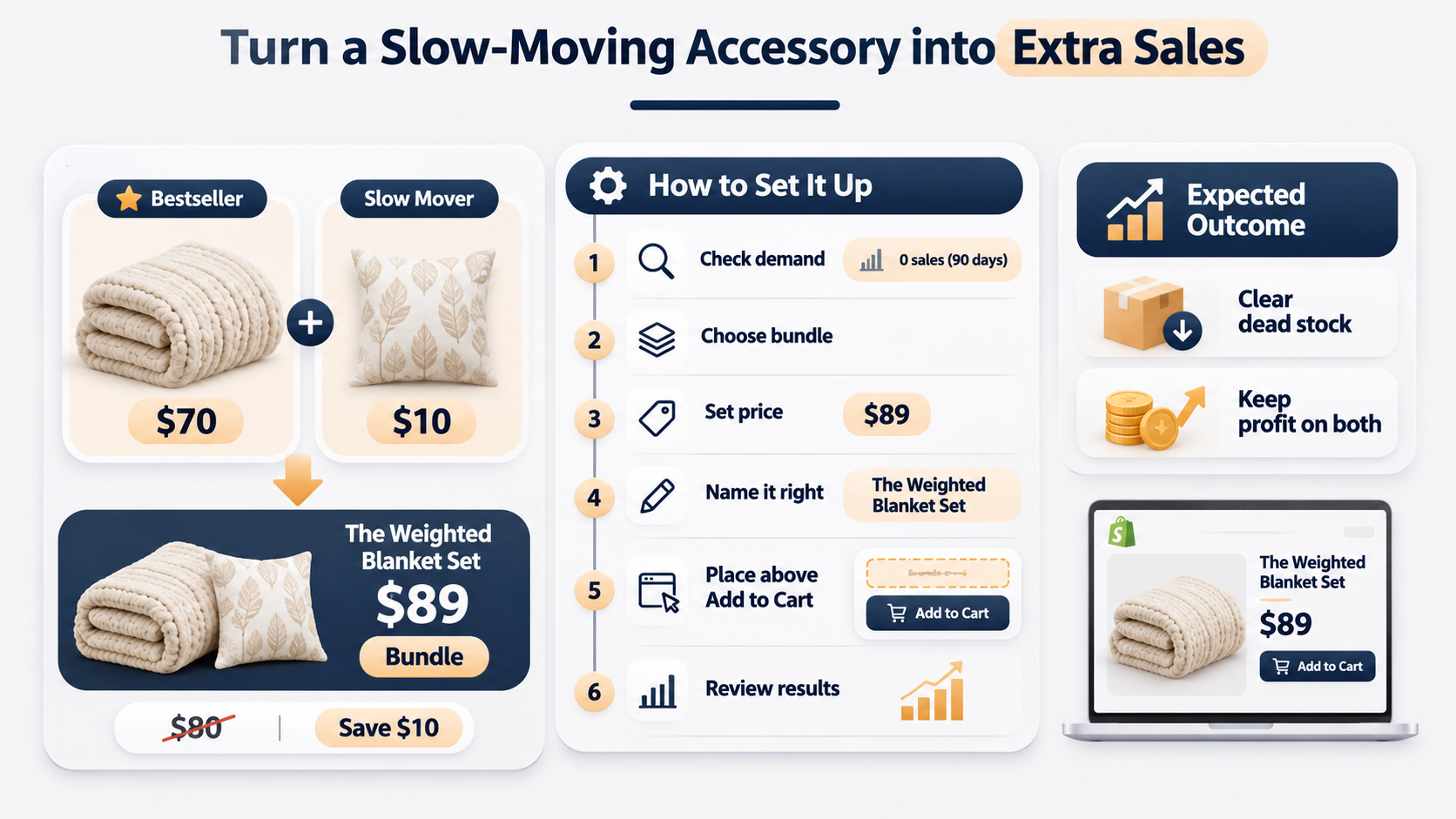
Say you sell home goods, and a patterned throw pillow cover from last season isn't moving, while a bestselling weighted blanket keeps selling at full price.
- Confirm the pillow cover qualifies. Units sold in the last 90 days are near zero, and the color story is discontinued, so it's genuine dead stock, not a seasonal dip.
- Pick the offer type. Product Bundles, pairing the blanket (bestseller) with the pillow cover (slow mover).
- Set the discount type. Specific price at $89 for the pair, against a $70 standalone blanket price and a $10 cost basis on the pillow cover, which still clears real margin on both pieces.
- Name it around the bestseller, not the clearance item. "The Weighted Blanket Set," not "Clearance Pillow Cover Bundle," so the offer leads with demand that already exists.
- Place it. Above the Add to Cart button on the blanket's product page, where the shopper who already wants it will see the combo.
Check the result after a few weeks. If blanket sales haven't dropped and the pillow cover's unit count is actually falling, the bundle is doing its job; if blanket sales dipped because shoppers are waiting for the combo price, revisit whether the pairing undercuts the standalone product too much.
Track Whether the Clearance Bundle Actually Cleared the Stock
Revenue from the bundle isn't the metric that matters most here. Pumper's per-offer analytics track impressions, add-to-carts, orders, revenue, and conversion rate for the bundle, plus a revenue dashboard showing extra revenue generated this month, over the last 30 days, and all time. For a clearance bundle specifically, cross-check that against your actual inventory count on the slow SKU. A bundle can show healthy orders and revenue while barely drawing down the dead-stock unit, if most buyers were already going to buy the bestseller and the pairing didn't change their decision at all. Watch the slow SKU's stock level directly, not just the offer's dashboard numbers, to confirm the clearance is actually happening.
If margin protection across several offers is the bigger goal this quarter, Pumper's guide to quantity break pricing and its comparison of pure bundling versus mixed bundling both cover pricing structures worth reviewing before you set final numbers on a clearance pairing.
Check whether your bundles are actually moving stockPumper's per-offer analytics track impressions, add-to-carts, and extra revenue for each clearance bundle, so you can see which pairings are working.
|
Common Mistakes That Waste a Clearance Bundle
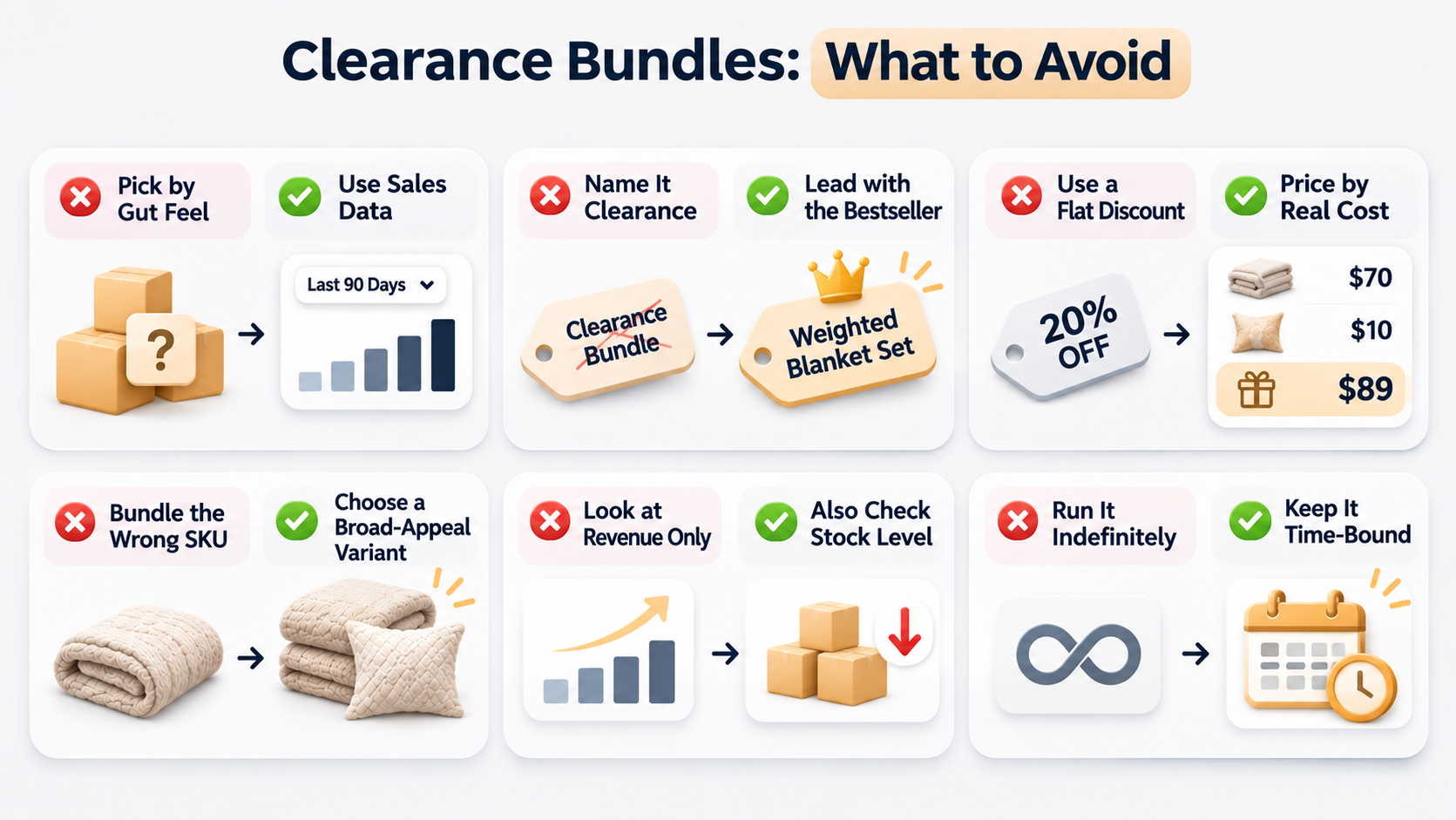
- Bundling by gut feel instead of by the numbers. A product that "feels" slow might just be between restocks. Screen by actual 90-day velocity before committing a SKU to the clearance list.
- Naming the bundle after the clearance item. A set called "Clearance Bundle" tells the shopper they're getting rid of something nobody wanted. Lead with the bestseller's name instead.
- Pricing the combo as a round discount instead of against landed cost. A "20% off the pair" framing can still lose money if the slow mover's cost basis is higher than it looks against the bestseller's healthy margin.
- Bundling a SKU that's slow on purpose. Clearing out a low-volume variant you keep for a specific customer segment can cost you more in lost retention than the shelf space is worth.
- Checking bundle revenue but not the SKU's actual stock level. A bundle can look successful on the dashboard while the dead-stock unit barely moves, if the bestseller was carrying all the demand anyway.
- Running the clearance bundle indefinitely. A bundle built to clear a specific, finite batch of excess stock should come down once that batch is gone, not become a permanent fixture that quietly discounts the bestseller forever.
Final Verdict
A year-end clearance sale and a clearance bundle solve the same problem with very different costs. The sale moves stock by discounting everything, including units that would have sold at full price anyway. The bundle moves the same dead stock by pairing it against something that's already selling, which protects the healthy product's price and the store's margin at the same time. Screen your catalog by actual sales velocity before you decide what's slow, match the offer type to the specific clearance scenario, price the pairing against your real landed cost, and confirm the dead-stock unit count is actually falling once the bundle is live. Pumper runs all four of the relevant mechanics- Product Bundles, Buy X Get Y, Free Gift, and Quantity Breaks- with the analytics to check which pairing actually worked.
Clear year-end stock without a sitewide markdownBuild bundles, free-gift add-ons, and quantity breaks for slow-moving SKUs from one Shopify app, then track which ones actually draw down the stock. Start on the free plan.
|
FAQs
How do I know if a product is actually "slow-moving" versus just between restocks?
Rank products by units sold over a fixed recent window; 90 days is a common choice, rather than by total units sitting in stock. A product with high stock but steady recent sales isn't slow; a product with low recent sales regardless of stock level is the real candidate.
Is bundling always better than discounting for clearance?
Not for every SKU. Bundling works best when the slow mover can plausibly pair with something that already sells well. For a product with no complementary bestseller and no realistic combo partner, a smaller, targeted markdown or a straightforward free-gift giveaway may still be the simpler fix.
Should the clearance item ever be the one the shopper searches for?
No. Lead the offer's name and placement around the bestseller or the product with real search demand, and let the slow mover ride along as the add-on. An offer named after the clearance item signals to shoppers that it's unwanted stock.
What if I don't have a true bestseller to pair a slow mover with?
Consider the free-gift or progressive-free-gift route instead. You still attach the slow mover to another product’s offer, but that product doesn’t have to be a true bestseller; it only needs an offer with a tier shoppers already pick.
How long should a clearance bundle stay live?
Until the specific batch of excess stock it was built for is gone, then take it down or reconfigure it. A clearance bundle left running indefinitely becomes a permanent, unintentional discount on whatever bestseller it's paired with.