



US shoppers spent $257.8 billion online during the 2025 holiday season, up 7% from the year before (Adobe Analytics, 2026). Mobile phones placed 56.4% of those orders. Most of that spend wasn't self-purchase. It was gift buying, and gift buying runs on a different set of decisions than a shopper buying for themselves.
A solo buyer compares price against a product they already know they want. A gift buyer is also solving for a stranger's taste, a delivery deadline, and the risk of handing over something that misses. The National Retail Federation's 2025 survey put planned per-person holiday spend at about $890 (NRF, 2025), spread across several recipients, several categories, and a hard date on the calendar. That's a shopper who's open to buying more per order, if the store makes the "more" easy to justify.
Most Shopify product pages still show that gift shopper the exact same single-SKU page a solo buyer sees. A holiday gift bundle, a curated or build-your-own set priced and framed specifically for giving, closes that gap. This guide covers how to design one, which Pumper offer type fits which gift occasion, how to price it without losing margin, and how to build the shipping deadline into the offer itself so the sale doesn't turn into a December 24th refund request.
Key Takeaways
- Gift buyers shop differently than solo buyers. They're less price-sensitive on a single SKU and more sensitive to delivery certainty, recipient fit, and the effort of putting a set together themselves (NRF, 2025).
- Price a gift bundle by occasion first (stocking stuffer, coworker gift, main gift, premium gift), then build the tiers to fit that price point, not the other way around.
- Pumper's five offer types map onto five different gift occasions: Product Bundles for curated sets, Mix & Match for build-your-own boxes, Bundle Themes for a fast seasonal launch, Buy X Get Y for a free add-on gift, and Quantity Breaks for shoppers buying the same gift for several people.
- USPS recommends shipping Ground Advantage and First-Class Mail by December 17, 2026 for Christmas delivery in the contiguous US, with Priority Mail by December 18 and Priority Mail Express by December 19 (USPS, 2026). Build that date into your offer copy, not just your shipping page.
- Directional industry reporting puts well-designed bundles at a 20-30% AOV lift, with some vendor-reported cases higher; treat any specific percentage as a starting benchmark to test against your own catalog, not a guarantee.
- Check margin and fulfillment time on every gift bundle before you publish it. A set that sells out demand you can't ship by December 25 creates refunds, not revenue.
Why Gift Shoppers Need a Different Offer Than Everyday Shoppers
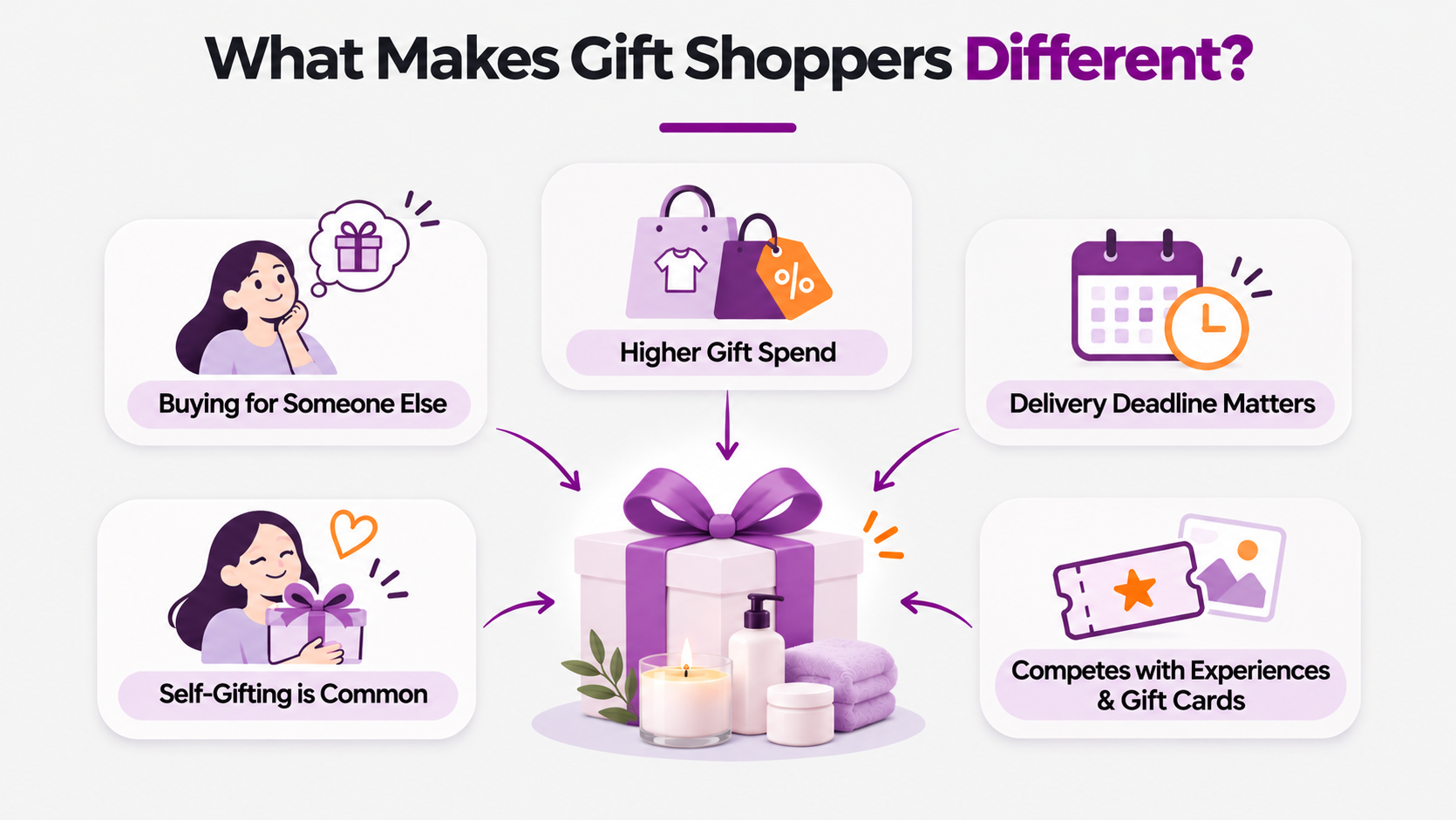
A gift purchase and a self-purchase look identical in your order data. They are not identical decisions, and treating them the same leaves AOV on the table.
- The buyer isn't the user. A solo shopper knows their own size, taste, and needs. A gift buyer is guessing at someone else's, which raises the appeal of a set covering several options at once instead of betting on one.
- Price sensitivity shifts. NRF's 2025 holiday survey found gift cards (50%) and clothing or accessories (46%) were the gifts consumers most want to receive. Shoppers already expect to spend across several categories, which is exactly what a multi-product bundle sells.
- Deadline anxiety is specific. A solo buyer who misses a delivery date reorders next week. A gift buyer who misses Christmas morning has failed the purchase entirely, which is why delivery certainty belongs in the offer, not just the shipping policy page.
- Self-gifting adds a second buyer type to plan for. Deloitte's 2025 Holiday Retail Survey found 46% of Gen Z and 41% of millennial shoppers planned to buy something for themselves while holiday shopping (Deloitte, 2025). A bundle priced only for giving ignores a meaningful share of the same traffic.
Experience and gift-card spend compete for the same budget. Half of shoppers in the same Deloitte survey said they planned to buy experience-based gifts instead of a physical product (Adweek coverage of Deloitte, 2025). A gift bundle has to feel like a complete, considered gift on its own.
See what gift shoppers actually buy togetherPumper's gift-specific use case covers the offer types retailers run during peak gifting season.
|
The Anatomy of a Holiday Gift Bundle That Converts
A gift bundle that works isn't a random assortment with a bow graphic on it. It's built from four decisions, in order.
Start With the Occasion, Not the Products
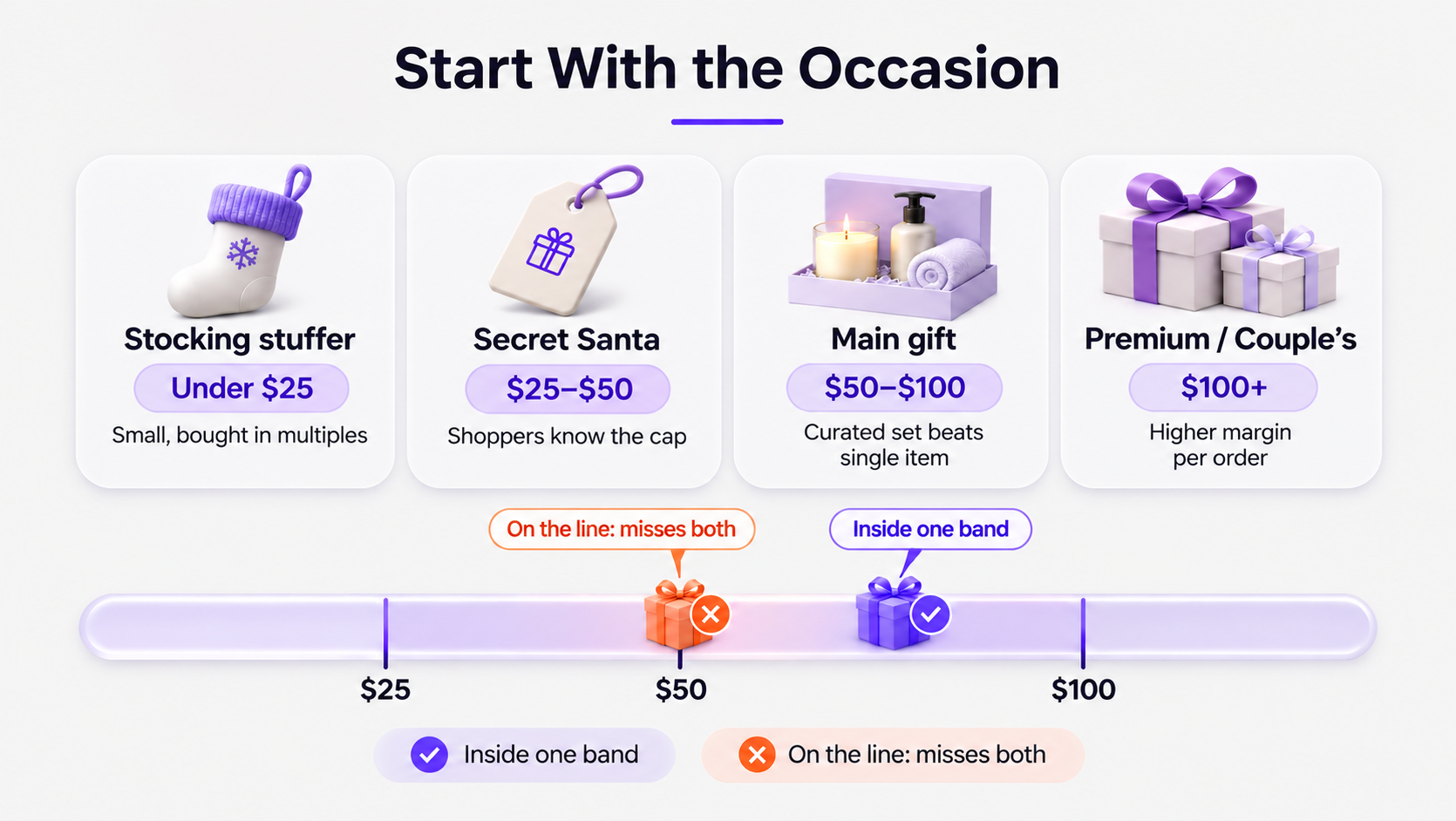
Every real gift falls into a rough price band tied to who's receiving it. Build your tiers around those bands instead of starting from your catalog and working backward:
- Stocking stuffer / white elephant: under $25. Small, low-commitment, often bought in multiples for different people.
- Coworker or Secret Santa gift: $25 to $50. The most price-anchored tier; shoppers in a gift exchange usually know the cap before they shop.
- Main gift for a close friend or family member: $50 to $100. The tier where a curated set beats a single item, because it signals more thought for roughly the same spend.
- Premium or couple's gift: $100-plus. Fewer units sold, higher margin per order, and the tier where a build-your-own set or a limited drop performs best.
Price each bundle to sit cleanly inside one of these bands. A $72 set that straddles the $50 coworker line and the $100 main-gift line will underperform both.
Keep the Product Pool Small Enough to Decide From
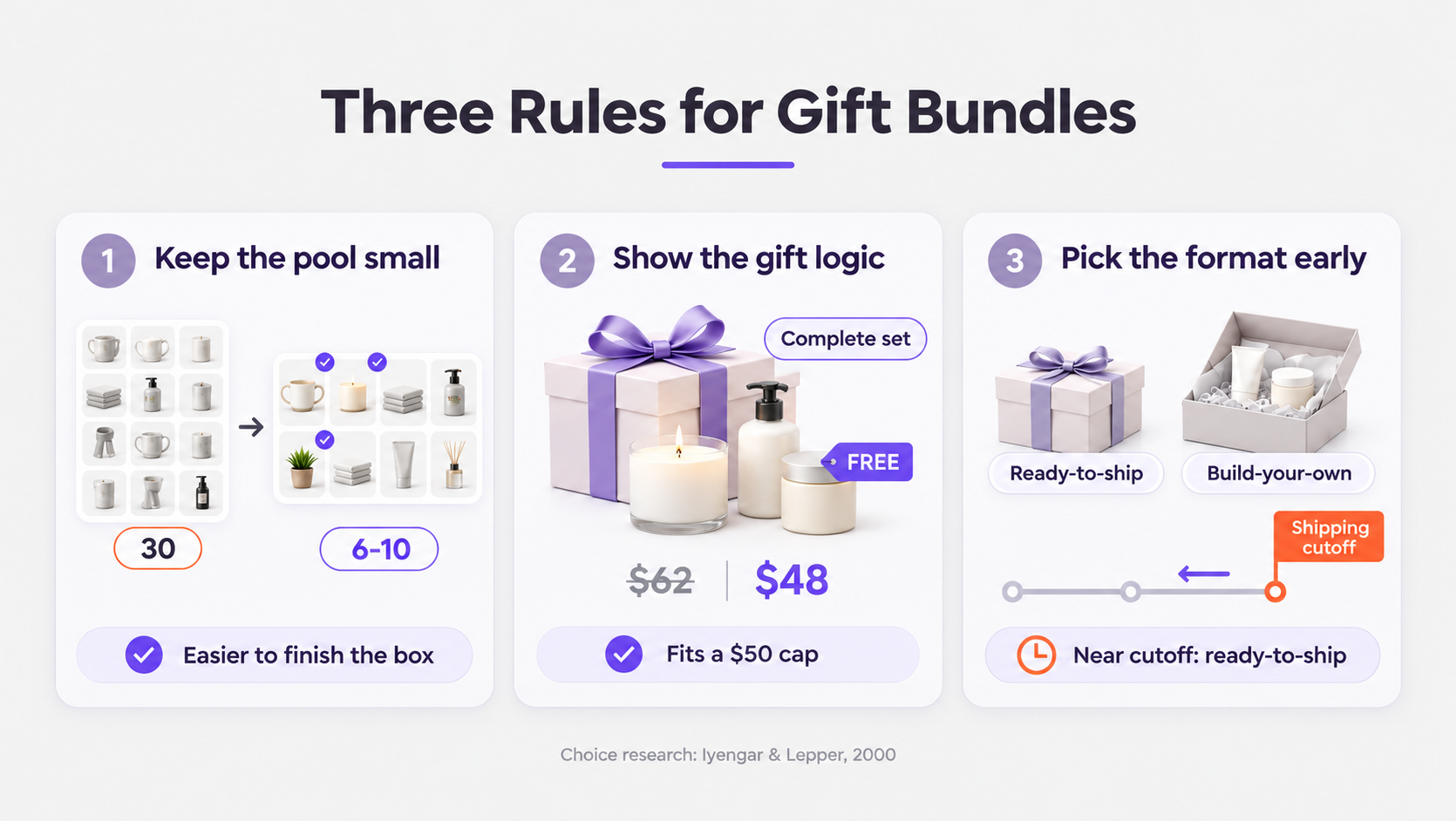
If you’re running a build-your-own gift box, the number of items in the selectable pool matters more than most merchants expect. Research suggests shoppers can get stuck when they see too many options: in a classic study by Iyengar and Lepper (2000), shoppers were more likely to buy from a smaller, curated set than from an extensive one. But this does not happen every time, and later studies have found mixed results. For a holiday shopper who’s already pressed for time, start with about 6 to 10 well-chosen products and test what works for your store.
Show the Gift Logic, Not Just the Discount
A quantity break says "buy 2, save 10%." A gift bundle should say what the shopper actually gets: a complete set, a free add-on, or a price that's easier to justify against a $50 Secret Santa cap than three separate line items would be. Use a compare-at or custom compare price so the set's value is visible next to its price, and label the free item clearly rather than folding it into a vague percentage.
Decide Ready-to-Ship vs. Build-Your-Own Early
A curated, fixed gift set ships faster, because you've already decided the contents and can pack it ahead of peak volume. A build-your-own set converts better with shoppers who want to personalize the gift, but it adds pick-and-pack time per order right when your fulfillment team is most stretched. Pick the format based on how close to your shipping cutoff the bundle will still be selling, not just on which one converts higher in isolation.
Which Pumper Offer Type Fits Which Gift Bundle
Pumper ships five offer types. Each one maps cleanly onto a different holiday gifting scenario.
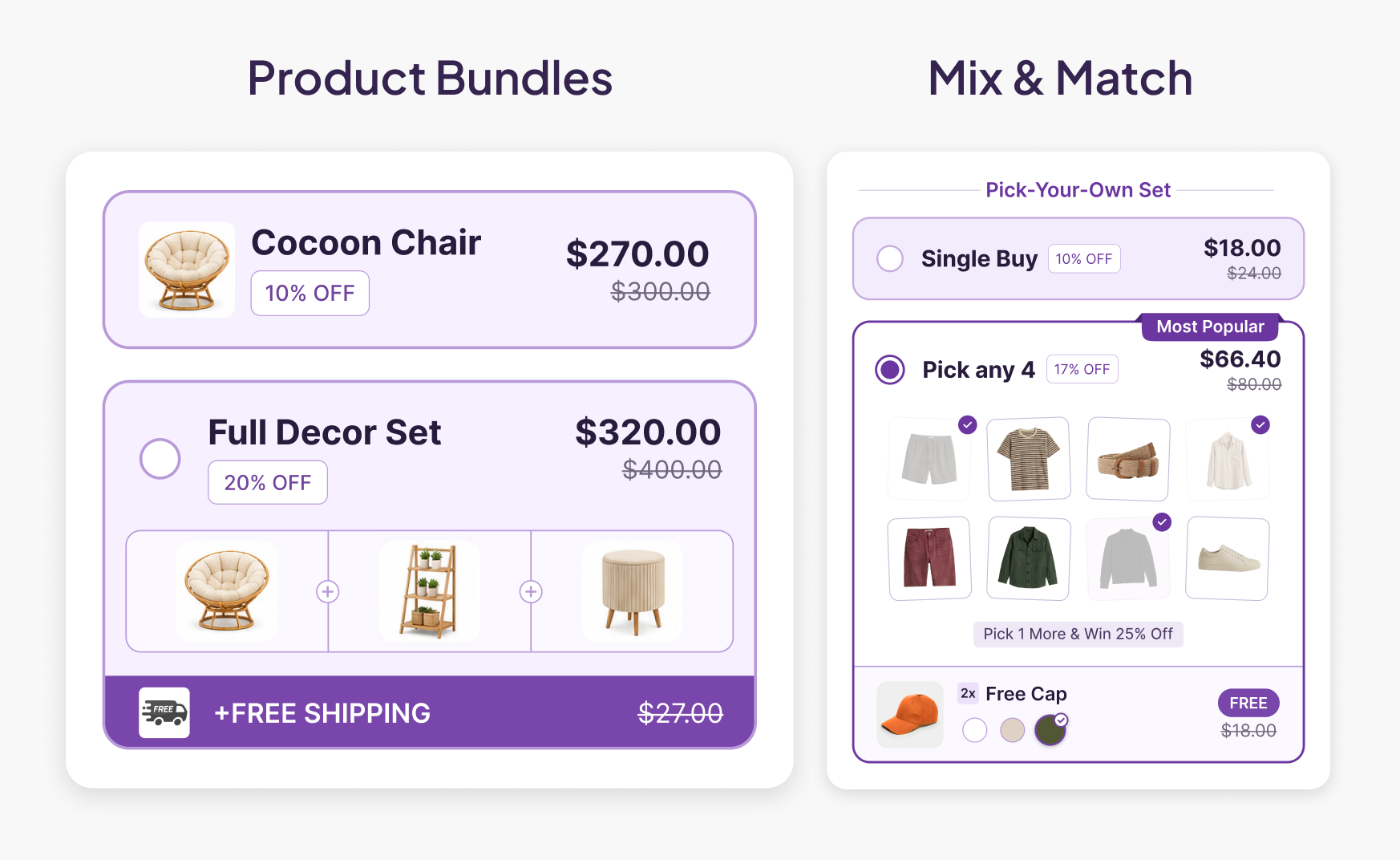
Product Bundles: The Curated Gift Set
Combine up to three products into one discounted combo, the natural shape for a named gift set: a "Winter Skincare Trio" or a "Coffee Lover's Starter Kit." Lead with this for your main-gift and premium tiers, where a named set reads as more considered than a loose discount.
Mix & Match: The Build-Your-Own Gift Box
For a deep catalog of smaller SKUs (candles, snack flavors, skincare minis), Mix & Match lets the shopper pick their own items from a defined pool and locks in the price once they've filled it. Use this for stocking-stuffer boxes, where the personalization is the gift.
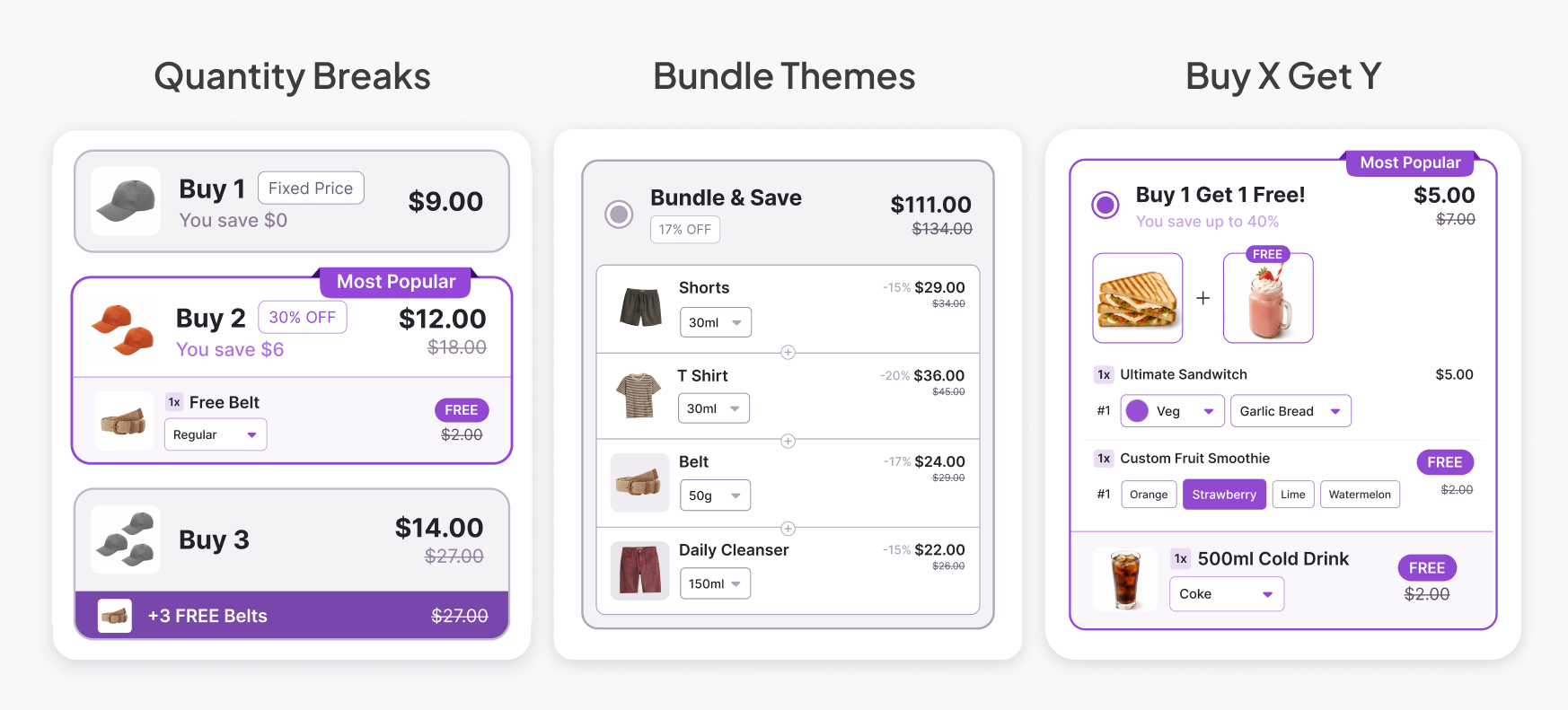
Bundle Themes: The Fast Seasonal Launch
If you don't have time to design a set from scratch before Black Friday or Cyber Monday traffic lands, Bundle Themes gives you a ready-made bundle design to populate and publish in minutes.
Buy X Get Y: The Built-In Free Gift
BXGY offers (buy X units, get Y of a different product free or discounted) frame the free item as part of the gift itself: "Buy the candle, get the matching matchbox free" reads as a complete gift, not a discount mechanic.
Quantity Breaks: For Shoppers Buying the Same Gift for Several People
A parent buying the same toy for three kids, or a team lead buying the same gift for five employees, is a quantity-break shopper wearing a gifting hat. A visible tier ladder rewards that buyer without a separate "bulk gifting" page.
The Add-Ons That Turn Any of These Into a Better Gift
Layer these on top of whichever offer type you choose:
- Free gift or progressive free gifts (up to 5 tiers) to reward a bigger spend with a bonus item, framed as a gift inside the gift.
- Free shipping unlocked on the tier that sits in your main-gift price band, since a surprise shipping cost at checkout is one of the most common reasons carts get abandoned (40% of abandoners cite extra costs, per Baymard Institute's checkout research, ongoing). Pair the deadline messaging with free shipping on your main-gift tier.
- Subscribe & Save on consumable gifts (coffee, skincare, supplements; needs a Shopify subscription app such as Appstle or Seal), framed as “the gift that keeps showing up,” which also turns a one-time holiday sale into a repeat customer.
Build a curated holiday gift setCombine up to three products into one named set with its own price, image, and savings badge, live above the Add to Cart button.
|
Price the Bundle So the Season Doesn't Eat Your Margin
A gift bundle that lifts revenue but erases profit per order hasn't worked, and the holiday season is where that mistake gets made most often, under pressure to look competitive against every other store's banner sale.
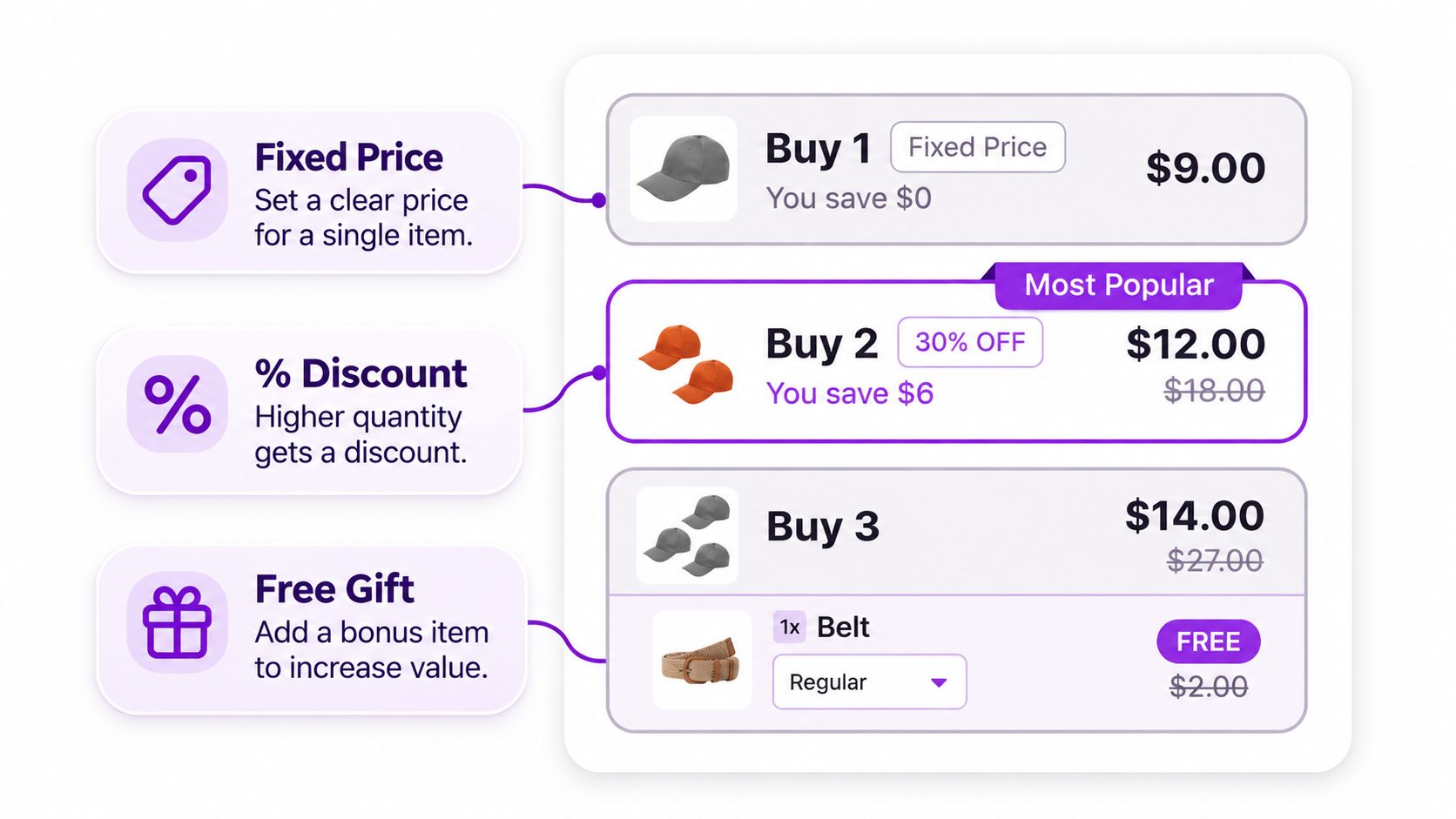
Pumper's discount types give you more control than a single percentage-off code:
- Specific price (fixed price) sells a set at one flat number, "the Winter Box, $59," which removes the mental math a rushed gift shopper doesn't want to do and gives you a locked margin per unit sold.
- Percentage discount works when your catalog's unit cost varies enough that a fixed price would under- or overprice some combinations.
- No-discount tier lets you offer a tier with no price cut at all, used purely to unlock a free gift or free shipping, so you're not discounting a sale you would have made anyway.
- Price rounding to .99 or .95 endings keeps the set's price consistent with the rest of your store without manual adjustment per bundle.
Price your tiers against your actual landed cost per set, not a round number that "feels right" for the season. If a $59 set costs you $34 in product and $8 in packaging and fulfillment labor, you're clearing $17 before ad spend and payment fees, not the $25 a quick mental calculation might suggest. Pumper's guide to increasing average order value on Shopify walks through that margin math in more depth if you're setting pricing across more than one bundle this season.
Build the Shipping Deadline Into the Offer Itself
Every holiday gift bundle runs on borrowed time, and the deadline is public information your shoppers already half-know. Put it in front of them instead of making them calculate it.
For 2026, USPS recommends shipping by December 17 for Ground Advantage and First-Class Mail, December 18 for Priority Mail, and December 19 for Priority Mail Express, for delivery by December 25 in the contiguous US (USPS, 2026, via Kiro7). UPS and FedEx typically hold two-day service open until around December 22, with overnight service available on December 23 for Christmas Eve delivery (CBS News, 2026). Confirm your own carrier's exact cutoffs before you publish any date in your offer copy, since carriers finalize these in the fall and they can shift by a day or two year to year.
Three Pumper features turn that calendar fact into part of the offer:
- Countdown timer. Set it to your actual ship-by date for standard shipping, not an arbitrary "sale ends" clock. A real deadline a shopper can verify against their own carrier knowledge builds trust instead of the fatigue generic countdown timers tend to produce.
- Sold-out tier overlay. If a gift set depends on inventory you can't restock before the cutoff, show the tier as sold out once stock runs low rather than overselling into a promise you can't fill.
- Sticky Add-to-Cart bar. On mobile, where more than half of 2025 holiday orders were placed, a sticky bar keeps the bundle and its deadline visible as the shopper scrolls through set contents, instead of disappearing once they move past the widget.
Pair the deadline message with free shipping on your main-gift tier, the tier that fits your main-gift price band. Baymard’s research lists unexpected extra costs as the single most common reason shoppers abandon a cart; removing that friction right as a deadline-pressed gift buyer is deciding does more for conversion than another percentage off.
Put a Real Shipping Deadline on Your Gift OffersRun a countdown timer against your actual ship-by date to create urgency around holiday purchases. Mark a tier as sold out when stock for the cutoff runs low, helping shoppers make timely buying decisions.
|
Merchandising and Placement for Gift Shoppers Specifically
Where the bundle appears matters as much as what's inside it. Pumper widgets render above the Add to Cart button via native Shopify Theme App Extensions, so a gift set shows up at the moment a shopper has already decided to consider the product, not in a popup competing for attention. Three placement moves matter most for gifting season:
- Homepage and landing pages. Build a dedicated "Gift Guide" landing page and place your gift-tier bundles there directly, so shoppers arriving from a "gifts under $50" search or email link see the full set immediately.
- Market (country) targeting. International shipping cutoffs land earlier than domestic ones. Run a separate, earlier countdown for those markets instead of showing a US-only date.
- Multiple offers per product. A single hero product can carry both a gift-set bundle and a quantity break at once, so the solo-gift buyer and the bulk-gift buyer each see the offer that fits them.
A Worked Example: Building a $65 "Holiday Spa Night" Gift Set
This is an illustrative walkthrough, not a documented case study, to show how the pieces above fit together in Pumper's dashboard.
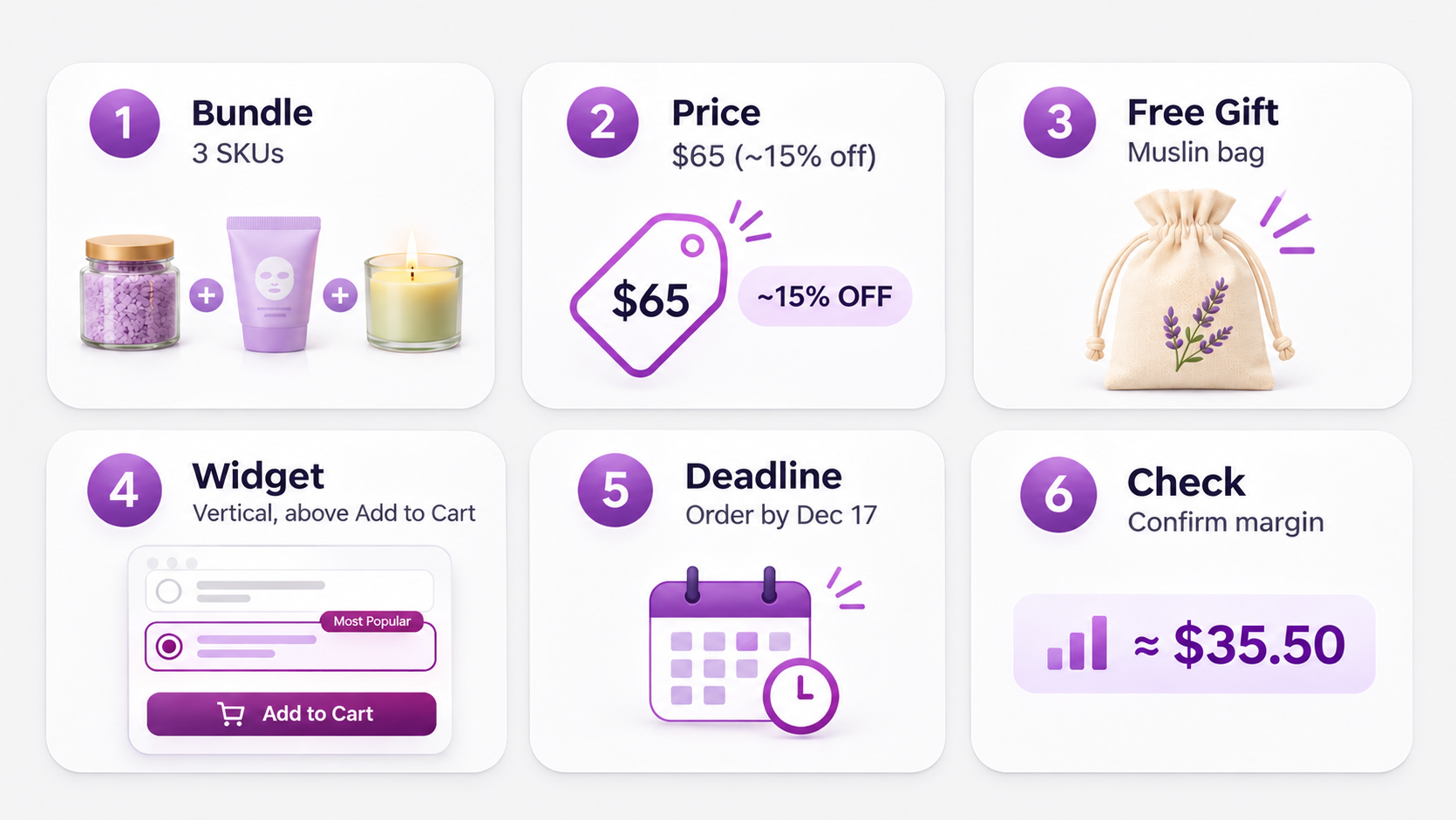
Say you sell bath and skincare products and want a main-gift-tier set for shoppers buying for a friend or parent.
- Pick the offer type. Product Bundles, combining three SKUs: a bath soak, a face mask, and a candle.
- Set the discount type. Specific price at $65, roughly 15% below the combined individual price, locking the margin regardless of which variant the shopper selects.
- Add the gift logic. A free gift, a small muslin bag, unlocks automatically on this tier, so the set arrives ready to wrap.
- Design and place the widget. A Vertical layout with a per-tier image showing the three products styled together, placed above Add to Cart on each component product and on your Gift Guide landing page.
- Add the deadline. A countdown timer reading "Order by Dec 17 for Christmas Ground delivery," tied to your actual carrier cutoff.
- Check the math. If the three products cost $28 combined and the gift bag costs $1.50, you're clearing roughly $35.50 before fulfillment labor and ad spend, a number worth confirming against your own catalog before you publish.
Track Whether Your Gift Bundles Actually Worked
Revenue alone won't tell you whether a gift bundle earned its shelf space or just redistributed sales you'd have made anyway. Pumper's per-offer analytics track impressions, add-to-carts, orders, revenue, and conversion rate for each bundle, plus a revenue dashboard showing extra revenue this month, over the last 30 days, and all time. Watch three numbers through the season: conversion rate on the bundle widget itself, extra revenue (Pumper's metric for revenue generated specifically because of the offer), and return rate on bundled orders in the weeks after Christmas, since a set assembled around guessing a recipient's taste carries more return risk than an item the buyer chose for themselves.
Pumper's guide to shopify promotion strategies and its breakdown of quantity break pricing cover the broader measurement habits worth building before the season starts.
Common Mistakes That Sink Holiday Gift Bundles
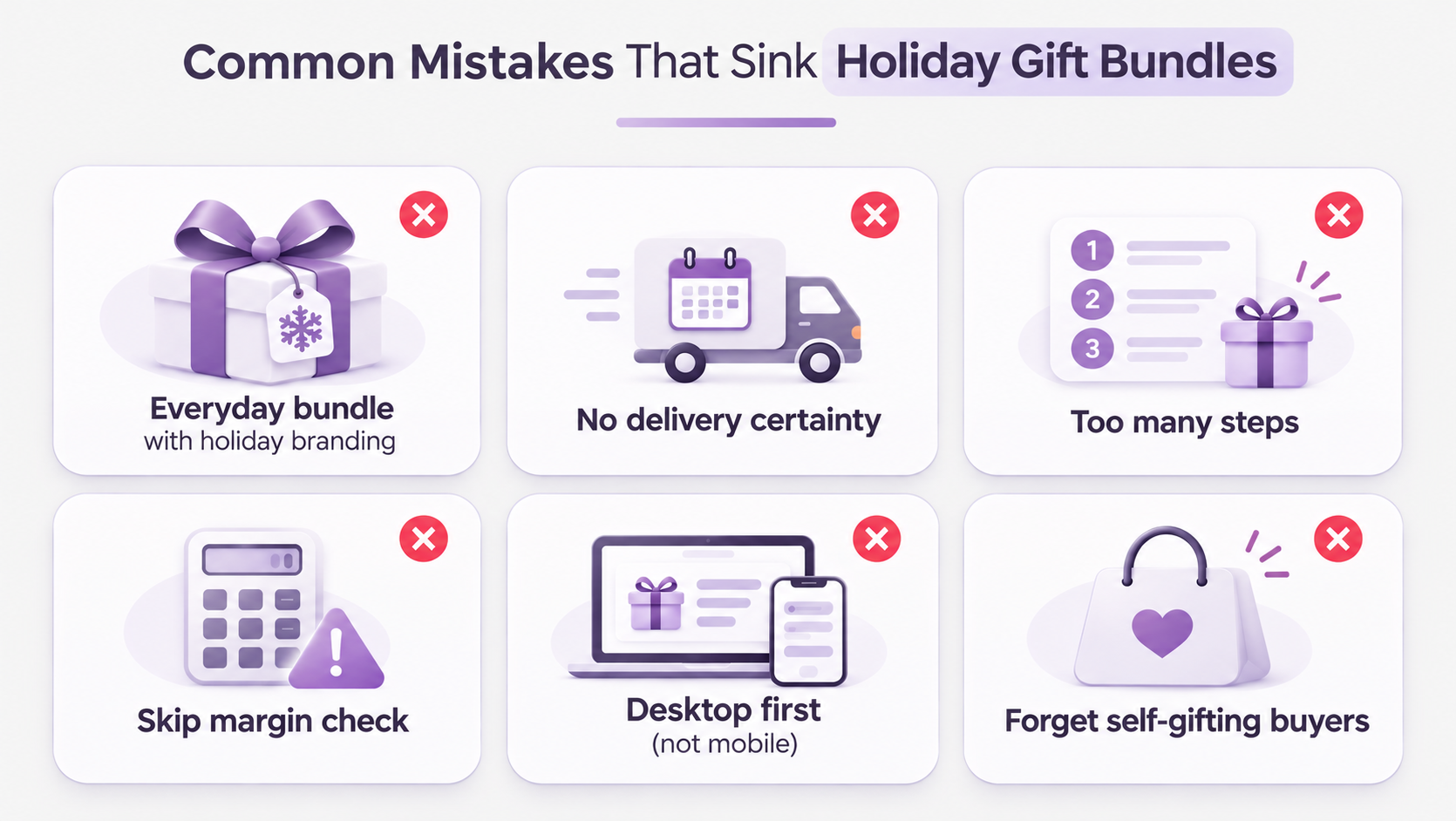
- Reusing an everyday bundle with a snowflake graphic. A set built for a random Tuesday doesn't read as a gift just because you added holiday branding. Rename it, re-curate it, and price it to a gift occasion.
- No delivery certainty in the offer. If the countdown timer or shipping message isn't visible next to the bundle, you're relying on a shopper to remember a date they read somewhere else.
- A build-your-own set with too many steps this close to the deadline. Personalization is a strength earlier in the season and a liability the week before Christmas.
- Skipping the margin check under pressure to "match" a competitor's sale. A set that moves volume at a loss isn't a win, even during the year's biggest sales window.
- Designing for desktop first. With mobile placing well over half of 2025 holiday orders, a widget that's hard to tap on a phone loses most of its actual traffic.
- Forgetting the self-gifting buyer. Not every gifting-season visitor is shopping for someone else; a bundle framed only around "the perfect gift for them" can undersell to a shopper quietly treating themselves too.
Final Verdict
A holiday gift bundle isn't a seasonal costume on top of your regular catalog. It's a different offer, built for a buyer who's optimizing for certainty and the recipient fits more than price, inside a hard deadline that's public knowledge. Pick the offer type that matches the gift occasion you're targeting, price it against your real cost, put the shipping deadline inside the offer itself, and check the numbers against your margin before the season, not after it. Pumper runs all five mechanics, the deadline-aware urgency features, and the per-offer analytics to track them, from one Shopify app with a free plan to start on.
Get Your Holiday Gift Bundles Live Before the Shipping CutoffBuild curated gift sets, build-your-own boxes, and free-gift add-ons from one dashboard. Track which offers actually lift AOV and make the most of your holiday sales. Start on the free plan.
Install from Shopify App Store → Start on the free plan. |
FAQs
What's the difference between a holiday gift bundle and a regular product bundle?
The products and the discount mechanic can be identical. What changes is the framing and pricing: a gift bundle is named and priced around a specific gift occasion (stocking stuffer, coworker gift, main gift), built around a delivery deadline, and merchandised on gift-specific pages like a holiday landing page, rather than treated as a generic everyday combo.
How many products should go in a holiday gift set?
Pumper's Product Bundles format supports up to three products per set, which tends to be enough to feel curated without feeling random. A Mix & Match build-your-own box can draw from a larger pool, but keep the selectable pool itself to roughly 6 to 10 items so the shopper can decide quickly.
Should I run a countdown timer on every gift bundle?
Only if the date is real and tied to an actual shipping cutoff you can confirm with your carrier. A countdown with no real deadline behind it reads as manipulative once a shopper notices it resets, which costs more trust than the urgency gains in conversion.
Do gift bundles work for digital or non-physical products?
The shipping-deadline urgency doesn't apply, but the core logic still does. Bundle a gift card with a digital product, or combine a subscription with a one-time item, and price it against a gift occasion the same way you would a physical set.
How early should I launch holiday gift bundles?
A later NRF survey found 84% of shoppers had already begun holiday shopping by Thanksgiving weekend (NRF, 2025). Have your gift bundles live and merchandised by early November so you're not building them while the season's biggest traffic is already arriving.