



Thanksgiving Day alone drove $6.4 billion in US online sales in 2025, up 5.3% year over year, and the full five-day stretch through Cyber Monday reached $44.2 billion. Shopify merchants contributed $14.6 billion of their own to Black Friday and Cyber Monday, a 27% jump from the year before. The window is big, it's growing, and it's more crowded every year.
In 2026, Thanksgiving falls on Thursday, November 26, Cyber Monday lands on November 30, and GivingTuesday follows on December 1. That's a tight five-day run of buying, followed almost immediately by GivingTuesday. A single sitewide percentage-off sale discounts orders you would have won anyway, while specific offers for specific shoppers protect profit and grow basket size at the same time.
This guide covers 10 promotion strategies built for that window. Some are calendar and channel moves, and some are offer mechanics you can configure on a Shopify product page in an afternoon. Each one comes with setup details, a margin check, and the mistake that usually sinks it. Further down you'll find the core context behind the numbers: what Thanksgiving shopping is, how it differs from Black Friday and Cyber Monday, what the 2025 data shows, and what shoppers expect before they'll hit "Pay now."
TL;DR
- Thanksgiving weekend is the biggest single stretch of the retail year. NRF counted 202.9 million US shoppers across the five days in 2025, and Adobe measured $44.2 billion in online spend.
- Thanksgiving Day itself is a real sales day now: $6.4 billion online in 2025, with mobile at 61.6% of that spend for the first time.
- 2026 dates: Thanksgiving is November 26, Black Friday is November 27, Small Business Saturday is November 28, Cyber Monday is November 30, and GivingTuesday is December 1.
- A day-by-day calendar with a different hero offer each day beats one sitewide sale, because each day has a different shopper mindset.
- Early access for email and SMS subscribers protects margin and fills your first 48 hours, since 84% of shoppers had already started holiday shopping by Thanksgiving weekend in 2025.
- Five basket-building offer types do most of the work on the product page: Buy More Save More tiers, gifting BOGO deals, tiered free gifts, and mix-and-match gift sets. You can run all of them from Pumper Bundles.
- Unexpected extra costs are the top reason carts get abandoned, cited by 40% of shoppers in Baymard Institute's research. A well-chosen free-shipping threshold fixes that and lifts basket size.
- Mobile decides the outcome on Thanksgiving Day. Put the offer above the Add to Cart button, and make checkout fast with Shop Pay and buy now, pay later options.
- Check margin on every offer before you publish it. A promotion that lifts revenue and erases profit isn't a win.
10 Shopify Promotion Strategies for Thanksgiving
Most stores get the best results from picking one calendar move, two or three offer types that fit their catalog, and one checkout fix.
1. Build a five-day promotion calendar instead of one sitewide sale
The shopper who buys on Thanksgiving evening isn't the same person who buys on Cyber Monday morning. Thursday spend skews heavily to phones, with mobile at 61.6% of the day's online sales in 2025. Black Friday buyers are hunting for the headline deal. Small Business Saturday shoppers respond to brand story and independence. Cyber Monday buyers are finishing gift lists and want certainty on delivery dates.
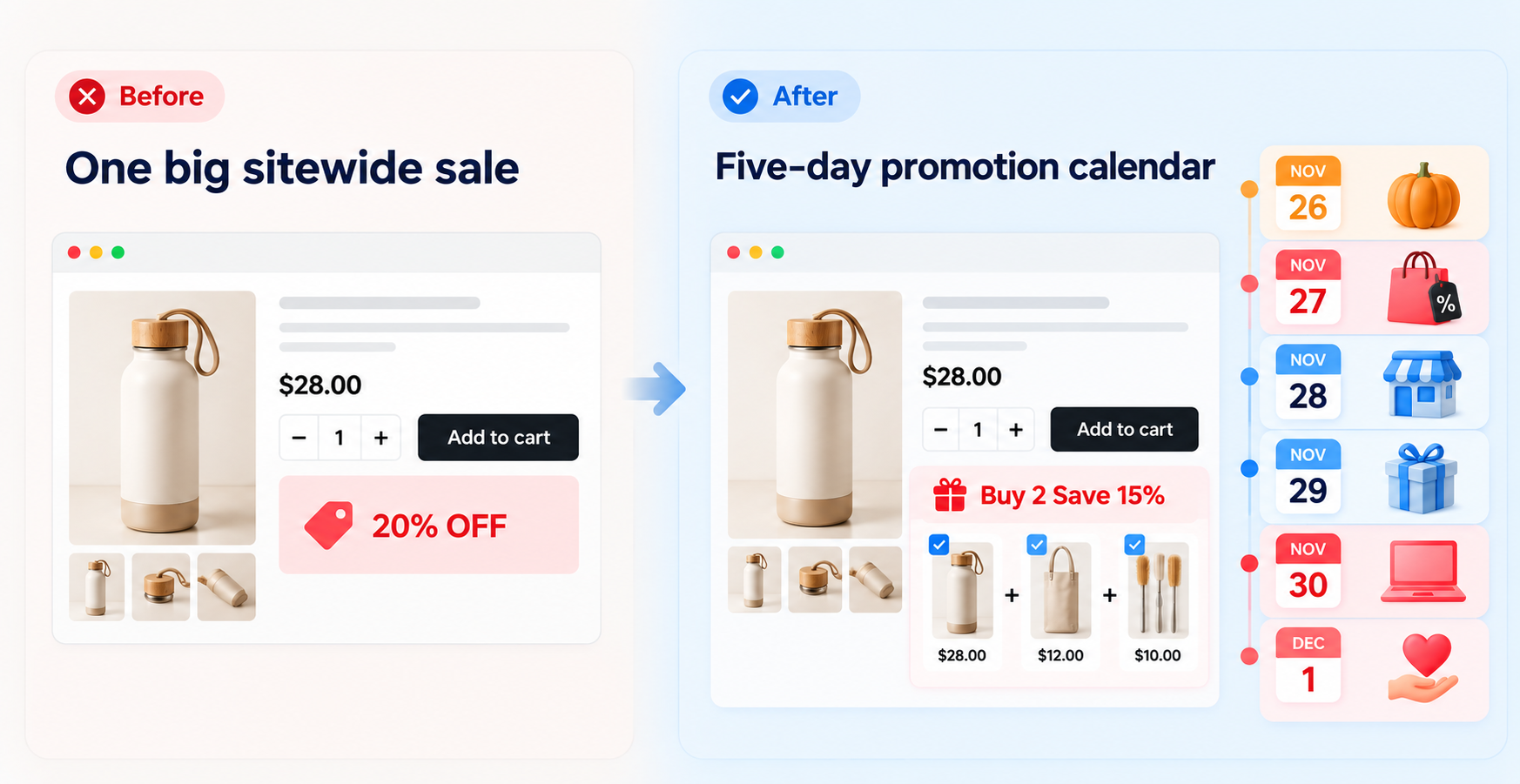
Give each day its own hero offer instead of running one percentage across all five. Here's an illustrative calendar for a store selling consumables and gift-friendly products:
- Thursday, November 26 (Thanksgiving): One simple, mobile-friendly offer, such as a Buy 2 Save 15% tier on your best sellers. Keep it easy to understand in a few seconds.
- Friday, November 27 (Black Friday): Your deepest offer of the weekend, limited to a short list of products you've checked for margin. This is where doorbusters belong.
- Saturday, November 28 (Small Business Saturday): A story-led offer. Lead with your founder, your making process, or your community, and attach a free gift or a bundle rather than a bigger discount.
- Sunday, November 29: A quieter day with a bundle or "complete the set" offer. The National Retail Federation (NRF) found 38.7 million people shopped online on Sunday in 2025, so it's worth a dedicated email rather than a day off.
- Monday, November 30 (Cyber Monday): A last-chance mix of your top offers, plus clear shipping cutoff dates. Adobe measured $14.25 billion in online spending on Cyber Monday 2025, still the largest single day.
- Tuesday, December 1 (GivingTuesday): A cause-linked offer if it fits your brand, or a quiet day that you spend on post-purchase and win-back emails.
Build the whole calendar in draft before the first day arrives. On Thanksgiving Day itself you'll be short on attention, and last-minute edits are where pricing mistakes happen.
Common mistake: discounting your best-selling product 40% on Thursday and then having nothing deeper to offer on Friday. Decide in advance which day carries your deepest offer, and make every other day's offer clearly smaller so shoppers have no reason to wait.
2. Give email and SMS subscribers early access before Thanksgiving
NRF's 2025 holiday survey found 84% of shoppers had already begun holiday shopping by Thanksgiving weekend, and 53% still had more than half of their list left to buy. That's two different groups. One has already made up their mind about where to buy gifts. The other is still deciding, and the first store to show them a clear offer gets the sale.
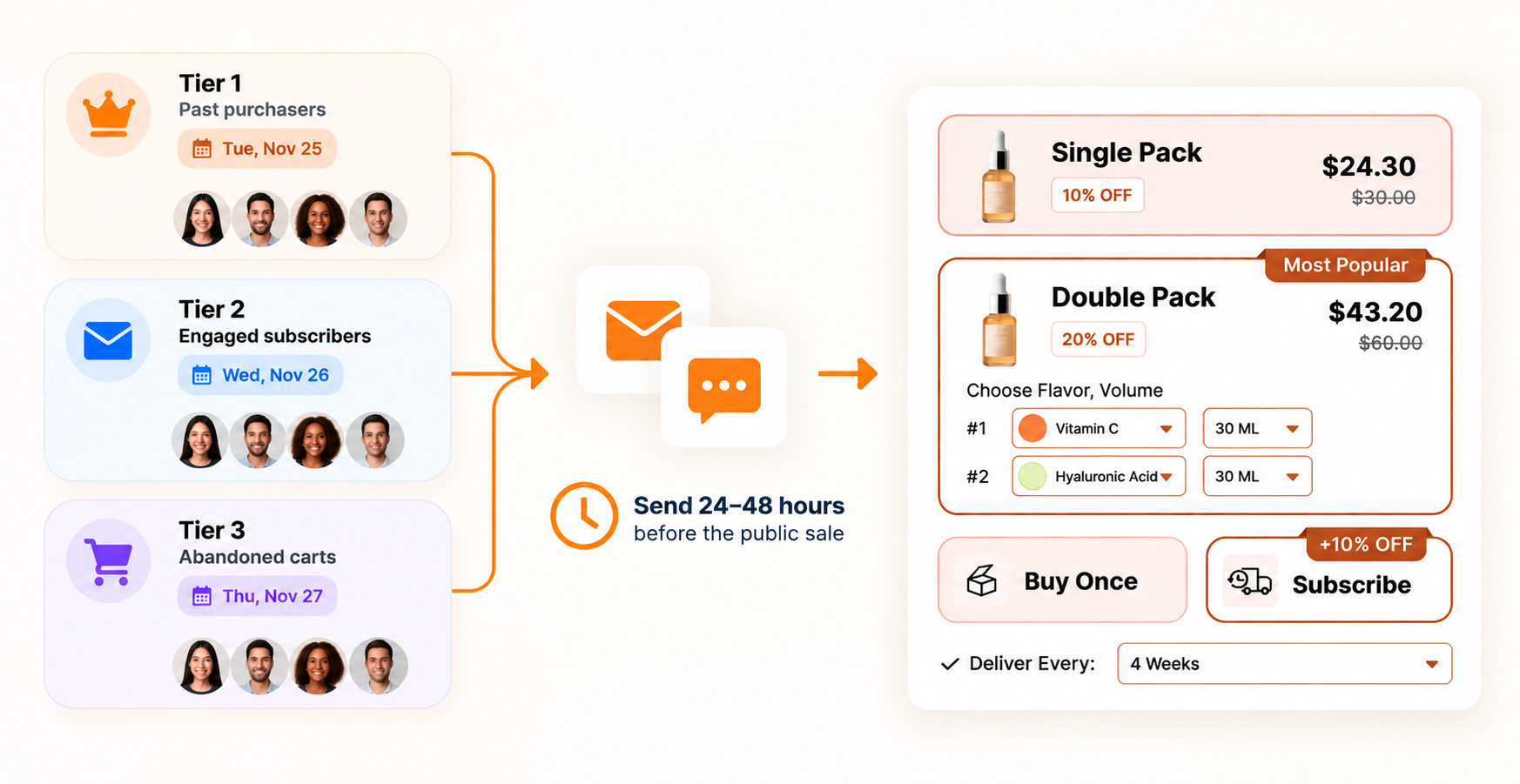
Early access puts your offer in front of both groups before the noise starts. Send it to a defined group 24 to 48 hours before the public sale. A good way to structure this:
- Tier 1, past purchasers: They know your product and your shipping times. Give them the first look on Tuesday or Wednesday.
- Tier 2, engaged subscribers who haven't bought: Open and click in the last 60 to 90 days, but no order. Early access gives them a nudge they didn't have before.
- Tier 3, abandoned carts from the last 30 days: A personalized reminder that the offer applies to what they already picked.
Early access works best when the reward is concrete: first pick of limited stock, a free gift unlocked earlier, or an extra tier that the public won't see until Friday. A subject line like "Your early access to our Thanksgiving offers is open until Thursday at 9 a.m." beats a generic "Sale starts now," since it names a deadline and a benefit.
Margin check: early access shouldn't mean a deeper discount than the public gets. Give early buyers priority and a head start. If you give them a bigger percentage as well, you've trained your best customers to wait for the next VIP window.
3. Run Buy More Save More tiers on gift-friendly multi-unit products
Quantity breaks are the most reliable basket-building offer for Thanksgiving weekend, because they match how people actually shop for gifts. They buy for several people, they stock up on consumables while prices are low, and they want a reason to add one more item rather than a deeper discount on a single unit.
A typical structure looks like this: Buy 1 at full price, Buy 2 save 10%, Buy 3 save 15%, Buy 4 save 20%. The tiers appear side by side on the product page so the shopper can compare them in one glance. The goal is to make the second and third units feel like the obvious choice.
Quantity breaks work best on products people already buy in multiples: candles, skincare, supplements, coffee, socks, pet treats, and anything that makes a natural gift set. They work poorly on a single, high-ticket item, where a free gift or bundle is the better lever.
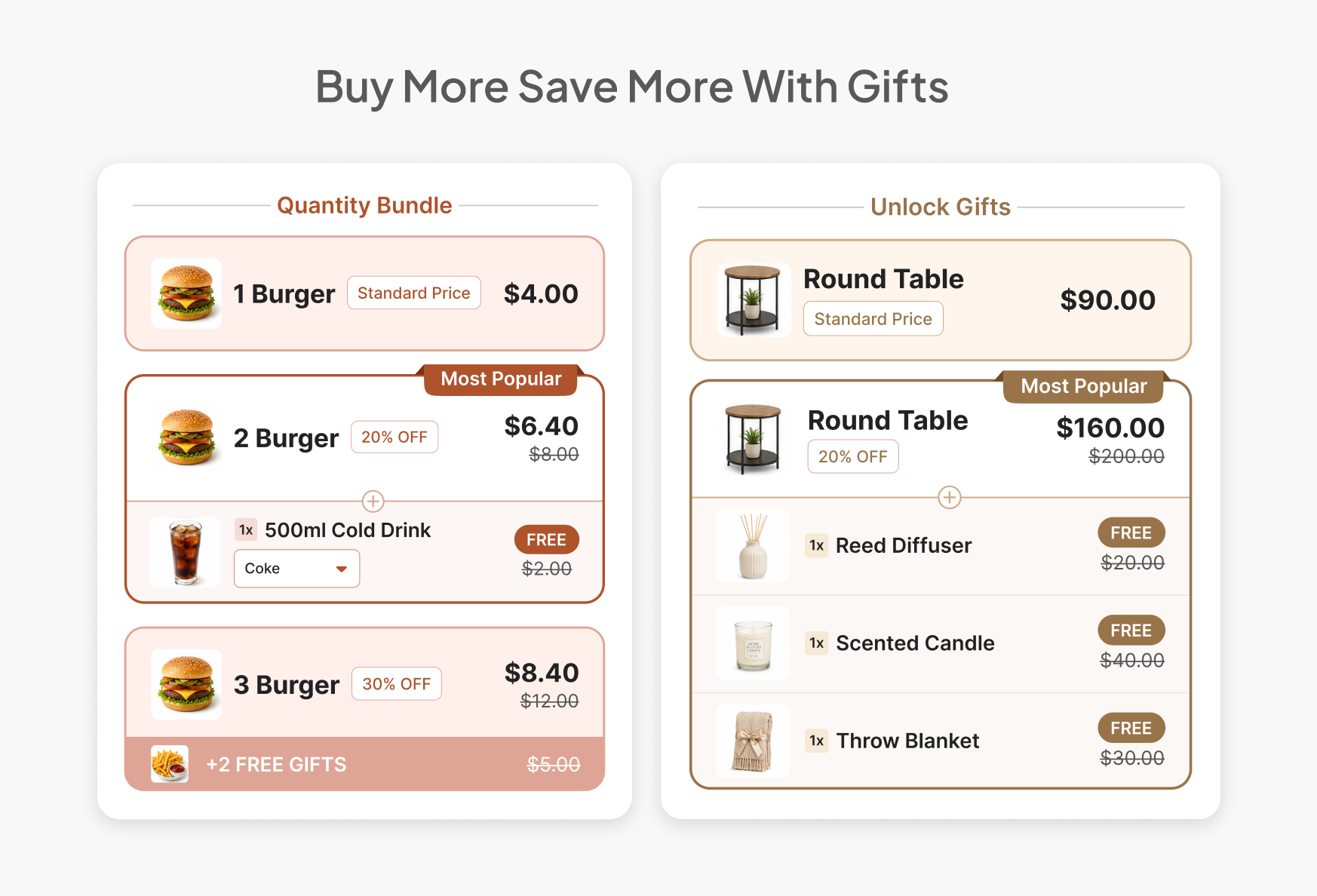
Pumper Bundles calls this offer type Buy More Save More. You set the tiers, choose the discount for each one, and the widget renders above the Add to Cart button on your product page through a native Shopify Theme App Extension, so no theme code gets edited. Discounts apply automatically at checkout in Automatic Discount mode, so shoppers don't have to enter a code. The Combination Discounts settings let you decide whether the offer stacks with Shopify's product, order, and shipping discounts. Check that setting before Thanksgiving so a quantity tier doesn't unintentionally stack with a sitewide code and cut your margin twice.
Set Up Buy More, Save More With PumperCreate quantity-break tiers above your Add to Cart button and apply discounts automatically at checkout. No theme code or discount codes required.
Start on the free plan. Publish when you're ready. |
4. Use BOGO offers built for gifting, not just clearance
BOGO is the most familiar promotion in retail, and most stores waste it on clearance stock. During Thanksgiving weekend, the stronger use is gifting. "Buy one, send one" and "Buy 2, get 1 free" both give shoppers a reason to add a second item that they'd planned to buy for someone else anyway. About two-thirds of NRF's 2025 average holiday spend of $337.86 per shopper went to gifts ($225.74), so a mechanic that matches gift buying is already pointed at the biggest slice of spend.
There are four BOGO structures worth testing:
- Classic BOGO free: Buy 1, get 1 free. This is expensive, so reserve it for products with low landed cost relative to price, or for slower-moving variants. Run the margin math first.
- BOGO at a percentage: Buy 1, get the second at 50% off. This is easier on margin and still reads as a strong deal.
- Buy 2 Get 2: Works well for items that are cheap relative to shipping, like small accessories and add-ons.
- Cross-product BOGO: Buy a hero product, get a related, lower-cost item free or discounted. This is how you move slower inventory without marking it down on its own.
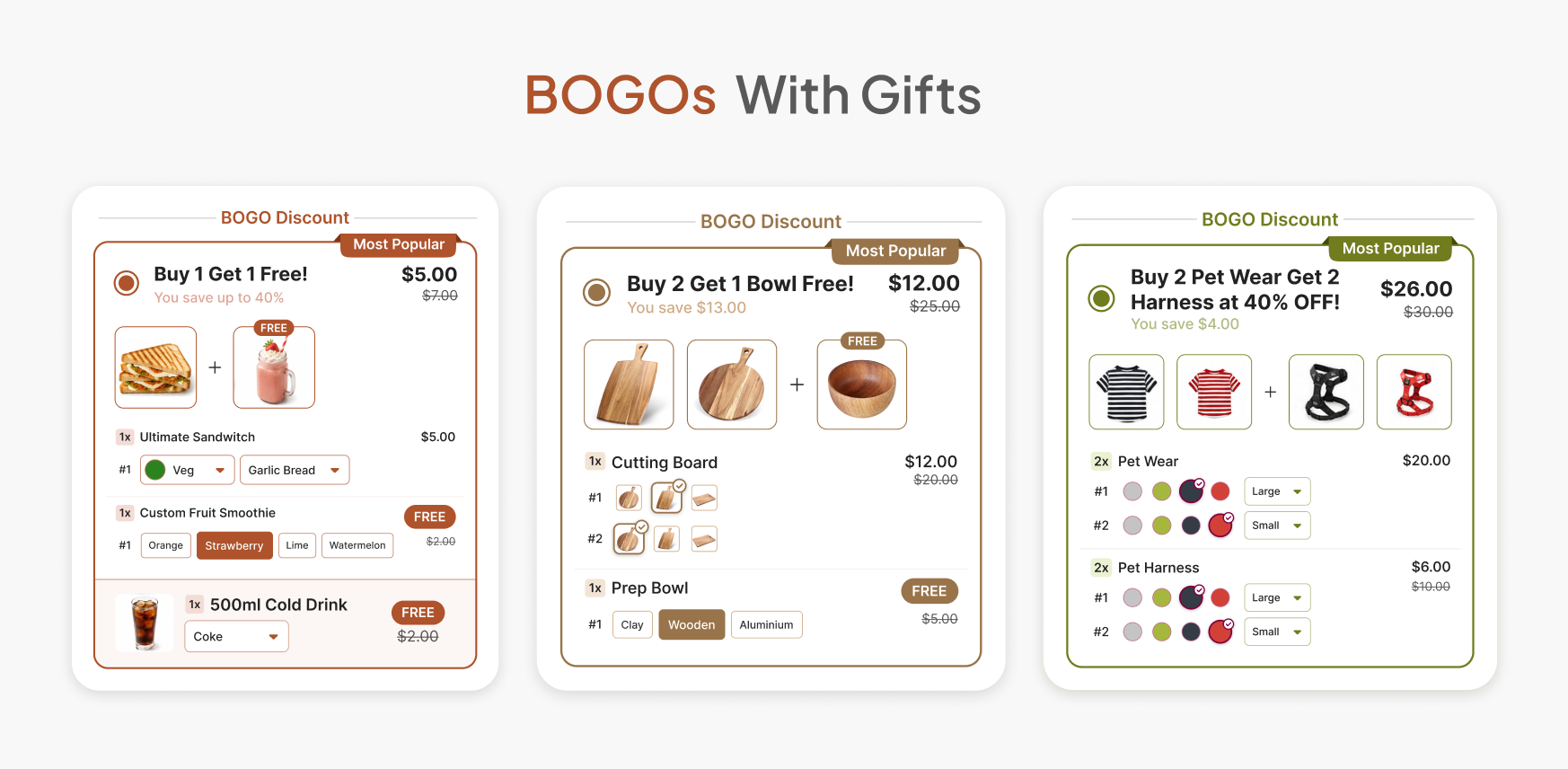
Pumper's BOGO Offers let you define Buy X Get Y rules on the same product or across products, then structure the deal as BOGO free, BOGO at a percentage, or Buy 2 Get 2. The offer shows as clear tier cards on the product page. Name each tier in gift language, such as "Buy one, gift one," in the widget copy so the shopper reads it as a gift.
If you sell outside English-speaking markets, each piece of widget copy is translatable per offer, with an Auto Translate option, which matters since Shopify reported cross-border orders at 16% of all global orders over Black Friday and Cyber Monday 2025.
Set Up BOGO Offers With Pumper
Create Buy One Get One, Buy 2 Get 2, or cross-product deals as clear tier cards on your product page. Name your offers in gift language shoppers will recognize.
View on Shopify App Store →5. Unlock free gifts at tiered spend or quantity thresholds
A free gift changes how the offer is perceived. A 15% discount subtracts value from your product, while a free gift adds value on top of it and leaves your price intact. That makes free gifts a good fit for Small Business Saturday and for brands that want to protect their price positioning.
Set the gift tiers just above your current average order value. If your store's AOV is $62, a first gift at $75 asks the shopper to add one more item, which is a realistic nudge. A second gift at $120 gives your highest-intent shoppers something to aim for. Here's an illustrative structure:
- Spend $75: a sample set or a small, brand-relevant add-on.
- Spend $120: a full-size product from a lower-volume SKU.
- Spend $200: a premium gift, such as a limited-edition item that only exists during the weekend.
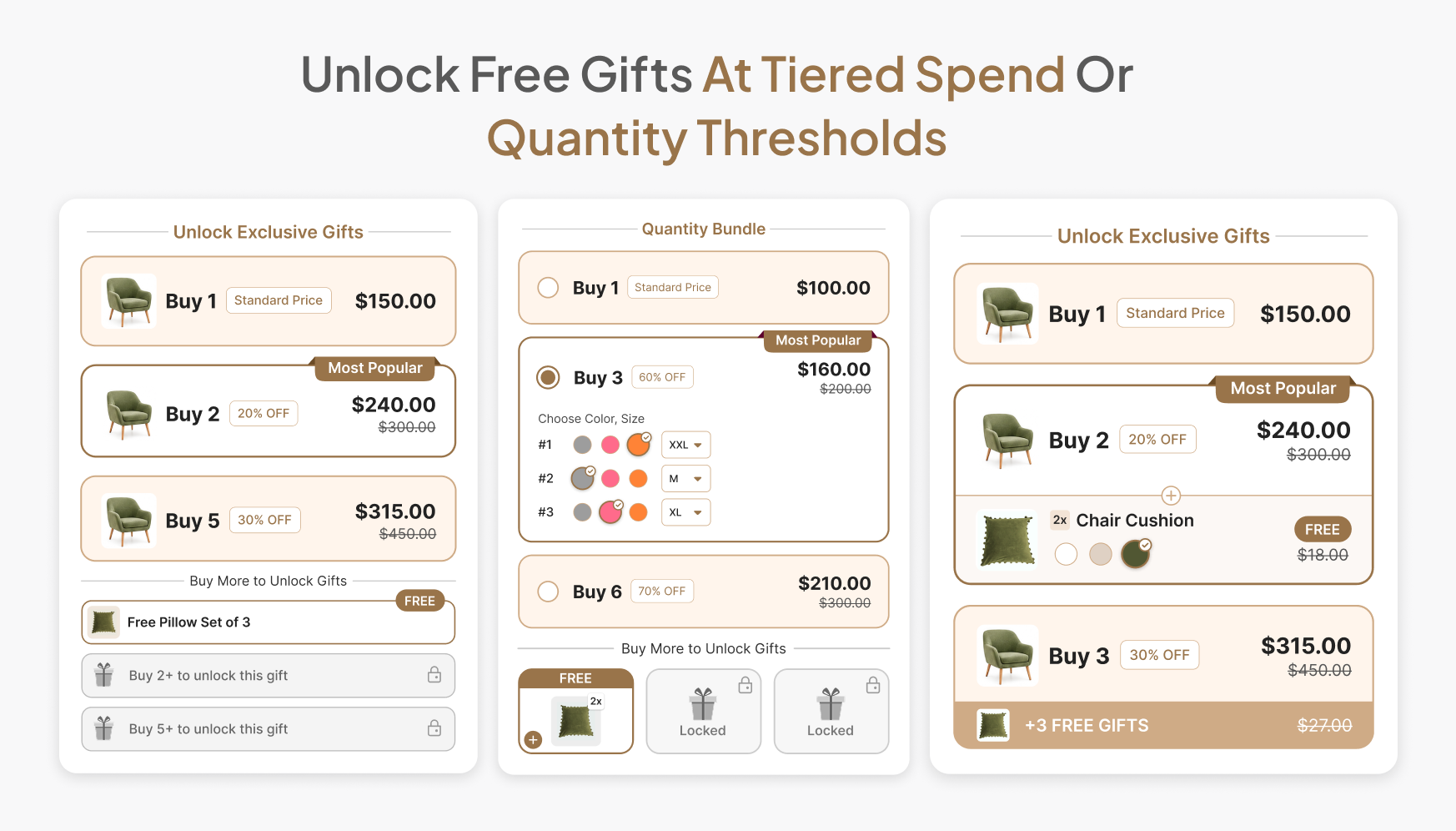
Choose gifts with a low landed cost and a high perceived value. Samples, travel sizes, accessories, and limited-edition packaging all work, and they bring in a trial effect that can lead to a full-size purchase later. Avoid gifts that look like leftover stock, since shoppers can tell, and it undermines the premium feel of the offer.
Pumper's Unlock Free Gifts offer lets shoppers unlock a free product at a spending or quantity threshold, and each tier can unlock a different gift. The widget labels it with a clear "FREE" tag and the gift name, so the reward is visible before the shopper commits. Set the tiers, assign a gift variant to each, and publish. Pumper's plans are capped by extra revenue generated, not by feature access, so adding a second gift tier doesn't move you to a different plan.
Margin check: add the landed cost of the gift to the discount you'd otherwise be giving. If a $75 gift threshold with a $6 gift lowers your gross margin on that order by 8 points, you need a basket lift that more than covers it. Look at your own AOV and decide whether it does before you set the threshold.
Set Up Tiered Free Gifts With PumperLet shoppers unlock a different free gift at each spend or quantity threshold. Display a clear FREE label on your product page, with each tier unlocking its own gift product.
|
6. Sell gift sets with mix-and-match bundles
Gift shoppers have a problem that your product pages usually don't solve: they know the recipient, and they don't know which product to pick. A curated gift set removes that decision. A mix-and-match bundle goes one step further by letting the shopper build the set, which feels personal while keeping the basket large.
Three bundle formats fit the Thanksgiving window:
- The curated set: a fixed combination, such as "The Cozy Night In: candle, matches, and room spray," priced a little below the sum of its parts.
- The pick-your-own set: the shopper chooses 3 or 4 items from a collection, and a combined discount applies once the set is complete.
- The starter kit: everything a first-time buyer needs, positioned as the best way to try the brand. This is especially useful because Thanksgiving weekend brings first-time buyers who may only buy once before the holidays.
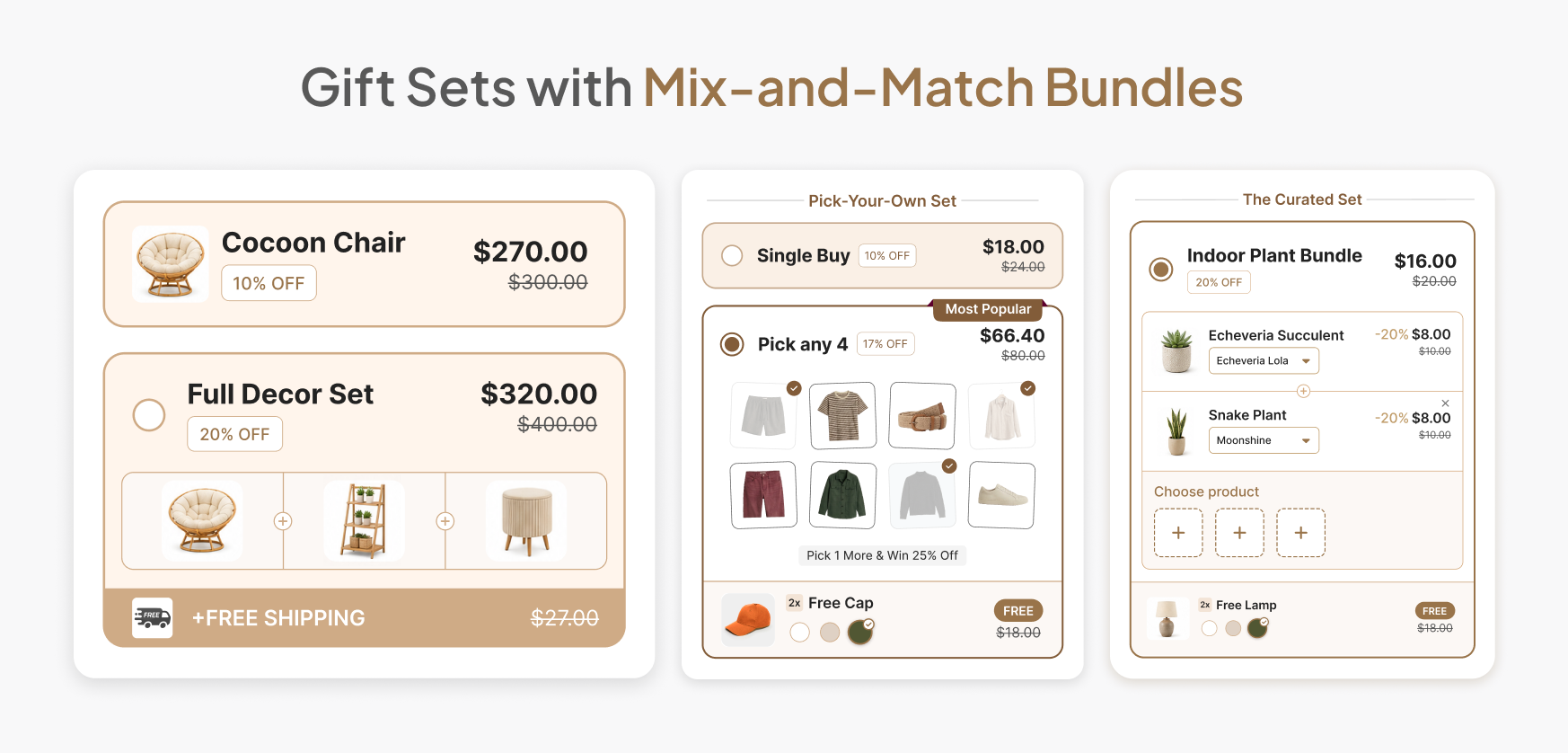
Pricing the set matters. A discount of 10% to 20% against the combined individual prices is a common starting range, and the real test is whether your margin survives it. Picture a three-item set where the individual prices total $90 and landed costs total $33. At 15% off, the shopper pays $76.50 and you keep $43.50, a 57% gross margin.
Pumper's Bundle & Save offer handles mix-and-match: customers pick which products to include inside a predefined bundle structure using a "Choose Product" picker, and a combined discount applies to the full set. You create it through the "Create a Bundle" button and pick one of six visual themes so the widget matches your store's colors before you edit anything.
Pumper's merchants have published results to show for this kind of offer. Larix reports a 60% AOV lift and $8,245 in extra monthly revenue, and Australian Standard reports a 65% AOV lift and $7,829 in extra revenue, both per Pumper's own published merchant results.
Your numbers will depend on catalog and traffic, so treat them as a reason to test and not a forecast. For bundle concepts you can adapt, see Pumper's guide to Shopify product bundling strategies.
Set Up Gift-Set Bundles With PumperLet shoppers build their own mix-and-match gift sets from your catalog, with a combined discount applied once the set is complete. Pick a theme, choose products, and publish.
|
7. Add a post-purchase upsell to catch the order you already won
The cheapest sale of the weekend is the one to a shopper who has just paid you. After checkout, trust is at its peak, the card is already entered, and the shopper is still in a buying frame of mind. A well-timed upsell at that moment doesn't have to compete with your discount banner or your competitors' ads.
The offer should be small, relevant, and easy to accept in one click. Good post-purchase offers during Thanksgiving weekend include:
- A complementary add-on: the refill, the case, the travel version, the matching accessory.
- An upgrade: the larger size, the premium version, or a multipack at a better per-unit price.
- A gift add-on: "Sending this as a gift? Add a second one for 20% off" works well because gift buyers often realize mid-checkout that they forgot someone.
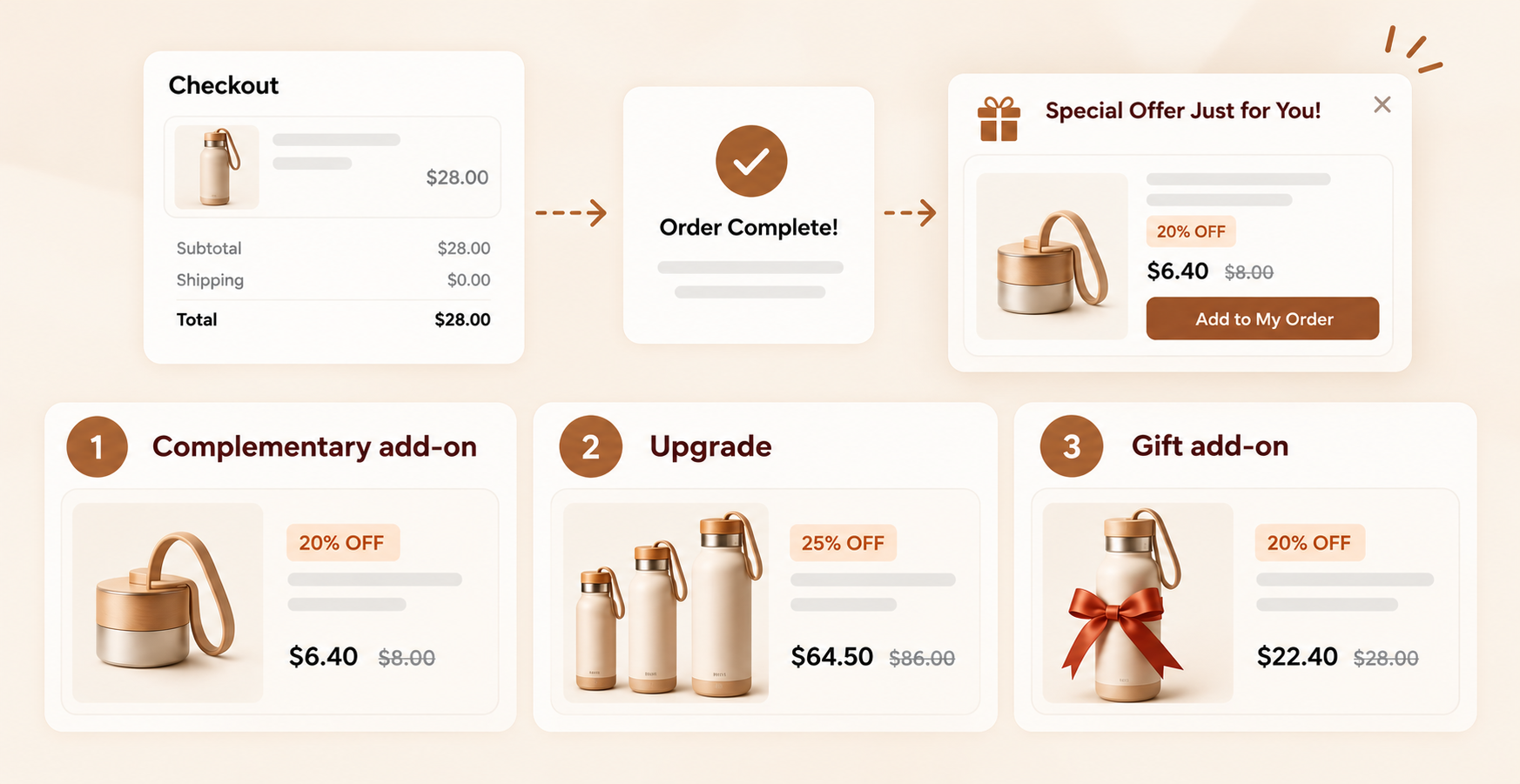
Keep the post-purchase discount modest and consider keeping it exclusive to this moment, since a shopper who sees the same price on the product page will just add it to the next order. Because this offer lands after the shopper has paid, it can't reduce the conversion rate of the main order, which is why it's the safest offer on this list to test even if you're nervous about changing your product pages the week of Thanksgiving.
8. Use your free-shipping threshold as a promotion lever
Shipping cost is where holiday carts die. Baymard Institute's research finds that 40% of US online shoppers who abandon a cart cite extra costs such as shipping, taxes, and fees, making it the leading reason, and 12% abandon because they can't see the total cost upfront. The average documented cart abandonment rate across 50 studies is 70.22% (Baymard Institute, 2025).
At the same time, shipping is getting more expensive for merchants. Deloitte reports that 67% of retail executives expect to raise their free-shipping thresholds in 2026, and Total Retail notes that Salesforce expects retailers to spend an additional $3 billion globally subsidizing free shipping this holiday season. If bigger retailers raise their thresholds, a smaller store with a sensible one has a genuine edge.
Treat the threshold as a basket-building tool, not a cost center:
- Set it just above your current AOV. If AOV is $62, test $75 for Thanksgiving weekend. This is a starting point to test, not a benchmark.
- Show progress. A cart message such as "You're $13 away from free shipping" turns the threshold into a goal.
- Pair it with your offer. A shopper who adds a third unit to reach a quantity tier often also crosses the free-shipping line.
- Show the total early. Put shipping costs or the free-shipping rule on the product page and in the cart, so nobody gets a surprise at checkout.
- Publish your shipping cutoff dates. Twenty percent of abandoners in Baymard's list cited delivery that was too slow, so state clearly which order dates still arrive before December 25.
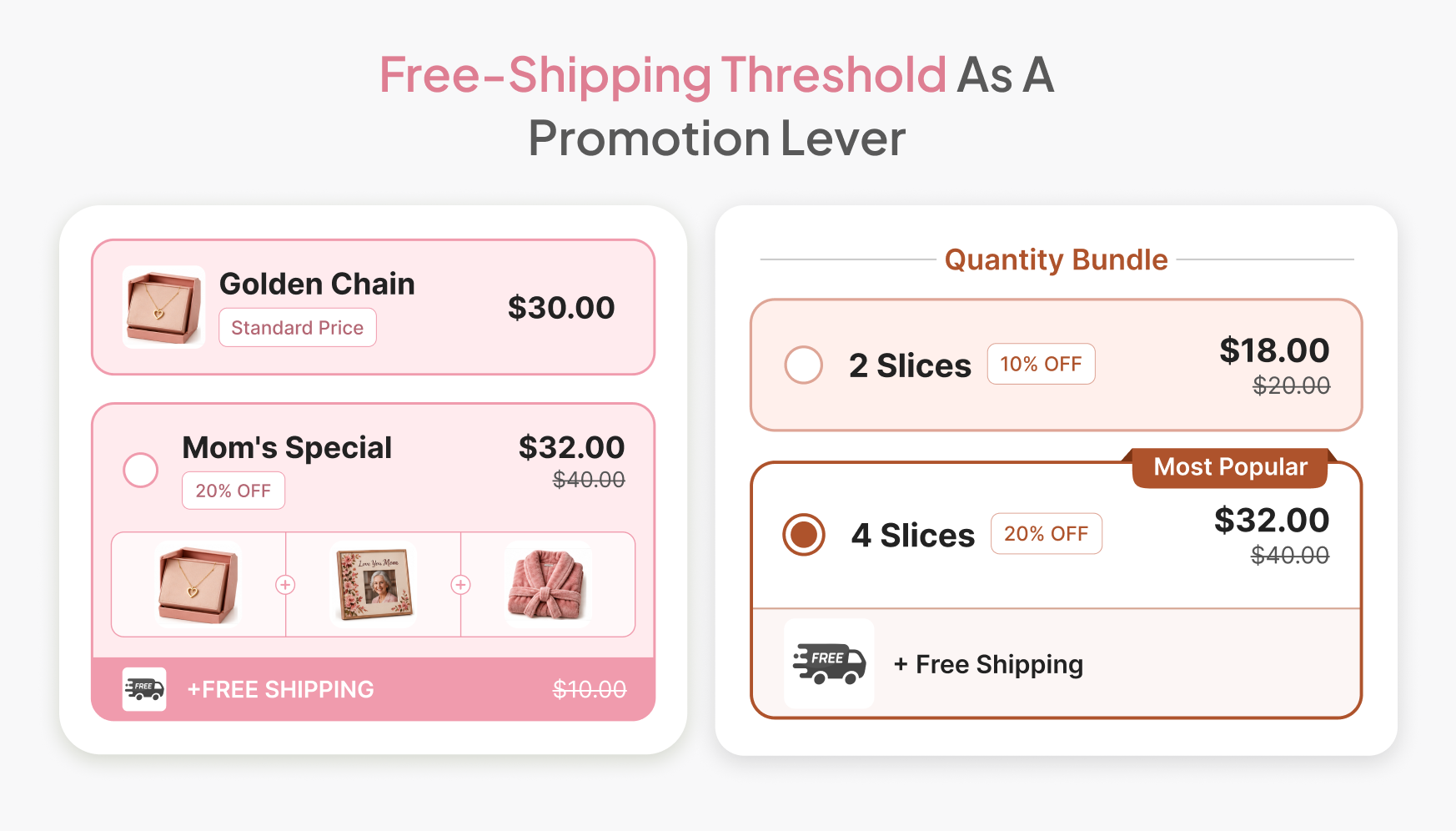
In Shopify admin, you can set free shipping by minimum order price under Settings, then Shipping and delivery. Run the math on your actual carrier rates before you commit, since a threshold that's too low will lose money on every order that qualifies.
9. Design every offer for the mobile shopper first
Mobile has become the main channel on Thanksgiving Day, with 61.6% of online sales coming from phones in 2025, the first time that share crossed 60% (Adobe, 2025). On Cyber Monday, mobile accounted for 57.5% of spending, and NRF counted 46.9 million mobile shoppers that day. A promotion that looks great on a desktop but hides the offer below a long product description is a promotion most of your shoppers will never see.
A mobile-first Thanksgiving checklist:
- Put the offer where the thumb lands. Tiers, gifts, and bundles belong above the Add to Cart button, not in a banner at the top of the page that scrolls away.
- Test on real phones. Open your top five products on an iPhone and an Android device in the week before the sale, and look for crowded layouts or widgets that push the button below the fold.
- Offer fast wallets. Shop Pay was used on 32% of orders during Shopify's 2025 Black Friday and Cyber Monday, with Shop Pay transactions up 39% year over year.
- Offer buy now, pay later. Adobe measured $1.03 billion in BNPL spend on Cyber Monday 2025, with 79.4% of it on mobile, so it's no longer a niche option.
- Check page speed. A slow product page on a phone loses the shopper before the offer loads. Remove unused apps and heavy videos before the weekend.
- Keep copy short. A phone screen fits about one sentence of offer text per tier. "Buy 2, save 15%" works. A paragraph of terms doesn't.
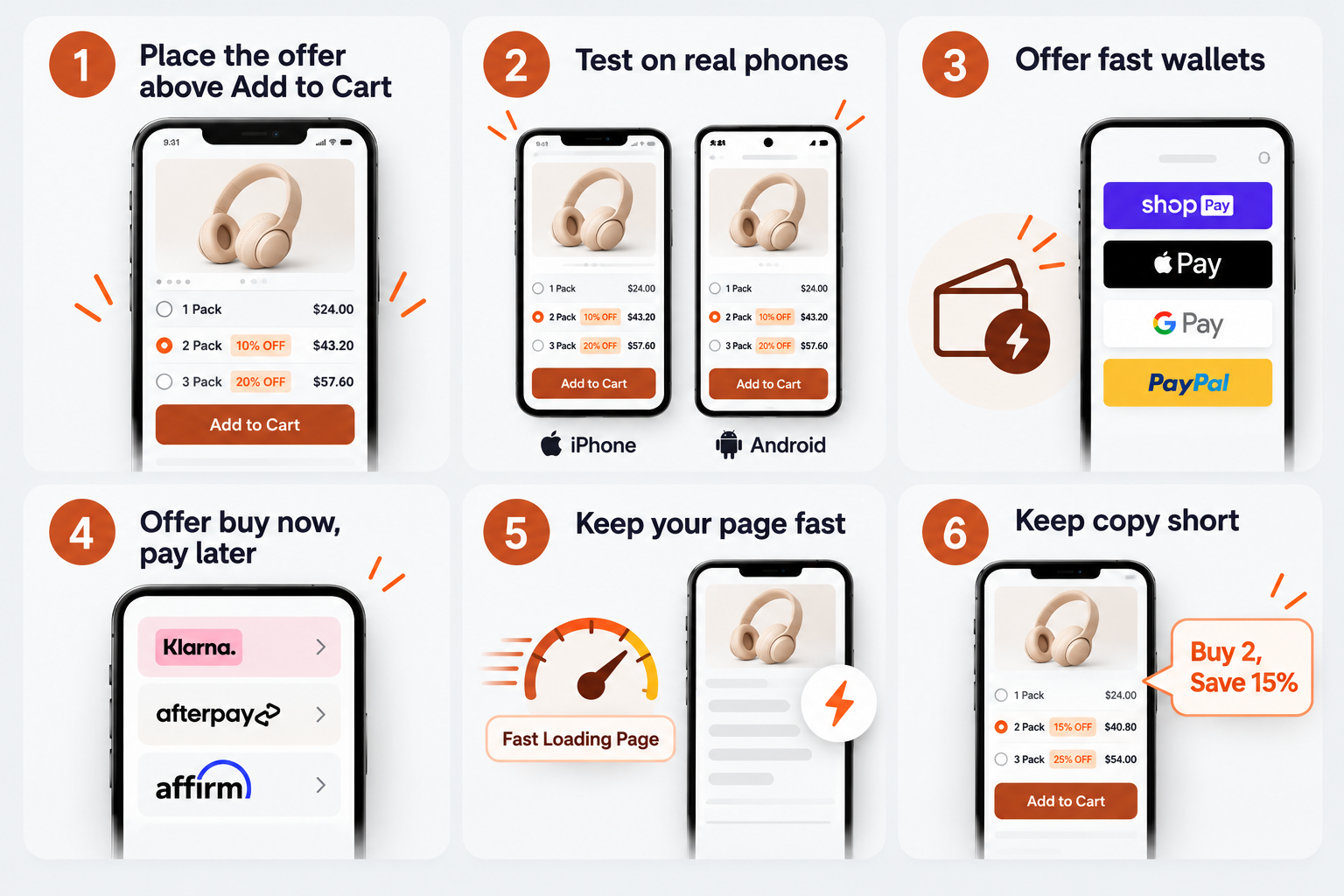
Make sure your emails and SMS messages link straight to the product page with the offer, not the homepage. On mobile, every extra tap loses shoppers.
10. Turn Thanksgiving buyers into repeat customers with Subscribe & Save
Thanksgiving weekend brings in a lot of first-time buyers, and most stores don't see them again. The weekend's biggest hidden cost is paying heavily to acquire a customer, giving them a discount, and never getting a second order. If you sell anything people use up, such as coffee, skincare, supplements, pet food, or cleaning products, a subscription option turns one order into a recurring one.
The offer is simple: next to the one-time purchase, show a "Subscribe & Save" choice with a discount of 10% to 15% and a delivery schedule the shopper picks, such as every 30 or 60 days. For a Thanksgiving promotion, you can add a small sweetener for the first order, such as a free gift on a first subscription, which gives shoppers a reason to choose it over the one-time price.
Where subscriptions fit best:
- Self-purchases: people stock up on their own staples during the sale, and subscribing locks in the price.
- Gift subscriptions or "start in January" options: these push a revenue stream past the holiday rush.
- Replenishment after a gifting purchase: if a gifted product runs out, the recipient may want to reorder, and the subscriber is the one who sees the next price.
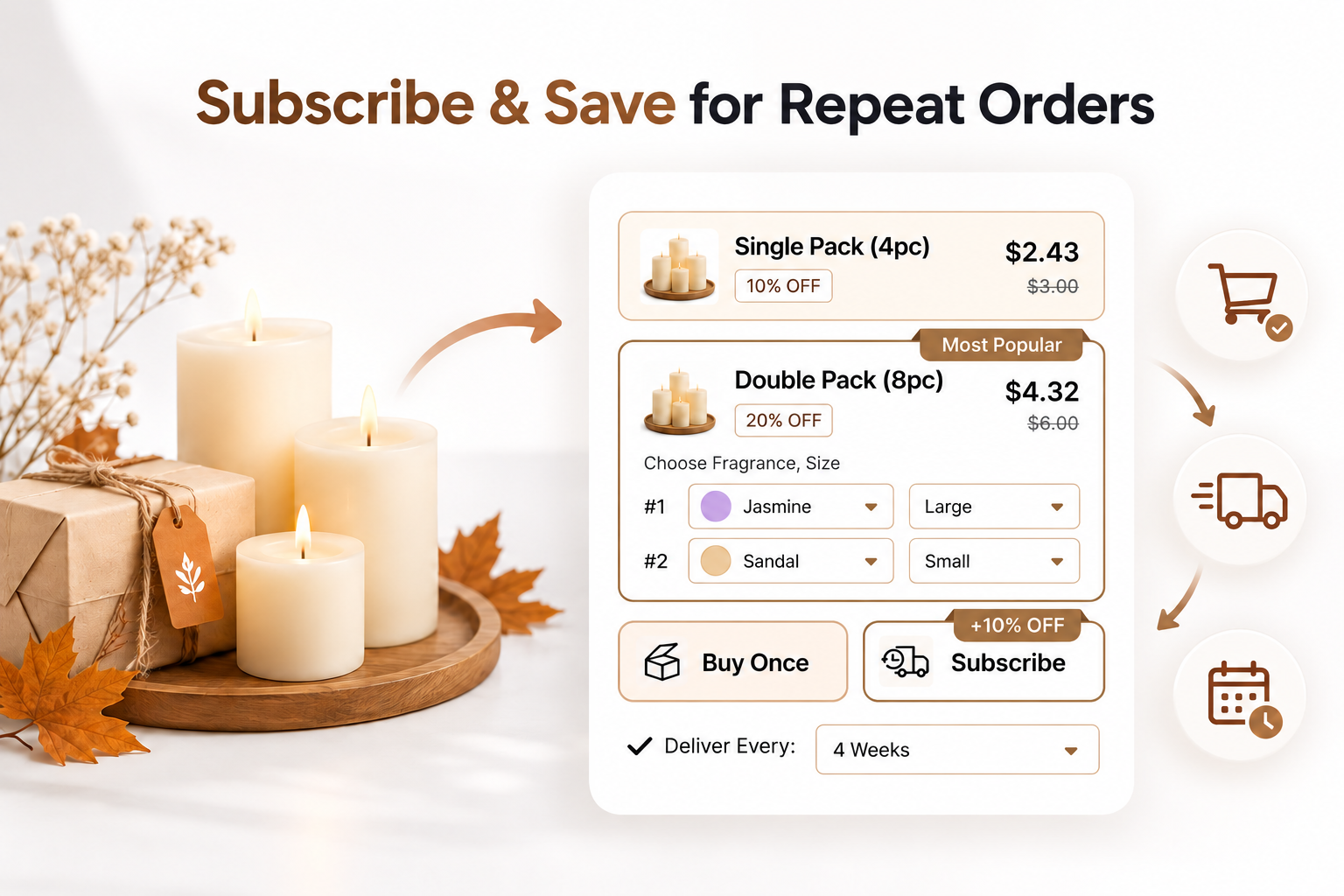
Make cancellation simple. A subscription that's easy to leave builds trust, and a trapped customer becomes a chargeback or a bad review. Be honest in your widget copy about the schedule, price, and how to pause or cancel.
Pumper's Subscribe & Save adds a subscription purchase option beside the one-time purchase, with a toggle between "One-Time Purchase" and "Subscribe & Save" and recurring delivery at a discount, such as weekly or monthly. It sits alongside the other offer types, so the same product page can carry a quantity break and a subscription option together if that fits your catalog. Test the combined layout on mobile before the weekend, and check your discount stacking settings first.
Set Up Subscribe & Save With PumperAdd a subscription option alongside one-time purchases so Thanksgiving shoppers have an easy reason to come back. Display your subscription app's plans next to the one-time purchase option, then publish.
|
What Is Thanksgiving Shopping?
Thanksgiving shopping is the stretch of retail activity that begins on Thanksgiving Day, the fourth Thursday of November, and runs through Black Friday, Small Business Saturday, Sunday, and Cyber Monday. The National Retail Federation tracks it as one five-day window, and 202.9 million US consumers shopped during it in 2025. For Shopify merchants, it's the first full test of holiday demand. Shoppers use it to buy gifts, stock up on household items, and pick up deals they've been tracking for weeks. Many stores now plan it as one connected campaign rather than as separate sale days.
When Does Thanksgiving Shopping Start?
Thanksgiving shopping officially starts on Thursday, November 26, 2026, but deals usually begin earlier. NRF found 84% of shoppers had already started holiday shopping by Thanksgiving weekend 2025. Open early access by Monday or Tuesday of Thanksgiving week, then run the public sale through Cyber Monday on November 30.
Why Thanksgiving Matters for Shopify Merchants
Thanksgiving weekend concentrates a large share of holiday demand into five days, and what happens in it shapes the rest of your quarter. Adobe measured $44.2 billion in US online spending across Cyber Week 2025, and Adobe put the full November and December season at $257.8 billion, up 6.8% (Adobe, 2025). Shopify merchants did $14.6 billion in sales across Black Friday and Cyber Monday alone, with more than 81 million customers buying.
It also matters for reasons beyond the weekend's revenue. Shoppers acquired now are your December repeat buyers and your January subscribers. It also shows what your customers respond to before the final weeks before Christmas, when changing course gets harder. And roughly two-thirds of NRF's average 2025 spend per shopper of $337.86 went to gifts, which means buyers are shopping for others and tend to add more items per order.
Thanksgiving vs. Black Friday vs. Cyber Monday
The three days overlap, but each rewards a different approach on a Shopify store. Thanksgiving is mobile-heavy and early-bird, Black Friday is where price comparison peaks, and Cyber Monday is the biggest online day and the one shoppers use to close out their lists. The table below compares them on the numbers and the play that fits.
Thanksgiving Shopping Trends for Shopify Stores
The 2025 numbers point in five directions that matter for your 2026 plan.
1. Thanksgiving Day is a full sales day
It reached $6.4 billion online in 2025, and Adobe credited better-than-expected discounts, particularly on electronics. Black Friday growth also outpaced Cyber Monday for the second year in a row (9.1% against 7.1%), which suggests shoppers are moving earlier in the weekend.
2. Mobile is the default
Mobile hit 61.6% of Thanksgiving spend, and it accounted for 57.5% of Cyber Monday. A September 2026 summary of forecasts expects mobile to be around 58% of online holiday sales this year, with total online sales passing $300 billion for the first time.
3. Discounts are deep in some categories
Adobe recorded Cyber Monday discounts of up to 31% in electronics, 28% in toys, and 25% in apparel. Cosmetics, apparel, activewear, and fitness and nutrition were among Shopify's strongest categories. If you sell in those categories, you're competing with those depths.
4. Payment and discovery are changing
Buy now, pay later crossed $1 billion in a single day on Cyber Monday, and AI-driven traffic to retail sites rose 670% from the year before, per Adobe. Shop Pay handled 32% of Shopify orders.
5. Shoppers are price-conscious
Summaries of 2026 holiday forecasts report that consumer pessimism has barely shifted, and Deloitte and Salesforce both point to free shipping and discounts as top decision factors. Average Shopify order value over Black Friday and Cyber Monday 2025 was $114.70, so basket-building offers have clear room to work.
What Customers Expect From Thanksgiving Promotions
Shoppers arrive at your store on Thanksgiving weekend with a clear set of expectations, and missing any of them costs you the order. The Baymard Institute's checkout research and the 2025 retail surveys give a consistent picture.
- A real deal that's easy to understand: Shoppers have seen a hundred sale banners by Thursday afternoon. They expect to understand your offer in a few seconds, such as "Buy 2, save 15%" or "Free gift over $75," without reading terms.
- No surprise costs: Forty percent of abandoners in Baymard's research cite extra costs, and 12% say they couldn't see the total upfront. Show shipping and taxes early.
- Free shipping, or a clear path to it: Free shipping remains a leading factor in where shoppers decide to buy, according to Salesforce research cited by Total Retail. If you can't offer it on everything, show how to earn it.
- Fast, low-friction checkout: Eighteen percent of abandoners in Baymard's list cited forced account creation, and 17% a long or complicated checkout. Guest checkout, saved wallets, and BNPL options address both.
- Delivery they can trust: Twenty percent cited slow delivery. Publish shipping cutoff dates before Christmas.
- A deadline that's honest: If your Thanksgiving offer says it ends Monday, it should end Monday. Shoppers remember when deadlines move.
- Offers that fit what they're buying: Gift shoppers want gift-ready bundles and quantity tiers. Self-purchasers want savings on staples. One banner can't speak to both, which is why product-page offers work better than a single sitewide message.
Plan Your Thanksgiving 2026 Promotions With Pumper
The strategies above all come back to the same principle: grow how much each shopper buys without discounting everything you sell. Thanksgiving weekend rewards stores that plan specific offers for specific moments, check margin before every publish, and make the offer visible on the phone where most of the buying happens.
If you want to run the on-page strategies, Pumper Bundles covers all five offer types in one Shopify app: Buy More Save More, BOGO Offers, Unlock Free Gifts, Subscribe & Save, and Bundle & Save. Offers appear above the Add to Cart button through native Shopify Theme App Extensions, so there's no code and no theme file editing. Pumper holds a 4.9-star rating across more than 3,500 reviews on the Shopify App Store, and the free plan covers up to $300 in extra revenue, which is enough to test a Thanksgiving offer before you scale it. Paid plans start at $9.99 per month and are capped by extra revenue generated, not by order count.
Start building in October, keep every offer in draft until your margin checks are done, and publish on your schedule. That leaves you free to spend Thanksgiving week on email, support, and fulfillment instead of fixing offers.
Get Your Thanksgiving 2026 Offers Live With PumperBuild quantity breaks, BOGO deals, free gifts, bundles, and subscriptions from one Shopify app. Set up your offers and publish when you're ready. Start on the free plan.
|
Frequently Asked Questions
When is Thanksgiving 2026, and when are Black Friday and Cyber Monday?
Thanksgiving is Thursday, November 26, 2026. Black Friday is November 27, Small Business Saturday is November 28, and Cyber Monday is November 30. GivingTuesday follows on Tuesday, December 1. Thanksgiving falls late this year, which leaves 29 days between Thanksgiving and Christmas, so shipping cutoff dates deserve a prominent spot on your site and in your emails.
How early should I start my Thanksgiving promotion on Shopify?
Open early access to your email and SMS subscribers by Monday or Tuesday of Thanksgiving week, and build the offers in October so you aren't editing pricing during the week itself. NRF found 84% of shoppers had begun holiday shopping by Thanksgiving weekend 2025, so a late start means missing shoppers who have already chosen where to buy.
What discount should I offer for Thanksgiving?
There's no universal number. Tier depth should come from your margin, not from competitors' headlines. Many stores find that tiered offers, such as 10% off two units and 15% off three, protect margin better than a single flat percentage, because the shopper earns the discount by buying more. Run the math on landed cost and shipping before you publish.
Should I discount my whole store or just selected products?
Selected products or threshold-based offers usually protect margin better. A sitewide code discounts orders that would have happened anyway, including at full price. Product-specific tiers, gift thresholds, and bundles reward the exact behavior you want, which is a bigger basket.
Do free gifts or discounts work better during Thanksgiving?
It depends on your products and margin. A free gift adds value on top of the product, which can protect your price positioning, while a discount subtracts from it. Test both on separate products, then compare average order value and profit per order after the weekend rather than revenue alone.
How do I set up Thanksgiving offers on Shopify without a developer?
Use a no-code offer app that renders through native Shopify Theme App Extensions. With Pumper Bundles, you pick an offer type, choose a visual theme, configure tiers and products, and publish. The offer appears above the Add to Cart button, with no theme code to edit.
Is it worth running a post-purchase upsell on Thanksgiving weekend?
For most stores, yes. The shopper has already paid, so the upsell can't lower the conversion rate of the main order, and the cost of testing it is low. Keep the offer relevant and the discount modest, and check offer analytics a day or two in so you can swap weak offers for stronger ones.
How do I protect margin during a Thanksgiving sale?
Calculate gross profit per order for each offer before you publish it, including the landed cost of any free gift and shipping. Limit your deepest discounts to a short list of products, check that Shopify discounts don't stack unexpectedly, and compare profit per order, not just revenue, after the weekend.